Kritin Kamonsin Receives Youth Awards

Chulalongkorn University is delighted to congratulate Mr. Kritin Kamonsin, a second-year student in the Department of Public Administration, Faculty of Political Science, who has been selected to receive the Outstanding Youth Award for Bringing Honor to the Nation for 2026. He received a certificate from Prof. Dr. Narumon Pinyosinwat, Minister of Education, on Thursday, January 8, 2026, at the Kuru Sapha Auditorium, Ministry of Education

Kritin said he felt extremely honored and proud to receive this award. It serves as an important encouragement, affirming that his dedication to social and community work has value and is recognized. It also motivates him to further develop himself to contribute even more to the country. 

Kritin is a responsible and active student with strong leadership qualities. He believes that being a good leader requires listening, learning, and continuously improving oneself in terms of thinking, discipline, and ethics in order to prepare for work that benefits the public and for personal development. 

In the past, Kritin has participated in numerous activities both within his faculty and across the university. These include serving on the team welcoming Her Royal Highness Princess Maha Chakri Sirindhorn on National Mother’s Day 2025, working as treasurer in the Environmental and Sustainability Division of the Provincial Administrative Organization, and serving on committees of the Social Welfare Council of Thailand, among others. 

Moreover, Kritin has received many previous awards recognizing his abilities, such as the Outstanding Military Leadership Youth Award, being named an Honorary Air Cadet by the Air Force, and contributing significantly to the 2nd Army Ranger Unit, for which he received honorary unit insignia and an honorary commando proficiency badge from the 2nd Army Region. 

In addition to his exceptional extracurricular achievements, Kritin has also excelled academically, achieving the highest scores in general aptitude and specialized subjects among students in the 77th cohort of the Public Administration program. 

Read more at: https://www.chula.ac.th/en/news/282676/

Thammasat Innovates One-Day Artificial Eyes

While most eye diseases are treatable, some conditions like accidents or tumors can lead to irreversible vision loss and eye removal, impacting patients’ social confidence. Artificial eyes are crucial for these patients to maintain their self-assured lifestyle. Off-the-shelf ocular prosthetics often lack realism. To address this, Thammasat University’s ophthalmologists and dentists created “3D Printed Customized Ocular Prosthesis in One Visit Delivery.” This innovation uses 3D printing and photographic imaging to produce personalized, realistic ocular prosthetics in a single day, eliminating long waits for patients.

3D Printed Customized Ocular Prosthesis in One Visit Delivery” is the result of the efforts of the Artificial Eye Center team at Thammasat University, led by Assoc. Prof. Dr. Sakchai Wongkittiruk (M.D.), Dr. Waraporn Mitsantisuk, an ophthalmologist, and Asst. Prof. Dr. Jitpimol Siriphan, a dentist. This work has successfully won the JDIE Best Invention Award at the Japan Design, Idea and Invention Expo held in Tokyo, Japan, competing against over 366 entries from 25 countries. In addition, it has also been able to receive numerous prestigious awards, such as the Gold Medal from the World Invention Intellectual Property Associations and the NRCT Special Award from the National Research Office, among others.

Create a realistic ‘artificial eye’ within one day.

Ocular prosthetics can be categorized into two types: ready-made prosthetics and custom prosthetics. The process of creating custom prosthetics originally involved several steps, including the initial printing of the eye socket, fitting of the clear glass eye, marking the position of the pupil, and applying color to the sclera and iris to achieve a realistic appearance that closely resembles the patient’s natural eye. This craftsmanship requires varying levels of skill and time. Therefore, the innovation of “3D Printed Customized Ocular Prosthesis in One Visit Delivery” utilizes technology to enhance aesthetics, reduce the time required for production, and improve the ability to predict the outcome with precision.

Asst. Prof. Dr. Jitpimol, a faculty member of the Faculty of Dentistry at Thammasat University, explained that this innovation combines 3D printing to create a sclera-like piece from a patient’s eye socket scan and a photography technique to apply the image onto it. This multi-step process for personalized prosthetic eyes is reduced to just 4 hours. Assoc. Prof. Dr. Sakchai further stated that the limitation is that it previously took months, or even several months, to obtain a custom prosthetic eye. This is due to the need for various molds and steps in the process, as well as the skill of the prosthetic eye maker in replicating the appearance of the other eye. While it may be an improvement over traditional ready-made prosthetic eyes, achieving a lifelike beauty requires both science and artistry, making the results difficult to predict. This has led to the innovation we see today. Currently, we observe a significant use of 3D printing technology in the medical field, including its application in dentistry for creating dentures for patients.      

Thammasat Researchers: Innovators for Society

Thammasat University, a pillar of society, educates quality graduates and supports research and innovation to address social issues. The university is currently aligning faculty and student research with pressing needs to create tangible societal benefits. Assoc. Prof. Dr. Sakchai emphasized that universities, beyond teaching, must generate practical research and innovations that improve quality of life. This specific innovation aims to empower visually impaired patients to live confidently.

The innovation “3D Printed Customized Ocular Prosthesis in One Visit Delivery” has been implemented at Thammasat University Hospital since the beginning of 2025. Currently, there are over 10 patients utilizing ocular prostheses from this innovation. The feedback received indicates increased happiness and confidence in social interactions among the patients. In the future, this innovation will be developed to reduce the time required for creating ocular prostheses, making them more aesthetically realistic, and enhancing public access to the services provided by this innovation.

Chula Welcomes Bhutanese King and Queen

On the occasion of His Majesty King Jigme Khesar Namgyel Wangchuck and Her Majesty Queen Jetsun Pema Wangchuck of the Kingdom of Bhutan’s visit to Chulalongkorn University to receive honorary doctoral degrees on December 22, 2025, at the Chulalongkorn University Auditorium, the event marked an important chapter in the university’s history. Chulalongkorn University had the honor of welcoming the King and Queen of Bhutan, and the ceremony was conducted with grandeur and elegance befitting their royal status, leaving a lasting impression on all who attended from that day until now. 

One of the most significant ceremonial highlights organized by Chulalongkorn University to welcome the King and Queen of Bhutan—captivating everyone in the auditorium—was the student flag procession paying the highest respect to the monarch and queen of Bhutan. The procession comprised 24 Chulalongkorn University students: 22 faculty flag bearers, 1 Chulalongkorn University flag bearer, and 1 bearer of the Phra Kiao (the university emblem). They entered the auditorium with grace and perfect coordination to the accompaniment of the Maha Chulalongkorn anthem before proceeding to the ceremony whereby Their Majesties were presented with honorary doctoral degrees. 

Although preparation time was limited, the student’s flag procession that appeared before the audience was majestic, beautiful, and worthy of the occasion. This was made possible through the unity and dedication of the students, trainers, and faculty members working behind the scenes with full commitment and determination. 

Assistant Professor Dr. Chanakida Thummanond, Vice Dean of the Faculty of Education, Chulalongkorn University, stated, “The students had just completed a four-day camp, but the lecturers saw their energy and willingness when they immediately volunteered. The selection of students for the flag procession used ‘heart’ as the main criterion. Even if some students had overlapping commitments, as long as their hearts were in it, we were willing to wait until the required number was complete.” 

“I feel proud and deeply fulfilled to have had the honor of serving. This feeling is no different from when I took part in organizing the Chulalongkorn student flag procession for the ceremony of presenting royal patronage academic gowns to His Majesty the King on December 22, 2024. This time, it was a special occasion organized by Chulalongkorn University to welcome the King and Queen of Bhutan, reflecting the long-standing close relationship between the monarchies of the two countries.” 

The trainer responsible for preparing the Chulalongkorn University student flag procession was Mr. Chalerm Suwannaprapha, a trainer and former member of the Royal Thai Navy SEALs. He adapted military-style training to ensure that students would not feel stressed, emphasizing enjoyment during rehearsals and readiness for the actual performance. He also focused on fostering unity, enabling more than 20 students to move as one under the Chulalongkorn University flag. 

“We had only 2–3 days of actual practice, rehearsing the march about 17–18 times. The main challenge was scheduling, as students had other commitments, so we could truly practice together only on Saturday and Sunday evenings. The most important element of the flag procession is the Phra Kiao. Students must hold it high because there is no stand, and it cannot be held below foot level, as it is the royal headdress of the King. The student entrusted with carrying the Phra Kiao high, though tired, felt happy to have the opportunity to do so.” 

Ms. Nattanan Chaiyaphate, a third-year student and student leader from the Faculty of Education, Chulalongkorn University, one of the participants in the procession, said: “I feel extremely happy and proud to represent Chulalongkorn University students and the Faculty of Education by carrying the flag before Their Majesties. It is a valuable opportunity given by the university and our lecturers. Even though it was during the semester break and rehearsal time was limited, everyone dedicated their time to practice with full commitment. Despite some difficulties, such as uncomfortable shoes or outfits that were hard to walk in, everyone did their best. This rehearsal brought about friendship and warmth, like being part of a family.” 

“While performing before Their Majesties, I felt very nervous, but I had to stay focused and perform as best as possible to represent my fellow students. After the performance, we stood in line to receive Their Majesties. Along the way, Their Majesties had kind words which they directed towards the students like ‘Thank you, which faculty are you from?’ This showed how much they appreciated the efforts shown by the students, and it made all the exhaustion from waking up at 5 a.m. completely disappear.”

Meanwhile, Mr. Phatpasit Promsri, a first-year student from the Faculty of Education, Chulalongkorn University, who participated in the flag procession for the first time, said: “I had no prior experience in marching. During practice, I sometimes stepped out of rhythm or bumped into the person in front of me, but I gradually improved. On the actual day, I was able to march in time without mistakes. Being given the opportunity to perform before Their Majesties was an invaluable and honorable experience I will always relish.” 

Training students for the flag procession required not only coordination but also knowledge of international etiquette and diplomatic protocol. To address this, Mr. Phanthachak Wongprecha, a former diplomat from the Ministry of Foreign Affairs and a graduate of the Faculty of Political Science, Chulalongkorn University, was invited to train the students in international manners. 

Mr. Phanthachak explained: “The training lasted a total of five hours—three hours of lectures and two hours of workshops. The content covered language usage, such as English royal vocabulary, understanding royal titles, duties in welcoming diplomats, the media, and faculty members, etiquette training, and creating a positive first impression through attire, smiles, composure, and nonverbal communication.” 

This training emphasized Royal Protocol, the highest level of protocol (out of three levels: Royal Protocol, State Protocol, and Business Protocol), as the event was highly sensitive and of great importance. During the workshop sessions, detailed practice included kneeling, knee-walking, and carrying ceremonial trays, preparing students for all possible situations. This training enabled students to learn how to be global citizens with proper manners and an understanding of international protocol—an embodiment of Chulalongkorn University’s distinguished grace, learned not only in the classroom but through hands-on experience and collaboration with others. 

“Preparation is like polishing a gemstone. Even though the students already possess quality, training in refined protocol and etiquette enhances their ability to serve as graceful ‘hosts’ on an international level to perfection,” Mr. Phanthachak concluded. 

Read more at: https://www.chula.ac.th/en/news/281194/

Thammasat Students Win with ‘Cow Eco+

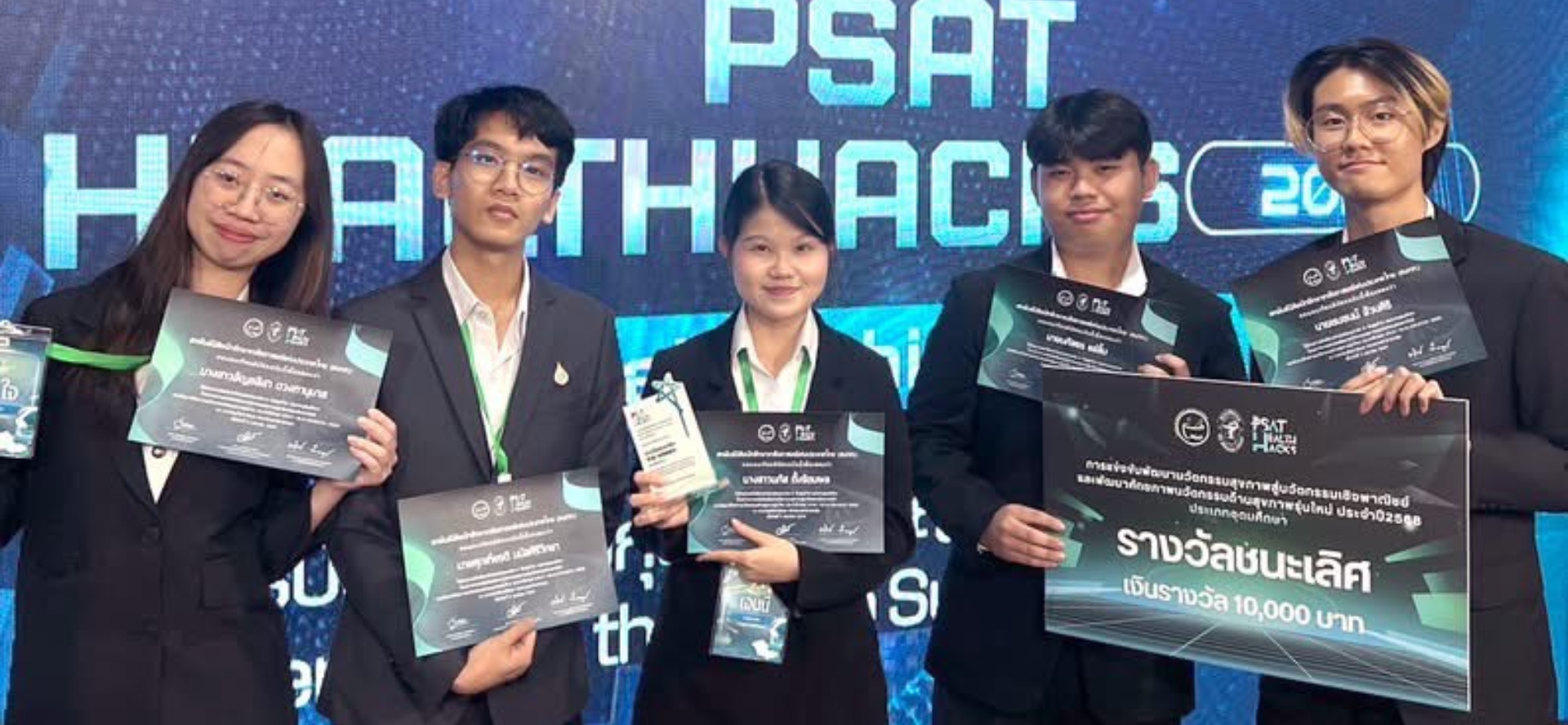
Livestock significantly contributes to methane release, a potent greenhouse gas driving climate change and affecting public health. Methane primarily comes from digestive fermentation in ruminants like cattle, leading many countries to implement controls. Recognizing this, students from Thammasat University (Public Health) and Chulalongkorn University (Commerce and Accountancy) developed the Cow Eco+ innovation to reduce cattle methane. Cow Eco+ won first prize at the Mahidol Public Health Hackathon 2025 on December 12-13, 2025.

The innovation development team consists of students from the Faculty of Public Health at Thammasat University, namely Adisorn Phutkaew, Sophita Rattanamankong, Kanokwan Kampranlan, Narathip Kengkarntham, and Piranat Pansaming, along with students from the Faculty of Commerce and Accountancy at Chulalongkorn University. The primary advisor is Asst. Prof. Dr. Kitrawee Jiraratsatit, a faculty member of the Faculty of Public Health at Thammasat University, with co-advisors including Dr. Rittikeard Prachumchai from the Faculty of Science and Technology at Thammasat University and Dr. Mayulee Suwankaew from the Faculty of Public Health at Thammasat University.

Adisorn, a Thammasat student, developed Cow Eco+, an innovative cattle dietary supplement. This shelf-stable blend of Thai herbs and modern technology maximizes active ingredients with reduced odor for easier consumption. Its primary goal is to reduce methane emissions, a major contributor to global warming. Cow Eco+ also improves cattle health by alleviating bloating, enhancing well-being, and providing antimicrobial/anti-inflammatory effects, thus reducing antibiotic use.


The Cow Eco+ innovation, led by Asst. Prof. Dr. Kitrawee, integrates public health, environment, agriculture, and Thai traditional medicine with technology to address livestock problems, focusing on holistic impact including minimizing drug residues and preventing contamination. The team is developing a practical formulation for farmers while stressing the connection between technical methane reduction results and tangible local environmental and health benefits.


Developing the Cow Eco+ innovation presented major challenges, as Peeranat Phansaming (Chulalongkorn University) noted, particularly working with non-communicative animals and creating a new, safe, practical solution. She emphasized meticulous development, safety research, and successful farmer implementation for sustainable environmental results. Sophita’s approach to global warming, rooted in risk prevention, integrates the One Health concept with Thai herbs and technology, reflecting Thammasat’s Public Health program’s focus on innovative thinking and prevention. The program emphasizes experiential learning, teamwork, and collaboration to create integrated, sustainable positive societal impacts by addressing root causes.

Chula Made Asia Certified to ISO 56001:2024

The Chulalongkorn School of Integrated Innovation (CSII) has been awarded ISO 56001:2024 certification for its Innovation Management System by the Management System Certification Institute (MASCI).  This makes CSII the first educational institution in Thailand and Asia to receive this certification. 

.

The ISO 56001:2024 certificate presentation ceremony was held on Wednesday, January 7, 2026, at the Chulalongkorn School of Integrated Innovation, 1st Floor, Chalerm Rajakumari 60th Anniversary Building (Chamchuri 10). The certificate was received by Professor Dr. Wilert Puriwat, President of Chulalongkorn University, from Mr. Jongrak Rojpalasatean, Director of MASCI, with Professor Dr. Suchada Sukrong, Director of the School of Integrated Innovation, co-receiving the certificate. 

.

Professor Dr. Wilert Puriwat, President of Chulalongkorn University, stated: 

“Receiving ISO certification on this occasion is a meaningful New Year’s gift for the Chula community. It demonstrates that this program not only meets international standards but is also truly capable of shaping the future of young people. The university focuses on creating innovators, because innovators come before innovations—the innovator is more important than what is created. Students are nurtured within an ecosystem rich in innovation. This program emphasizes integration between academic knowledge and hands-on practice, both domestically and internationally, to instill a start-up spirit and the wisdom to create new solutions for the future world.” 

.

Professor Dr. Suchada Sukrong, Director of the Chulalongkorn School of Integrated Innovation, said, “The ISO standard we received is for an innovation management system, which supports the systematic nurturing of students—from ideation, prototype development, and go-to-market processes to fundraising. Integrated innovation is not pursued merely for advancement or novelty; it must create a strong impact that benefits Thai society and humanity worldwide. The program emphasizes the commercialization of innovation to generate circulating capital and help Thailand escape poverty, with the goal of developing students into global citizens and future leaders.” 

This achievement at the global standard level is the result of policies and management under the vision of Professor Dr. Suchada Sukrong, Director of the School of Integrated Innovation, together with Assistant Professor Dr. Ronnakorn Vaiyavuth, Deputy Director for Innovation and Commercialization, who served as head of the working team. Along with faculty members, staff, and students, they have driven the innovation management system seriously, continuously, and systematically until certification was successfully achieved. 

.

This success represents a significant leap forward following the school’s previous ISO 56002:2019 certification in 2564 B.E. (2021). The upgrade to ISO 56001:2024, the latest innovation management system standard, reaffirms the school’s commitment to becoming an international leader in innovation. It also provides a vital foundation for empowering students and new entrepreneurs to create integrated innovations that sustainably drive global society and the world economy. 

.

Read more at: https://www.chula.ac.th/en/news/281932/

Thammasat Boosts Global Ties

“Being a leader of a university that learns from real experiences” is a significant milestone throughout the tenure of Professor Dr. Supasawad Chardchawarn, Rector of Thammasat University (TU), who aims to reform the human resource development system in Thailand to ensure it is “truly effective” in supporting the country’s economic and social development.

Amid a global “crisis within a crisis,” including a workforce shortage, Thailand faces challenges, compounded by a two-year high 2.1% unemployment rate (Q2 2025) and demographic shifts toward an aging society. For the past 19 months, Professor Dr. Supasawad has focused on elevating the university through partnerships. Domestic collaborations include MOUs with Siam Cement Group, the Federation of Thai Industries, and Gulf Energy Development for cooperative education. Internationally, the focus is on expanding relationships, including student exchange and Dual Degree programs, to achieve international standards, foster knowledge sharing, become a Comprehensive University, and transform human resource production.

In 2025, Professor Dr. Supasawad stated that there have been travels to various countries to discuss cooperation in the field of education. In Japan, visits were made to three universities: the University of Hyogo, Hokkaido University, and Rakuno Gakuen University. The latter two universities are partners in collaboration and the organization of the One Health Lecture Series 2025. All the universities expressed their desire to visit Thammasat University to enhance cooperation in higher education. The University of Hyoko aims to increase international students, offering high school quotas. Learning Thammasat University has a secondary school, they expressed interest in a visit, scholarships, and recruiting students from the Thammasat Demonstration School. Separately, the President of Hokkaido University, specializing in agriculture and health sciences, also plans to visit Thammasat University in 2026.

Thammasat University will attend the Beijing Forum 2025 in China, invited by Peking University President Gong Qihuang, to discuss and strengthen global academic cooperation, particularly in science, technology, and AI. This builds on existing bilateral ties. Additionally, TU visited three universities in Uzbekistan, Tashkent State University of Law, Samarkand State University, and the National University of Uzbekistan (which has an existing education MOU), to expand relations with the resource-rich nation. Professor Dr. Supasawad noted that expanding relations with Uzbekistan enhances knowledge, attracts international students, and serves as a gateway to Central Asia. Thammasat currently holds 171 active MOUs with foreign institutions: 55 in Europe, 135 in Asia, 10 in Oceania, 1 in Africa, 3 in Latin America, and 18 in North America.

In 2026, Thammasat University (TU) will expand relations with China and Indonesia. Collaboration with China seeks technological partnerships, especially in AI, and increased Chinese student enrollment, capitalizing on their rapidly growing universities. Indonesia is a key target due to its population and TU’s reputation as a top Southeast Asian university, aiming to attract Indonesian students. These efforts support TU’s goal to become a regional educational hub and an international center for social sciences.

Thammasat Named First ASEAN’s ‘People of ACM’

Asst. Prof. Dr. Worawan Marurngsith Diaz Carballo is a faculty member in the Department of Computer Science at the Faculty of Science and Technology, Thammasat University (TU), Lampang Campus. She has been selected by the world’s largest professional organization in the field of computing, the Association for Computing Machinery (ACM), as one of the People of ACM for the year 2025. This recognition is awarded to individuals who contribute to advancing and shaping the future of the global computing industry, making her the first person from Thailand and the ASEAN region to receive this honor.

Asst. Prof. Dr. Worawan was selected for her work promoting supercomputer utilization through the HPC Ignite project. This initiative developed high-performance computing (HPC) skills for 373 people in four northern provinces (Lampang, Chiang Mai, Mae Hong Son, and Lamphun) to foster local innovation and address regional issues. Supported by NRCT, ThaiSC, and Thammasat University, the project addresses the need for skilled operators alongside supercomputing technology to boost national economic competitiveness. Supercomputers accelerate calculations, speeding up product development (e.g., Google DeepMind’s 800-year knowledge search in 17 days). Recognizing that only a small group in Thailand currently uses available supercomputers, this project is the first to connect this powerful technology to the general public. She further stated that the aforementioned research project is not merely about skill development but is aimed at creating an ecosystem to train skills in High-Performance Computing (HPC) for individuals who may not have the opportunity to access supercomputers. Some participants in the research project come from areas that frequently experience power outages, lack learning devices at home, and only have access to mobile phones. The research team has therefore developed a website for learning that can be accessed via mobile phones, which includes features for practical training, learning, and matching skill goals, as well as recommending learning pathways. 

Asst. Prof. Dr. Worawan noted that the research project’s ecosystem for skill development, including a learning system website, was effective. This website was used during the ACM HPC Summer School to ensure trainees without necessary equipment could participate equally. The platform has thus benefited both Thailand and the global community.

These achievements, including research projects and crucial access to supercomputers in Thailand, rely on Thammasat University’s support. Furthermore, Thammasat’s consistent participation and awards in the APAC-HPC AI Competition have led ThaiSC to grant them supercomputer access.

“Being named a People of ACM is highly significant,” Asst. Prof. Dr. Worawan concluded. “It acts as a catalyst, encouraging a wide audience to grasp the vital role of supercomputers and see them not as an abstract concept. Crucially, it inspires nations globally to bolster their specialized workforce. This enhancement in capacity allows each country to independently drive innovations, including AI development, ultimately bringing substantial national benefits. Moreover, this recognition solidifies Thammasat University’s dedication to supporting its personnel and serving society.”

Chula Garners 68 National Research Awards

Chulalongkorn University extends its congratulations on the achievements of its faculty members and researchers who received the prestigious National Research Awards at Thailand Inventors’ Day 2026, held on January 8, 2026, at Event Hall 102, BITEC Exhibition and Convention Center, Bangna. This year, Chulalongkorn University faculty and researchers received as many as 68 awards across various categories, bringing about immense honor and pride to the university. 

.

Her Royal Highness Princess Sirivannavari Nariratana Rajakanya graciously appointed her representative to preside over the opening ceremony of Thailand Inventors’ Day 2026 and to present certificates to the recipients of the National Research Awards. On this occasion, Professor Dr. Wilert Puriwat, President of Chulalongkorn University, together with Professor Dr. Pornanong Aramwit, Vice President, presented congratulatory flower bouquets to all award recipients. The 68 awards comprised: 

  • 3 National Outstanding Researcher Awards 
  • 12 Research Work Awards 
  • 12 Thesis Awards 
  • 10 Invention Awards 
  • 31 NRCT Quality Achievement Awards 

.

Thailand Inventors’ Day 2026 was held for the 27th occasion, from January 5 to 9, 2026, at the BITEC Exhibition and Convention Center, Bangna, under the theme “Unlocking Thailand with the Power of Inventions and Innovation.” The event was organized to honor and commemorate the inventive achievements of His Majesty King Bhumibol Adulyadej the Great, revered as “The Father of Thai Invention.” The event featured exhibitions of ready-to-use inventions and innovations, presentations on national advancements in invention and innovation, and a Highlight Zone with special activities for visitors to enjoy. 

.

(Information provided by the Research Management Office, Chulalongkorn University) 

Read more about the National Research Council of Thailand (NRCT) Award recipients for 2026 at: 

https://www.chula.ac.th/en/news/276007/

https://www.research.chula.ac.th/nrct-award-fiscal-year-2026/

Download photos from the event at: https://bit.ly/3L5cfvX 

.

Read more at: https://www.chula.ac.th/en/news/281920/

Sasin, Chula to Host Open House 2026

The Sasin School of Management of Chulalongkorn University invites those interested in applying for enrollment in the 2026 academic year to attend the Sasin Open House on Saturday, January 24, 2026, from 10:00 a.m. to 12:00 p.m., at Sasin, Chulalongkorn University. 

Participants will have the opportunity to learn more about Sasin’s programs, including the MBA, Executive MBA, and DBA. The event will also feature current students, alumni, and Sasin faculty members who will share their experiences and provide information about teaching and learning in each program of interest. 

In addition, prospective Sasin MBA applicants who are preparing for the GMAT should not miss the special GMAT Insights Session, jointly organized by Sasin and GMAC, from 1:00 to 1:45 p.m. (after the Sasin Open House). 

Register for the Open House at: https://tinyurl.com/6swn8fw4 

Register for the GMAT Insights Session at: https://tinyurl.com/mvfkkbv4 

Read more at: https://www.chula.ac.th/en/news/281914/

Chula Partners with Nanchang University

Chulalongkorn University has signed a Memorandum of Understanding (MOU) with Nanchang University, a world-class university renowned for its excellence in food science and technology and ranked 8th in the US News: Best Global Universities Rankings 2026. This collaboration will serve as a key mechanism for jointly advancing Thai society and the global community toward sustainable development. 

The MOU signing ceremony was held on December 29, 2025, at Nanchang University, Jiangxi Province, People’s Republic of China. The agreement was signed by Prof. Dr. Wilert Puriwat, President of Chulalongkorn University, and Professor Chen Yeguang, President of Nanchang University, with the aim of promoting international academic cooperation between the two institutions. 

The core of this collaboration focuses on integrating expertise in knowledge creation, research, training, and the development of academic networks. It also emphasizes the expansion of interdisciplinary research, strengthening the capacity of Thai scientists, researcher exchanges, and linking research outcomes to national-level and policy applications between the two countries to drive concrete joint projects and activities. 

Attendees at the signing ceremony included Assoc. Prof. Dr. Palanee Ammaranond, Vice President; Assoc. Prof. Dr. Thiti Bovornratanaraks, Dean of the Graduate School; Assoc. Prof. Dr. Inthawoot Suppavorasatit, Deputy Dean of the Faculty of Science; Prof. Dr. Supachitra Chadchawan, Deputy Dean of the Graduate School; Assoc. Prof. Dr. Kitipong Assatarakul, Head of the Department of Food Technology; and Assoc. Prof. Chaleeda Borompichaichartkul, Lecturer in the Department of Food Technology. 

On this occasion, Prof. Luo Sihai, Secretary of the Party Committee, hosted a reception to celebrate the occasion and officially welcome the collaboration between the two institutions. 

This MOU signing marks another important milestone for Chulalongkorn University in expanding its network of international partnerships and reflects its role as an academic hub committed to contributing to sustainable transformation at both regional and global levels. 

Read more at: https://www.chula.ac.th/en/news/281020/