



Thammasat Students Win with ‘Cow Eco+

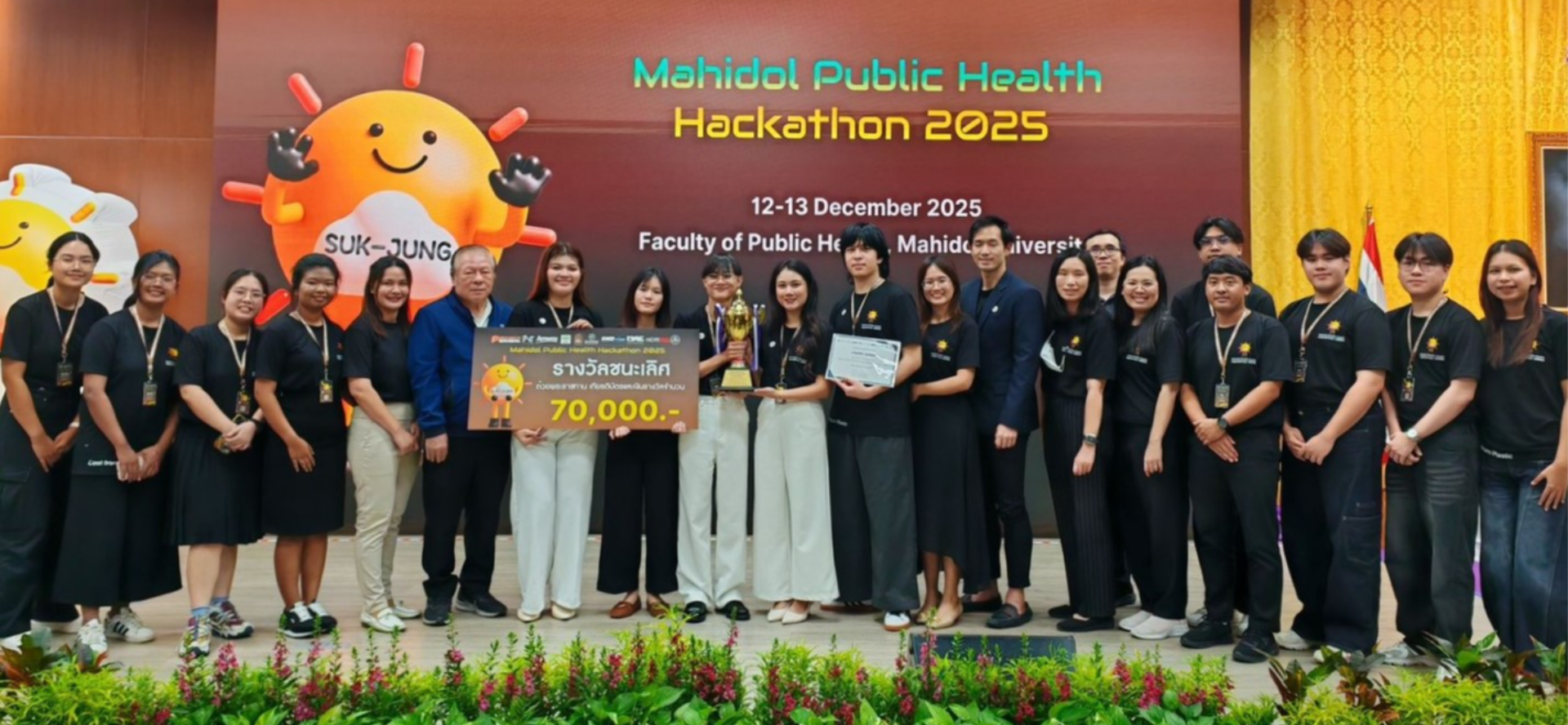
Livestock significantly contributes to methane release, a potent greenhouse gas driving climate change and affecting public health. Methane primarily comes from digestive fermentation in ruminants like cattle, leading many countries to implement controls. Recognizing this, students from Thammasat University (Public Health) and Chulalongkorn University (Commerce and Accountancy) developed the Cow Eco+ innovation to reduce cattle methane. Cow Eco+ won first prize at the Mahidol Public Health Hackathon 2025 on December 12-13, 2025.

The innovation development team consists of students from the Faculty of Public Health at Thammasat University, namely Adisorn Phutkaew, Sophita Rattanamankong, Kanokwan Kampranlan, Narathip Kengkarntham, and Piranat Pansaming, along with students from the Faculty of Commerce and Accountancy at Chulalongkorn University. The primary advisor is Asst. Prof. Dr. Kitrawee Jiraratsatit, a faculty member of the Faculty of Public Health at Thammasat University, with co-advisors including Dr. Rittikeard Prachumchai from the Faculty of Science and Technology at Thammasat University and Dr. Mayulee Suwankaew from the Faculty of Public Health at Thammasat University.

Adisorn, a Thammasat student, developed Cow Eco+, an innovative cattle dietary supplement. This shelf-stable blend of Thai herbs and modern technology maximizes active ingredients with reduced odor for easier consumption. Its primary goal is to reduce methane emissions, a major contributor to global warming. Cow Eco+ also improves cattle health by alleviating bloating, enhancing well-being, and providing antimicrobial/anti-inflammatory effects, thus reducing antibiotic use.


The Cow Eco+ innovation, led by Asst. Prof. Dr. Kitrawee, integrates public health, environment, agriculture, and Thai traditional medicine with technology to address livestock problems, focusing on holistic impact including minimizing drug residues and preventing contamination. The team is developing a practical formulation for farmers while stressing the connection between technical methane reduction results and tangible local environmental and health benefits.


Developing the Cow Eco+ innovation presented major challenges, as Peeranat Phansaming (Chulalongkorn University) noted, particularly working with non-communicative animals and creating a new, safe, practical solution. She emphasized meticulous development, safety research, and successful farmer implementation for sustainable environmental results. Sophita’s approach to global warming, rooted in risk prevention, integrates the One Health concept with Thai herbs and technology, reflecting Thammasat’s Public Health program’s focus on innovative thinking and prevention. The program emphasizes experiential learning, teamwork, and collaboration to create integrated, sustainable positive societal impacts by addressing root causes.

Chula Made Asia Certified to ISO 56001:2024

The Chulalongkorn School of Integrated Innovation (CSII) has been awarded ISO 56001:2024 certification for its Innovation Management System by the Management System Certification Institute (MASCI).  This makes CSII the first educational institution in Thailand and Asia to receive this certification. 

.

The ISO 56001:2024 certificate presentation ceremony was held on Wednesday, January 7, 2026, at the Chulalongkorn School of Integrated Innovation, 1st Floor, Chalerm Rajakumari 60th Anniversary Building (Chamchuri 10). The certificate was received by Professor Dr. Wilert Puriwat, President of Chulalongkorn University, from Mr. Jongrak Rojpalasatean, Director of MASCI, with Professor Dr. Suchada Sukrong, Director of the School of Integrated Innovation, co-receiving the certificate. 

.

Professor Dr. Wilert Puriwat, President of Chulalongkorn University, stated: 

“Receiving ISO certification on this occasion is a meaningful New Year’s gift for the Chula community. It demonstrates that this program not only meets international standards but is also truly capable of shaping the future of young people. The university focuses on creating innovators, because innovators come before innovations—the innovator is more important than what is created. Students are nurtured within an ecosystem rich in innovation. This program emphasizes integration between academic knowledge and hands-on practice, both domestically and internationally, to instill a start-up spirit and the wisdom to create new solutions for the future world.” 

.

Professor Dr. Suchada Sukrong, Director of the Chulalongkorn School of Integrated Innovation, said, “The ISO standard we received is for an innovation management system, which supports the systematic nurturing of students—from ideation, prototype development, and go-to-market processes to fundraising. Integrated innovation is not pursued merely for advancement or novelty; it must create a strong impact that benefits Thai society and humanity worldwide. The program emphasizes the commercialization of innovation to generate circulating capital and help Thailand escape poverty, with the goal of developing students into global citizens and future leaders.” 

This achievement at the global standard level is the result of policies and management under the vision of Professor Dr. Suchada Sukrong, Director of the School of Integrated Innovation, together with Assistant Professor Dr. Ronnakorn Vaiyavuth, Deputy Director for Innovation and Commercialization, who served as head of the working team. Along with faculty members, staff, and students, they have driven the innovation management system seriously, continuously, and systematically until certification was successfully achieved. 

.

This success represents a significant leap forward following the school’s previous ISO 56002:2019 certification in 2564 B.E. (2021). The upgrade to ISO 56001:2024, the latest innovation management system standard, reaffirms the school’s commitment to becoming an international leader in innovation. It also provides a vital foundation for empowering students and new entrepreneurs to create integrated innovations that sustainably drive global society and the world economy. 

.

Read more at: https://www.chula.ac.th/en/news/281932/

Thammasat Boosts Global Ties

“Being a leader of a university that learns from real experiences” is a significant milestone throughout the tenure of Professor Dr. Supasawad Chardchawarn, Rector of Thammasat University (TU), who aims to reform the human resource development system in Thailand to ensure it is “truly effective” in supporting the country’s economic and social development.

Amid a global “crisis within a crisis,” including a workforce shortage, Thailand faces challenges, compounded by a two-year high 2.1% unemployment rate (Q2 2025) and demographic shifts toward an aging society. For the past 19 months, Professor Dr. Supasawad has focused on elevating the university through partnerships. Domestic collaborations include MOUs with Siam Cement Group, the Federation of Thai Industries, and Gulf Energy Development for cooperative education. Internationally, the focus is on expanding relationships, including student exchange and Dual Degree programs, to achieve international standards, foster knowledge sharing, become a Comprehensive University, and transform human resource production.

In 2025, Professor Dr. Supasawad stated that there have been travels to various countries to discuss cooperation in the field of education. In Japan, visits were made to three universities: the University of Hyogo, Hokkaido University, and Rakuno Gakuen University. The latter two universities are partners in collaboration and the organization of the One Health Lecture Series 2025. All the universities expressed their desire to visit Thammasat University to enhance cooperation in higher education. The University of Hyoko aims to increase international students, offering high school quotas. Learning Thammasat University has a secondary school, they expressed interest in a visit, scholarships, and recruiting students from the Thammasat Demonstration School. Separately, the President of Hokkaido University, specializing in agriculture and health sciences, also plans to visit Thammasat University in 2026.

Thammasat University will attend the Beijing Forum 2025 in China, invited by Peking University President Gong Qihuang, to discuss and strengthen global academic cooperation, particularly in science, technology, and AI. This builds on existing bilateral ties. Additionally, TU visited three universities in Uzbekistan, Tashkent State University of Law, Samarkand State University, and the National University of Uzbekistan (which has an existing education MOU), to expand relations with the resource-rich nation. Professor Dr. Supasawad noted that expanding relations with Uzbekistan enhances knowledge, attracts international students, and serves as a gateway to Central Asia. Thammasat currently holds 171 active MOUs with foreign institutions: 55 in Europe, 135 in Asia, 10 in Oceania, 1 in Africa, 3 in Latin America, and 18 in North America.

In 2026, Thammasat University (TU) will expand relations with China and Indonesia. Collaboration with China seeks technological partnerships, especially in AI, and increased Chinese student enrollment, capitalizing on their rapidly growing universities. Indonesia is a key target due to its population and TU’s reputation as a top Southeast Asian university, aiming to attract Indonesian students. These efforts support TU’s goal to become a regional educational hub and an international center for social sciences.

Thammasat Named First ASEAN’s ‘People of ACM’

Asst. Prof. Dr. Worawan Marurngsith Diaz Carballo is a faculty member in the Department of Computer Science at the Faculty of Science and Technology, Thammasat University (TU), Lampang Campus. She has been selected by the world’s largest professional organization in the field of computing, the Association for Computing Machinery (ACM), as one of the People of ACM for the year 2025. This recognition is awarded to individuals who contribute to advancing and shaping the future of the global computing industry, making her the first person from Thailand and the ASEAN region to receive this honor.

Asst. Prof. Dr. Worawan was selected for her work promoting supercomputer utilization through the HPC Ignite project. This initiative developed high-performance computing (HPC) skills for 373 people in four northern provinces (Lampang, Chiang Mai, Mae Hong Son, and Lamphun) to foster local innovation and address regional issues. Supported by NRCT, ThaiSC, and Thammasat University, the project addresses the need for skilled operators alongside supercomputing technology to boost national economic competitiveness. Supercomputers accelerate calculations, speeding up product development (e.g., Google DeepMind’s 800-year knowledge search in 17 days). Recognizing that only a small group in Thailand currently uses available supercomputers, this project is the first to connect this powerful technology to the general public. She further stated that the aforementioned research project is not merely about skill development but is aimed at creating an ecosystem to train skills in High-Performance Computing (HPC) for individuals who may not have the opportunity to access supercomputers. Some participants in the research project come from areas that frequently experience power outages, lack learning devices at home, and only have access to mobile phones. The research team has therefore developed a website for learning that can be accessed via mobile phones, which includes features for practical training, learning, and matching skill goals, as well as recommending learning pathways. 

Asst. Prof. Dr. Worawan noted that the research project’s ecosystem for skill development, including a learning system website, was effective. This website was used during the ACM HPC Summer School to ensure trainees without necessary equipment could participate equally. The platform has thus benefited both Thailand and the global community.

These achievements, including research projects and crucial access to supercomputers in Thailand, rely on Thammasat University’s support. Furthermore, Thammasat’s consistent participation and awards in the APAC-HPC AI Competition have led ThaiSC to grant them supercomputer access.

“Being named a People of ACM is highly significant,” Asst. Prof. Dr. Worawan concluded. “It acts as a catalyst, encouraging a wide audience to grasp the vital role of supercomputers and see them not as an abstract concept. Crucially, it inspires nations globally to bolster their specialized workforce. This enhancement in capacity allows each country to independently drive innovations, including AI development, ultimately bringing substantial national benefits. Moreover, this recognition solidifies Thammasat University’s dedication to supporting its personnel and serving society.”

Chula Garners 68 National Research Awards

Chulalongkorn University extends its congratulations on the achievements of its faculty members and researchers who received the prestigious National Research Awards at Thailand Inventors’ Day 2026, held on January 8, 2026, at Event Hall 102, BITEC Exhibition and Convention Center, Bangna. This year, Chulalongkorn University faculty and researchers received as many as 68 awards across various categories, bringing about immense honor and pride to the university. 

.

Her Royal Highness Princess Sirivannavari Nariratana Rajakanya graciously appointed her representative to preside over the opening ceremony of Thailand Inventors’ Day 2026 and to present certificates to the recipients of the National Research Awards. On this occasion, Professor Dr. Wilert Puriwat, President of Chulalongkorn University, together with Professor Dr. Pornanong Aramwit, Vice President, presented congratulatory flower bouquets to all award recipients. The 68 awards comprised: 

  • 3 National Outstanding Researcher Awards 
  • 12 Research Work Awards 
  • 12 Thesis Awards 
  • 10 Invention Awards 
  • 31 NRCT Quality Achievement Awards 

.

Thailand Inventors’ Day 2026 was held for the 27th occasion, from January 5 to 9, 2026, at the BITEC Exhibition and Convention Center, Bangna, under the theme “Unlocking Thailand with the Power of Inventions and Innovation.” The event was organized to honor and commemorate the inventive achievements of His Majesty King Bhumibol Adulyadej the Great, revered as “The Father of Thai Invention.” The event featured exhibitions of ready-to-use inventions and innovations, presentations on national advancements in invention and innovation, and a Highlight Zone with special activities for visitors to enjoy. 

.

(Information provided by the Research Management Office, Chulalongkorn University) 

Read more about the National Research Council of Thailand (NRCT) Award recipients for 2026 at: 

https://www.chula.ac.th/en/news/276007/

https://www.research.chula.ac.th/nrct-award-fiscal-year-2026/

Download photos from the event at: https://bit.ly/3L5cfvX 

.

Read more at: https://www.chula.ac.th/en/news/281920/

Sasin, Chula to Host Open House 2026

The Sasin School of Management of Chulalongkorn University invites those interested in applying for enrollment in the 2026 academic year to attend the Sasin Open House on Saturday, January 24, 2026, from 10:00 a.m. to 12:00 p.m., at Sasin, Chulalongkorn University. 

Participants will have the opportunity to learn more about Sasin’s programs, including the MBA, Executive MBA, and DBA. The event will also feature current students, alumni, and Sasin faculty members who will share their experiences and provide information about teaching and learning in each program of interest. 

In addition, prospective Sasin MBA applicants who are preparing for the GMAT should not miss the special GMAT Insights Session, jointly organized by Sasin and GMAC, from 1:00 to 1:45 p.m. (after the Sasin Open House). 

Register for the Open House at: https://tinyurl.com/6swn8fw4 

Register for the GMAT Insights Session at: https://tinyurl.com/mvfkkbv4 

Read more at: https://www.chula.ac.th/en/news/281914/

Chula Partners with Nanchang University

Chulalongkorn University has signed a Memorandum of Understanding (MOU) with Nanchang University, a world-class university renowned for its excellence in food science and technology and ranked 8th in the US News: Best Global Universities Rankings 2026. This collaboration will serve as a key mechanism for jointly advancing Thai society and the global community toward sustainable development. 

The MOU signing ceremony was held on December 29, 2025, at Nanchang University, Jiangxi Province, People’s Republic of China. The agreement was signed by Prof. Dr. Wilert Puriwat, President of Chulalongkorn University, and Professor Chen Yeguang, President of Nanchang University, with the aim of promoting international academic cooperation between the two institutions. 

The core of this collaboration focuses on integrating expertise in knowledge creation, research, training, and the development of academic networks. It also emphasizes the expansion of interdisciplinary research, strengthening the capacity of Thai scientists, researcher exchanges, and linking research outcomes to national-level and policy applications between the two countries to drive concrete joint projects and activities. 

Attendees at the signing ceremony included Assoc. Prof. Dr. Palanee Ammaranond, Vice President; Assoc. Prof. Dr. Thiti Bovornratanaraks, Dean of the Graduate School; Assoc. Prof. Dr. Inthawoot Suppavorasatit, Deputy Dean of the Faculty of Science; Prof. Dr. Supachitra Chadchawan, Deputy Dean of the Graduate School; Assoc. Prof. Dr. Kitipong Assatarakul, Head of the Department of Food Technology; and Assoc. Prof. Chaleeda Borompichaichartkul, Lecturer in the Department of Food Technology. 

On this occasion, Prof. Luo Sihai, Secretary of the Party Committee, hosted a reception to celebrate the occasion and officially welcome the collaboration between the two institutions. 

This MOU signing marks another important milestone for Chulalongkorn University in expanding its network of international partnerships and reflects its role as an academic hub committed to contributing to sustainable transformation at both regional and global levels. 

Read more at: https://www.chula.ac.th/en/news/281020/

Thammasat Student, Thailand’s Sole Youth Rep

‘Nan-Nunnaphat Pongwitoon,’ a fourth-year student majoring in Spanish and Latin American Studies at the Faculty of Arts, Thammasat University, has been selected as the sole youth representative of Thailand to participate in the 20th Conference of Youth (COY20) and is one of the nine Thai youths who will attend the 30th UNFCCC Conference of Parties (COP30) from November 5-19, 2023, in Belém, Federative Republic of Brazil, which serves as an international forum on climate change. She stated that this year she has the opportunity to serve as the Project Manager for the Local Conference of Youth Thailand 2025, which is an environmental conference organized by Thai youth for Thai youth. The event aims to gather the voices of Thai youth to create a youth statement to be forwarded to the YOUNGO network at COY20 and COP30. Consequently, she has the chance to participate in the Conference of Youth (COY20), which is a global youth conference on climate change, as the sole representative from Thailand.

The Department of Climate Change and Environmental Affairs, with support from the Global Fund for Children, enabled Nunnaphat’s participation as a youth representative at the COP30 side events. She effectively participated in the “Youth Participation in Climate Policy” discussion, sharing policy advocacy experiences with peers from the Philippines, South Korea, and Taiwan. This exchange highlighted diverse methods, including social campaigns, government collaboration, and legal action. She concluded that promoting youth involvement in environmental issues is vital, as it empowers future societal drivers and upholds the fundamental human right to a quality, just, and fair environment. Through global youth exchange, Nunnaphat realized environmental issues link to social inequality, disproportionately affecting vulnerable groups regarding pollution, climate change, and eco-friendly alternatives—a key call for Climate Justice at COP.


“My background in Spanish and Latin American studies provides the language skills and historical context to connect environmental issues between Southeast Asia and Latin America more effectively,” Nunnaphat concluded. COP30 was vital not just for policy learning, but also highlighted education’s role and youth involvement in shaping a sustainable future.

Thammasat Studies ‘Ko’ Thai Fabric

Thammasat University is researching “Thai textiles in Tambon Ko, Lamphun Province” (within Mae Ping National Park) to promote community sustainability. The initiative aims to add value through new patterns, tailoring, and innovations, supporting the fashion industry and creative economy in line with Her Majesty Queen Sirikit, the Queen Mother’s royal initiatives.


Asst. Prof. Dr. Wuthigrai Siriphon, Assoc. Dean, Faculty of Fine and Applied Arts, Thammasat University, noted the continuous growth of Thailand’s creative economy, projected to exceed 1.44 trillion baht in 2024 and create nearly 1 million jobs, particularly in the in-demand fashion and textile sectors. This growth is attributed to the Queen Mother’s initiatives, which established a complete ecosystem for Thai textiles, promoting usage and stable professions.


The research team, led by Asst. Prof. Dr. Wuthigrai and Dr. Nalinee Nattithammakorn, is developing a holistic design concept for community handicraft products, focusing on textiles from Ko Subdistrict, the only community in Mae Ping National Park. This supports local livelihoods, enhances product value, and promotes appropriate natural resource use to reduce wildfire and PM2.5 risks.


Ko Subdistrict’s community uniquely controls its textile production process from upstream (cotton cultivation) to downstream (sales). The research provides knowledge, skill development (pattern design, sewing), and natural dyeing techniques (Padauk and Pegaga bark) to create new garment lines and income, along with providing equipment.


These efforts have enhanced skills, increased product variety, value, and income, and utilize environmentally friendly production, aligning with SDGs (Goals 11, 12, and 15). The resulting garments have been exhibited at various events, including Bangkok Design Week and the National Research Expo, and will be shown at Chiangmai Design Week.


Currently, the textile creations are part of the rotating sustainability exhibition (SDGs) Phase 2, “Sustainable Cities and Communities,” featuring over 40 works from social sciences and humanities faculties. The exhibition runs from November 2025 to February 2026 at the SDG Lab, Thammasat University, Rangsit Campus, open Tuesdays and Thursdays, 10:00 AM to 4:00 PM. Interested individuals can book a visit online. The exhibition covers five zones: Climate Change, Sustainable Cities, Circular Economy, Agriculture/Food/Health, and Diversity/Equity/Inclusion.

Chula Hosts International Seminar

Chulalongkorn University, through the Faculty of Engineering, will host a high-level Special Seminar on “Microplastic Issues and Health” on December 12, 2025, at Room 201A, Centennial Building, bringing together leading global experts to discuss the latest scientific evidence, policy implications, and solutions to one of the world’s most pressing environmental challenges. 

The full-day seminar, running from 9:00AM to 4:30PM, with registration at 8:30AM–9:00AM, features renowned researchers and practitioners from the University of Tokyo, the University of Miami, Chulalongkorn University, and international organizations.  

Participants will gain insights into emerging findings on microplastics in the environment and their impacts on human health, as well as perspectives on policy development, circular economy approaches, private-sector innovation, and future directions for collaborative research. 

The event will open with remarks by Assoc. Prof. Dr. Witaya Wannasuphoprasit, Dean of the Faculty of Engineering, Chulalongkorn University, underscoring the university’s commitment to advancing scientific understanding and multisectoral action on environmental health. 

Distinguished Speakers Include: 

The seminar also offers valuable networking opportunities for researchers, policymakers, industry partners, and stakeholders committed to addressing microplastic pollution through science-based and collaborative solutions. 

This event reflects Chulalongkorn University’s leadership in driving interdisciplinary dialogue and innovation for a healthier, more sustainable future. 

Register here: https://docs.google.com/forms 

For more information, please contact Assoc. Prof. Dr. Nutta Taneepanichskul at [email protected] or scan the QR code provided. 

Read more at: https://www.chula.ac.th/en/news/274627/