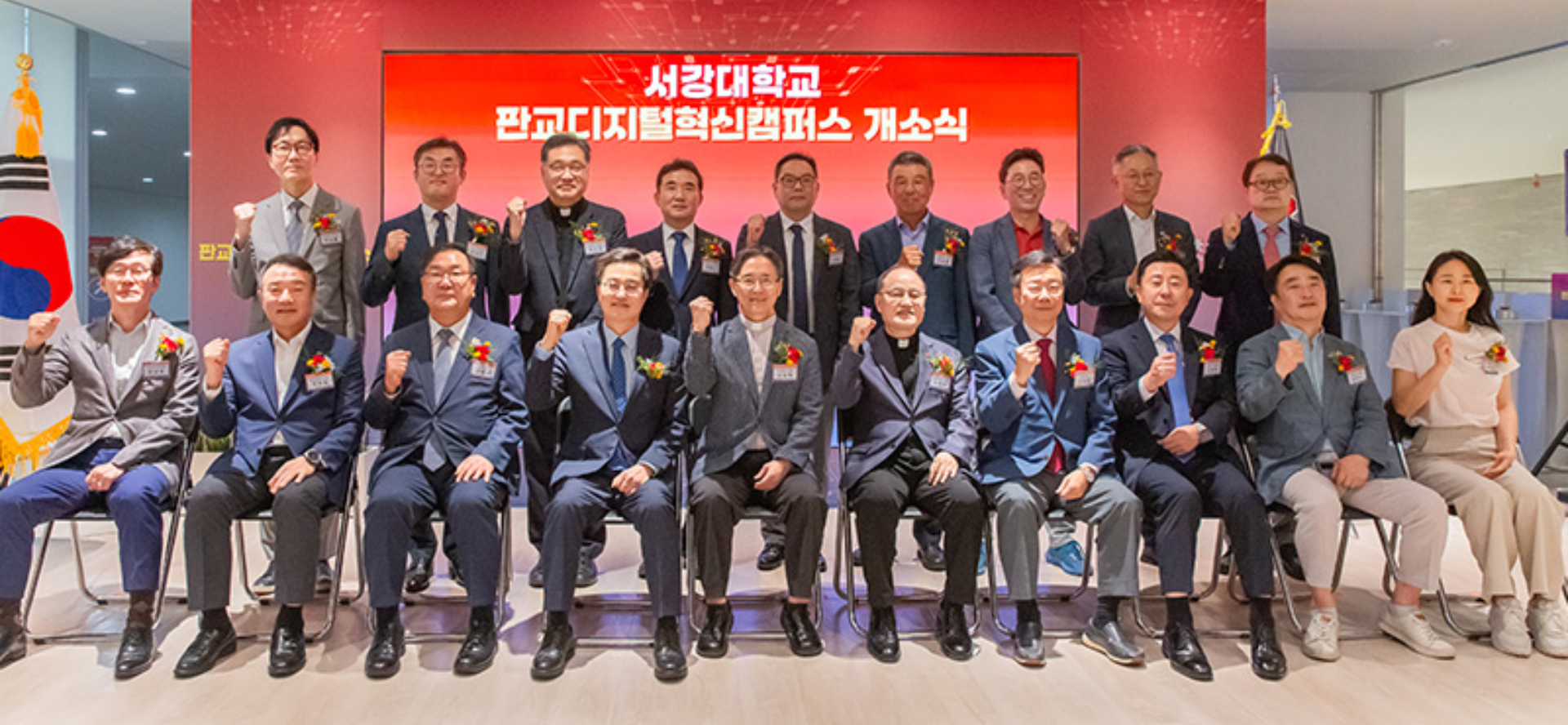
Sogang University has established the Sogang–Pangyo Digital Innovation Campus in Pangyo Techno Valley, creating a new industry–academia collaboration platform focused on artificial intelligence, semiconductors, and advanced mobility. Located in Widen Tower, the campus serves as a strategic base for education, research, startup incubation, and global partnership development within South Korea’s leading innovation cluster.
The university has secured approximately 10,000 square metres of dedicated campus space, housing educational facilities for system semiconductor design and technology management–entrepreneurship, alongside an integrated industry–academia hub. Designed as a practice-oriented campus embedded within an industrial environment, the Pangyo Campus brings together teaching, research, and startup activities in close proximity to industry partners, offering a new model of collaboration distinct from conventional university campuses.
The establishment of the Pangyo Campus reflects Sogang University’s long-term strategy to strengthen links between academia and industry while cultivating talent for future industries. By leveraging its research strengths and entrepreneurial expertise, the university aims to foster global startups and train professionals equipped to lead technological innovation.
The campus has garnered strong support from local and national stakeholders, including Gyeonggi Province and Seongnam City, as well as from corporate partners located in Pangyo Techno Valley. Executives from the four holding companies of Widen Tower—Motrac, Inox Advanced Materials, Estraffic, and YMC—along with representatives from Gyeonggi Housing & Urban Corporation (GH) and innovation partners such as Pii Co., Ltd., have participated in building the campus’s collaborative ecosystem. Additional support has been provided by domestic and international partners, including HT Holdings, BDC Accelerator, and global research and innovation institutions.
The Pangyo Digital Innovation Campus also integrates creative and interdisciplinary elements into its innovation environment. Digital works produced by students from Sogang University’s Department of Art & Technology are showcased across campus spaces, highlighting the convergence of technology and creativity and contributing to a dynamic, open innovation culture.
Key entrepreneurship support organisations, including a Startup Support Foundation, Technology Holding Company, and accelerator programmes, operate within the campus. Facilities include joint industry–academia research centres, private and co-working offices, and startup training spaces designed to support innovation-driven enterprises. Through partnerships with global institutions such as TNO and GDIN, the campus facilitates international collaboration and supports the global expansion of promising startups. Further cooperation with institutions in India and China is also under discussion, strengthening the campus’s global reach.
Across its facilities, the Pangyo Campus hosts student- and faculty-founded ventures, international research collaborations, and customised training programmes for working professionals, alongside startups in AI, semiconductors, and advanced mobility. Faculty members conduct teaching and research directly on site, reinforcing the campus’s role as a practice-based innovation hub embedded within an active industrial ecosystem.
Through the Pangyo Digital Innovation Campus, Sogang University aims to identify and support high-potential startups both domestically and internationally, expand global university–industry collaboration projects, and provide hands-on learning opportunities for students and professionals. The campus is envisioned as an open space for innovation where local communities, companies, and entrepreneurs can collaborate, experiment, and translate ideas into real-world impact.
President Shim Jong-hyeok emphasized that the Pangyo Campus is designed to serve as a hub where companies can access advanced technologies and talent, young entrepreneurs can pursue and realise their startup ambitions, and the broader Pangyo–Seongnam community can engage with innovation and culture. He noted that, through sustained collaboration between universities and industry, the initiative aims to establish a pioneering model that contributes to regional development and enhances national competitiveness.