Igor Sikorsky Kyiv Polytechnic Institute
Published on 26 June 2026




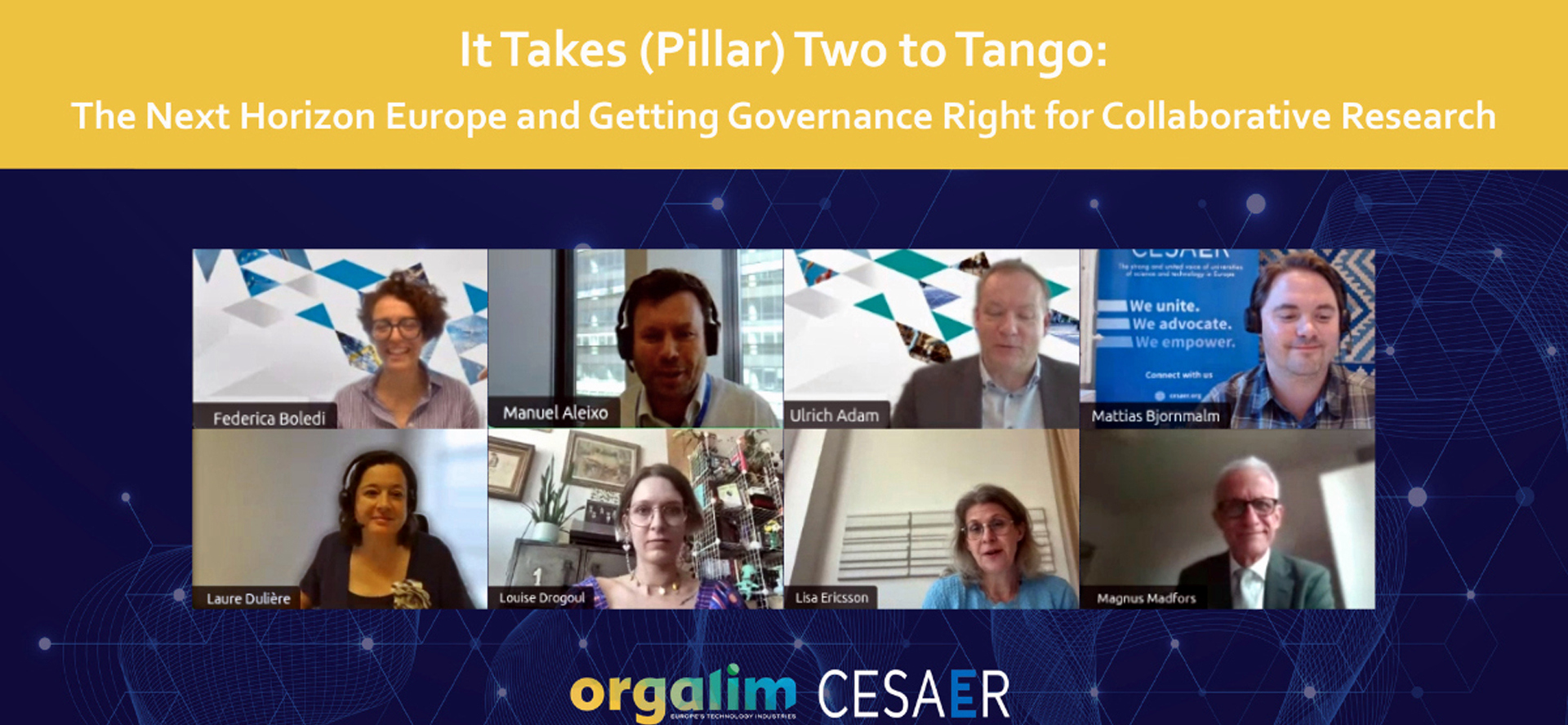
On 22 June 2026, Orgalim (Europe's tech industries) and CESAER (Europe's universities of science and technology) co-hosted the webinar titled “It takes (Pillar) Two to Tango: Collaborative Research the next Horizon Europe.”
Bringing together representatives from industry, academia and the European Commission, including the International Collaboration Department staff and member of the National Contact Point of Horizon Europe for Cluster 5 “Climate, Energy and Mobility” at the Igor Sikorsky Kyiv Polytechnic Institute (KPI), the event served as a platform to discuss the future governance of collaborative research under FP10 and its relationship with the proposed European Competitiveness Fund (ECF). Speakers explored how Europe can strengthen innovation, close the competitiveness gap with global rivals and ensure that excellent research is translated into industrial deployment and societal impact.
The webinar commenced with welcome addresses from Ulrich Adam, Director General of Orgalim, and Matthias Björnmalm, Secretary General of CESAER.
According to Ulrich Adam, Pillar Two (Global Challenges and European Industrial Competitiveness) is where excellent research can move in step with technological development, industrial needs and ultimately deployment in the market and in society. “At a time when Europe is seeking to strengthen its competitiveness, resilience and technological leadership, a strong and well-funded collaborative research programme is more important than ever,” he said.
Matthias Björnmalm emphasised the need for ambitious and well-funded programmes, collaborative research at scale and governance arrangements informed by excellence, expertise and a clear understanding of outcomes. “We are facing growing pressure to close the innovation gap with global competitors while preserving its strengths in excellence, openness and trust,” he observed. “Universities of science and technology play a central role in this effort by generating frontier knowledge, training talent and building long-term capacity through collaboration with industry and society.”
Delivering a keynote speech, Manuel Aleixo, Cabinet Expert in the Cabinet of European Commissioner for Startups, Research and Innovation Ekaterina Zaharieva, pointed out that Commission’s proposals for FP10 and the ECF are designed to place research and innovation at the heart of European competitiveness. While maintaining continuity with Horizon Europe, the proposals seek to improve coherence between research, innovation and industrial deployment, helping innovators move more effectively from knowledge creation to market impact. “We are aiming to provide much better possibilities in the innovation-to-investment journey,” he stated.
Presenting a joint vision from industry and academia, Laure Dulière, Orgalim Manager for Energy, Climate and Innovation, and Louise Drogoul, Senior Adviser for Innovation and Sustainability at CESAER, highlighted the need for two strong and distinct programmes that would tango. While FP10 should continue supporting collaborative research and innovation, the Competitiveness Fund should help ensure successful deployment and market uptake. The key challenge, they argued, lies in creating an effective interface between the two. They summarised by explaining that the EU needs both programmes: a strong FP10 where innovation and research happen, and a deployment instrument under the Competitiveness Fund that helps bring results to market and that both industry and academia need more coherence, not more confusion. With this in mind, FP10 and the ECF should remain distinct, but they must not be disconnected.
Lisa Ericsson, Head of KTH Innovation and CEO of KTH Ventures, believes Europe does not lack excellence, talent or entrepreneurial ambition. From her viewpoint, the challenge lies in scaling innovation and turning breakthrough research into globally competitive companies and value chains. Universities have a critical role to play, not only through research and education but also by creating spin-offs, supporting deep-tech entrepreneurship and strengthening regional innovation ecosystems. “As such, FP10 can be more than a tool for generating knowledge for existing industry and actually support future industries to be created,” she noted.
As Magnus Madfors, Ericsson Head of Technical Regulations, put it, “Europe has excellent research and excellent framework programmes but where we fail is in bringing our innovations successfully to market.” Collaborative research remains one of Europe’s strengths, but research alone is not enough. To improve competitiveness, Europe must become better at deploying and scaling the innovations it develops. Research, standardisation, intellectual property, regulation and market uptake must all work together as part of a broader innovation ecosystem.
During the discussion, speakers repeatedly stressed the importance of strong stakeholder involvement in programme design and implementation. Industry, universities and research organisations all highlighted the value of being involved early in priority setting, ensuring that future research programmes remain aligned with Europe’s technological, industrial and societal needs.
Closing the event, Ulrich Adam underlined both the scale of challenges ahead and the importance of continued collaboration across the research and innovation ecosystem. “A strong Pillar Two, with a stable and ambitious budget and the right governance model, is one of the keys for Europe can address this challenge,” he concluded. “It takes an entire village to raise a child.”
The Orgalim team would like to thank Federica Boledi, Orgalim Policy Manager, for moderating the discussion, and its partners at CESAER for their collaboration in organising this event.
Watch the full recording of the webinar here
https://www.youtube.com/watch?v=46ywJpTUXm4