Thammasat University
Published on 29 October 2026




Canadian Govt & Thammasat Join Forces on Nature-Based Solutions for Bangkok Climate Resilience
The Government of Canada commends Thammasat University's urban development research using Nature-based Solutions to strengthen infrastructure for coexisting with and managing water via natural capital.
The Canadian Government commends Thammasat University's urban development research using "Nature-based Solutions" to build water-resilient infrastructure. Following a site visit to Benjakitti Forest Park, Thammasat's Vice Rector for Research emphasized advancing policy-driven research for Bangkok, leveraging data analysis and smart water management to design climate-resilient green spaces.
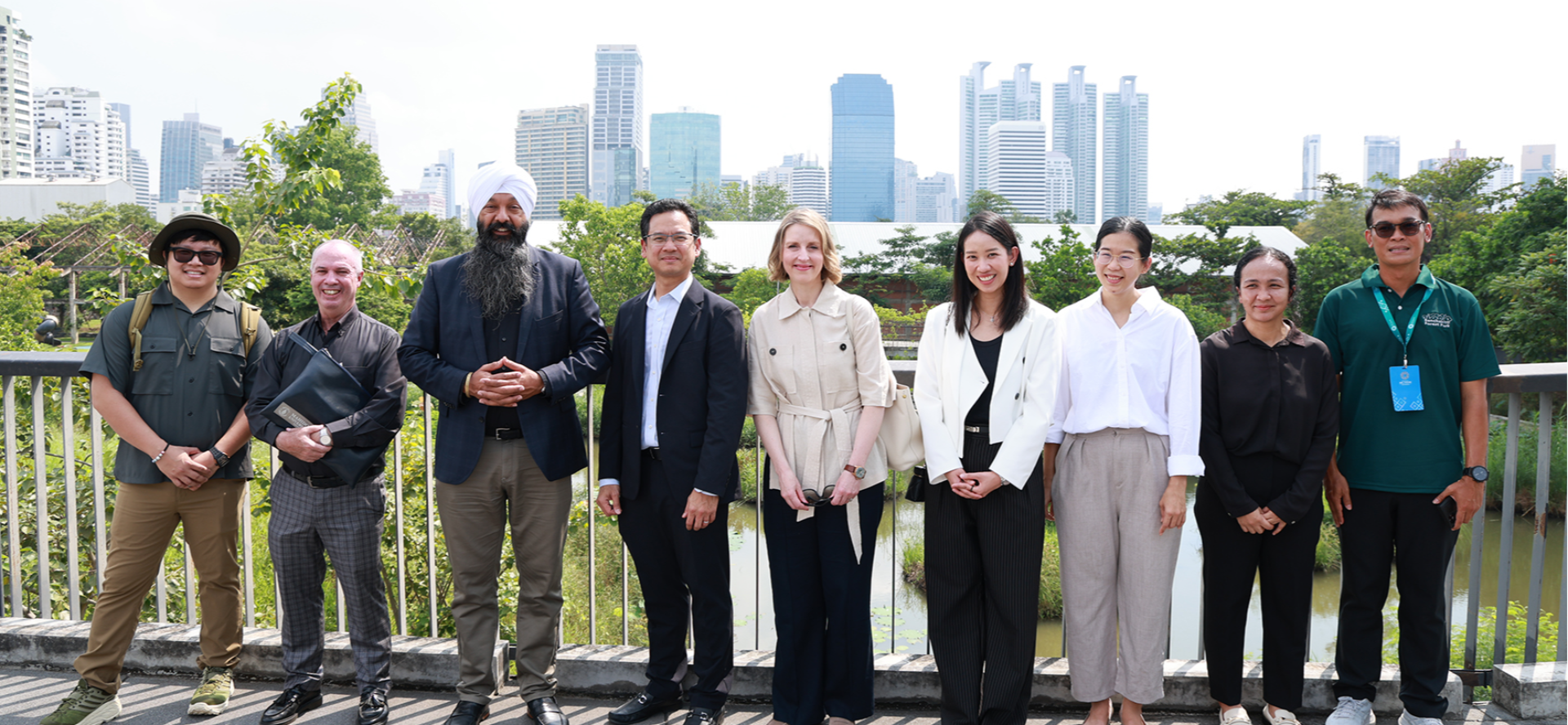
On October 17, 2026, The Honourable Randeep Sarai, Secretary of State (International Development), and Amanda Strohan, Ambassador of Canada to Thailand, along with representatives from the Government of Canada, visited Benjakitti Park in Bangkok. This site serves as a case study for the application of Nature-based Solutions (NbS), which utilize nature as a basis for problem-solving, to enhance water management efficiency and increase urban resilience. They were welcomed by Assoc. Prof. Dr. M.L. Pinitbhand Paribatra, Vice Rector for Research and Innovation at Thammasat University, Assoc. Prof. Dr. Supranee Lisawadi, Assistant Vice Rector for Research and Innovation at Thammasat University, and Assoc. Prof. Dr. Kim Neil Irvine, Head of the Nature-based Solutions in Water Management Research Unit (NbSWM), who engaged in knowledge exchange.
For the application of the NbS concept to peri-urban agricultural areas under the project "Enhancing Community Climate Change Resilience and Environmental Quality through Organic Farming and Design Thinking in Peri-urban Bangkok," and the case study of Benjakitti Park, it falls under the research topic "NbCLARE: Nature-Based Solutions for Climate Adaptation and Resilience" by the NbSWM research unit at the Faculty of Architecture and Planning, Thammasat University, led by Assoc. Prof. Dr. Kim Neil Irvine and Asst. Prof. Fa Likitsawat. Collaborating with them is Khun Tip, Chatchanin Sung, Director of the Landscape Architecture Studio at Asramsilp Community and Environmental Architects Co., Ltd., serving as the consultant and designer for Benjakitti Park. Both research projects are supported by the Canada Fund for Local Initiatives (CFLI) and the International Development Research Centre (IDRC) in partnership with the UK government.
CFLI support enables the development of real-time, remote-controlled smart sensor monitoring stations to enhance environmental tracking and area management. Used in sustainable agriculture and research, three updated third-generation prototype stations currently operate at Bangkok's Benjakitti Forest Park. The Sponge City concept key to this area uses designed wetlands and green spaces to absorb, retain, and delay rainfall, restore ecosystems, and promote biodiversity. Benjakitti Forest Park thus provides a recreational area and functions as a Living Lab public space for learning and studying urban wetland forest ecosystems.
Nature-based Solutions (NbS) view nature as core environmental infrastructure rather than an aesthetic feature. The late September 2026 Bangkok flooding highlighted interconnected climate, infrastructure, and land-use challenges.
Addressing flooding requires enhancing a city's capacity to receive, retain, and slow water at the source by combining nature with existing drainage systems, easing infrastructure strain and expanding long-term management options. Additionally, Ecosystem Services helps evaluate natural benefits, such as water regulation, heat reduction, water quality improvement, biodiversity support, and public health, to plan green spaces that comprehensively address environmental, social, and economic needs.
Regarding research translation, Assoc. Prof. Dr. M.L. Pinitbhand Paribatra noted that in June 2026, Thammasat University's NbSWM unit presented Nature-based Solutions to the BMA. Using Benjakitti Forest Park as a case study, they exchanged approaches for urban resilience and promoted designing networks that integrate green spaces with canal systems for effective management.
Building resilient cities demands cross-sector collaboration, from government and business to communities and academia, across all project stages. Thammasat University serves as a hub uniting researchers, policymakers, practitioners, and the public to translate research into real-world applications.
The Embassy of Canada in Thailand recently prioritized working with Thammasat University, local farmers, and international partners like the UK Government to advance water management and urban development. Key figures, including Secretary of State Randeep Sarai and Ambassador Amanda Strohan, supported these efforts, highlighting the university's role in convening scholars, policymakers, practitioners, businesses, and the public.
This collaboration leverages international support and local research to advance Nature-based Solutions (NbS) from pilot studies to practical policy. By integrating nature with urban infrastructure, Bangkok and other cities aim to mitigate flooding and climate change while promoting long-term urban sustainability and quality of life.