Chulalongkorn University
Published on 21 October 2026




What if a weapon against some of the world’s most stubborn bacteria were hiding in the soil beneath our feet? Could these microscopic hunters help us confront antibiotic-resistant “superbugs” and bacterial diseases devastating shrimp? The answer may lie in understanding these astonishing viruses—and the hidden battles unfolding all around us.
Highlights
· Decoding Microbes, Designing Tomorrow’s Therapies
· Bacteriophages: Viruses That Hunt Bacteria
· Building a Protective “Nucleus”
· Phage Therapy vs Superbug
· The Churi phage: A Discovery Beneath a Fallen Tree
· Phage: A Promising Future Therapy
· Phages in the Global Spotlight
· From Human Health to Shrimp Farms
· Meet the Star Phages: Eric and Ariel
· The Phage Cocktail
· From Research to Commercial Application
· Shrimp Mortality Control
· The Challenges Beyond the Science
· CAPSiD: Building a Library of Tiny Weapons
· Beyond Shrimp
· The Future for Fighting Bacteria
Researchers at Chulalongkorn University are exploring an extraordinary class of viruses called jumbophages—giant bacteriophages that prey on bacteria. Among them are unusual “nucleus-forming” phages that build a protective compartment inside infected bacterial cells, creating a microscopic battlefield unlike anything seen in ordinary phage infections.
These remarkable viruses could open new possibilities for tackling antibiotic-resistant bacteria and diseases that threaten shrimp farming. From the ground beneath our trees to the tiniest arenas of microbial life, researchers are uncovering a hidden world where viruses hunt bacteria—and where new tools for fighting disease may be waiting.
Decoding Microbes, Designing Tomorrow’s Therapies
At Chulalongkorn University, Assoc. Prof. Dr. Vorrapon Chaikeeratisak of the Department of Biochemistry, Faculty of Science, has studied an unusual group of bacterial viruses known as nucleus-forming jumbophages. Since 2018, his laboratory, known as The Microbe Lab, focuses on three interconnected themes: bacteriophages, phage-derived antimicrobials, and antibiotic discovery.
“Our focus is on understanding how bacteriophages infect bacteria and how they can be used to target multidrug-resistant pathogens. We also develop bacterial cytological profiling methods to see what happens inside bacterial cells when they are exposed to antibiotics or phage-derived proteins. Ultimately, we want to understand how these treatments kill bacteria and uncover new ways to fight difficult-to-treat infections.”
Assoc. Prof. Vorrapon said the ultimate goal of this project is to support alternative ways to treat infections, tackling one of the world’s growing health threats – antimicrobial resistance. Within a decade, that vision has shown to become a reality. His research reveals a remarkable twist: nature’s microscopic predators might just be our best defense against harmful bacteria threatening human health, food supply and sustainable farming.
The Microbe Lab, focuses on three interconnected themes: bacteriophages, phage-derived antimicrobials, and antibiotic discovery.
Focuses on three interconnected themes: bacteriophages, phage-derived antimicrobials, and antibiotic discovery.
Bacteriophages: Viruses That Hunt Bacteria
Bacteriophages, or simply phages, are viruses that infect bacteria. They attach to bacterial cells, inject their genetic material and take over the cell’s machinery to produce new phages. Eventually, the infected cell bursts, releasing the new viruses to infect other bacteria.
Phages come in an extraordinary range of shapes and sizes. Some are tiny, while others carry exceptionally large genomes and are known as jumbo or giant phages.
Among the most unusual are nucleus-forming jumbophages.
A giant phage infects a bacterium. A nucleus-like compartment (green) is formed to protect the newly synthesized phage genomes from bacterial defense systems. The capsids (gray) of the new phage travel along filaments called PhuZ (yellow) to be delivered to the nucleus where they dock in order to package phage DNA. Eventually, the bacterial cell lyses and the new phage emerge ready to infect new bacteria.
A giant phage infects a bacterium. A nucleus-like compartment (green) is formed to protect the newly synthesized phage genomes from bacterial defense systems. The capsids (gray) of the new phage travel along filaments called PhuZ (yellow) to be delivered to the nucleus where they dock in order to package phage DNA. Eventually, the bacterial cell lyses and the new phage emerge ready to infect new bacteria.
Assoc. Prof. Vorrapon first encountered these viruses during his postdoctoral research at the University of California San Diego, where he worked with Prof. Joe Pogliano, Department of Molecular Biology and Collaborative to Halt Antibiotic-Resistant Microbes (CHARM). What fascinated him was not simply their size, but their sophisticated strategy for surviving inside infected bacteria.
Building a Protective “Nucleus”
Unlike most phages, nucleus-forming jumbophages construct a protective protein shell around their DNA after infection. This compartment resembles a nucleus and separates the phage genome from many of the bacterium’s defense mechanisms.
“Bacteria are anything but passive hosts; they possess sophisticated defenses that detect and eliminate foreign genetic material. By forming a protected nucleus-like compartment, phages create an additional layer of defense, enabling their genomes to replicate shielded from some of the host’s antiviral mechanisms.” Assoc. Prof. Vorrapon shared.
Understanding this unusual system could help researchers develop new strategies for controlling bacteria—including strains that have become resistant to conventional antibiotics.
Phage Therapy vs Superbug
Antimicrobial resistance (AMR) is one of the world’s growing health challenges. A 2024 Lancet Series on antimicrobial resistance study forecast since 2016 that 10 million people could die annually from AMR by 2050. In Thailand, the Second National Action Plan on AMR 2023-2027, revealed that AMR is attributed to 38,000 deaths annually, and the numbers will continue to rise if no immediate and efficient actions been in place.
The rising death statistics are caused by “Superbug”, a bacterium that has developed resistance to multiple antibiotics, making infections increasingly difficult to treat.
Phages offer a fundamentally different approach. Rather than using a chemical drug to kill bacteria, phage therapy harnesses viruses that naturally infect and destroy specific bacterial targets.
“The idea is straightforward: when antibiotics can no longer kill a specific bacterium, a naturally occurring phage that targets that bacterium may offer an alternative.” Assoc. Prof. Vorrapon explained.
But phage therapy is not simply a replacement for antibiotics. Phages are highly specific biological agents, and their effectiveness depends on selecting the right phage for the right bacterial strain. Their clinical use therefore requires careful testing, formulation and regulation.
The Churi phage: A Discovery Beneath a Fallen Tree
One of Assoc. Prof. Dr. Vorrapon’s most memorable discoveries began in an unexpectedly ordinary place. In 2019, a large Chamchuri tree fell on the Chulalongkorn University campus. Researchers collected soil from beneath it as part of an effort to build a collection of phages found in Thailand.
Among the discoveries was Churi, a jumbophage isolated from campus soil and named after the Chamchuri trees. According to Assoc. Prof. Vorrapon, Churi infects Pseudomonas aeruginosa, an opportunistic pathogen associated with hospital-acquired infections and antimicrobial resistance. Churi belongs to the family Chimalliviridae, whose members have genomes exceeding 200,000 base pairs and form a nucleus-like compartment inside bacterial cells.
In simple terms, Churi:
1. injects its DNA into the bacterium;
2. builds a protective “phage nucleus”;
3. replicates its genome inside that compartment; and
4. shields much of its viral DNA from bacterial defense systems.
The discovery demonstrated that Thailand’s own environment could be a rich source of phages with potentially valuable properties.
Phage: A Promising Future Therapy
On April 2026, the potential medical value of phage research became particularly clear when Assoc. Prof. Vorrapon’s team was contacted by a Thai hospital treating a patient infected with a drug-resistant strain of Pseudomonas aeruginosa. With conventional antibiotics providing limited options, the hospital sought information about phages that might target the bacterium.
A scenario like this demonstrates the urgent need for researchers to find alternatives to conventional antibiotics.
“Unfortunately, we could not proceed further because a clear regulatory pathway for clinical phage use in Thailand is not yet established,’’ Assoc. Prof. Vorrapon reflected. “Phage therapy, though considering as a potential option, is still an emerging field. Yet carefully selected phages could eventually give us another way to treat difficult bacterial infections.”
In Thailand, scientific potential faces a regulatory hurdle. Without a framework specifically designed for phage products, there is still a gap between laboratory discoveries and clinical application.
To bridge this gap, Assoc. Prof. Vorrapon together with Prof. Joe Pogliano and Prof. David Pride, a prominent leader at The Center for Innovative Phage Applications and Therapeutics (iPATH), have been working toward strengthening phage research and clinical capabilities in Thailand. The proposed Center for Applied Phage Science and Discovery (CAPSiD) in Chulalongkorn University is part of this broader vision, connecting basic research, clinical needs and future applications.
Phages in the Global Spotlight
Assoc. Prof. Vorrapon’s story of discovery and research was featured on CNN’s Vital Signs program in an episode titled “How Naturally Occurring Viruses Could Help Treat Superbug Infections.” The international recognition is highly encouraging, Assoc. Prof. Vorrapon said, as it introduces phage research to audiences beyond the scientific community.
“The feature highlights the potential of naturally occurring viruses, or bacteriophages, in addressing antibiotic-resistant infections and showcases our work and story as part of this important field of research. Being featured on CNN’s Vital Signs provided an opportunity to communicate to a much broader audience that bacteriophages are not simply laboratory curiosities—they may provide practical solutions to major challenges such as antimicrobial resistance and bacterial diseases in aquaculture,” Assoc. Prof. Vorrapon shared.
Watch the full feature here: https://edition.cnn.com/videos/health/2023/12/05/phages-antibiotic-resistance-research-vital-signs-intl-spc.cnn
“For our research group, this visibility has also opened opportunities for international collaboration and discussions with researchers, industry, farmers, and other stakeholders. It has strengthened our motivation to move beyond proof-of-concept studies toward technologies that can actually be used in the field.”
“Perhaps most importantly, greater public awareness helps people understand that phage therapy represents a complementary biological approach to controlling bacterial infections, rather than simply another replacement for antibiotics. This broader understanding will be important as Thailand develops the scientific evidence, regulatory framework, and public confidence needed for future phage applications,” Assoc. Prof. Vorrapon continued.
From Human Health to Shrimp Farms
Beyond human health, the research extends to aquatic animal health, where phage technology targets lethal bacterial pathogens threatening Thailand’s shrimp industry, including acute hepatopancreatic necrosis disease (AHPND), commonly known as Early Mortality Syndrome (EMS). The disease is associated with pathogenic strains of Vibrio parahaemolyticus and can cause devastating losses.
In respond to this challenge, Assoc. Prof. Vorrapon’s team has been investigating nucleus-forming jumbophages that target Vibrio bacteria, working with the Department of Fisheries and collecting samples from major shrimp-producing areas including Chanthaburi, Chachoengsao, Krabi, Rayong, Songkhla, Pattani and Phuket.
The approach is fundamentally different from broad-spectrum antibiotics. Phages can target specific bacterial strains while leaving many other microorganisms untouched.
The researchers compare the principle to targeted cancer therapy: instead of attacking everything, the treatment focuses on a particular biological target. That specificity can be a major advantage—but it also means that success cannot always be measured simply by whether total bacterial numbers decline. The key question is whether the harmful bacterium has been controlled while beneficial microorganisms remain intact.
Meet the Star Phages: Eric and Ariel
Among the most promising phages discovered during the aquaculture research were two nucleus-forming jumbophages collected from marine samples near Songkhla.
They were named Eric and Ariel, inspired partly by Disney’s animation The Little Mermaid and partly by their ocean origins.
Their discovery was closely linked to collaboration with the Department of Fisheries, which works directly with shrimp farmers. When farmers encounter disease outbreaks, fisheries officials collect samples and identify the bacterial strains involved. Researchers can then use those local strains to search for matching phages.
According to Assoc. Prof. Vorrapon, “This local approach is crucial. Instead of relying on generic solutions developed elsewhere, scientists can identify phages specifically adapted to the bacterial strains present in Thailand’s own aquaculture environments.”
The Phage Cocktail
A single phage may kill one bacterial strain but have little effect on another. To overcome this limitation, researchers combine several phages into a phage cocktail. Each phage acts as a specialist targeting particular bacterial strains. Together, they can potentially provide broader coverage and reduce the risk that bacteria will develop resistance to any one phage.
But developing a successful cocktail involves more than identifying effective phages. Researchers must also determine the right combination, formulation, dosage, delivery method and storage conditions.
From Research to Commercial Application
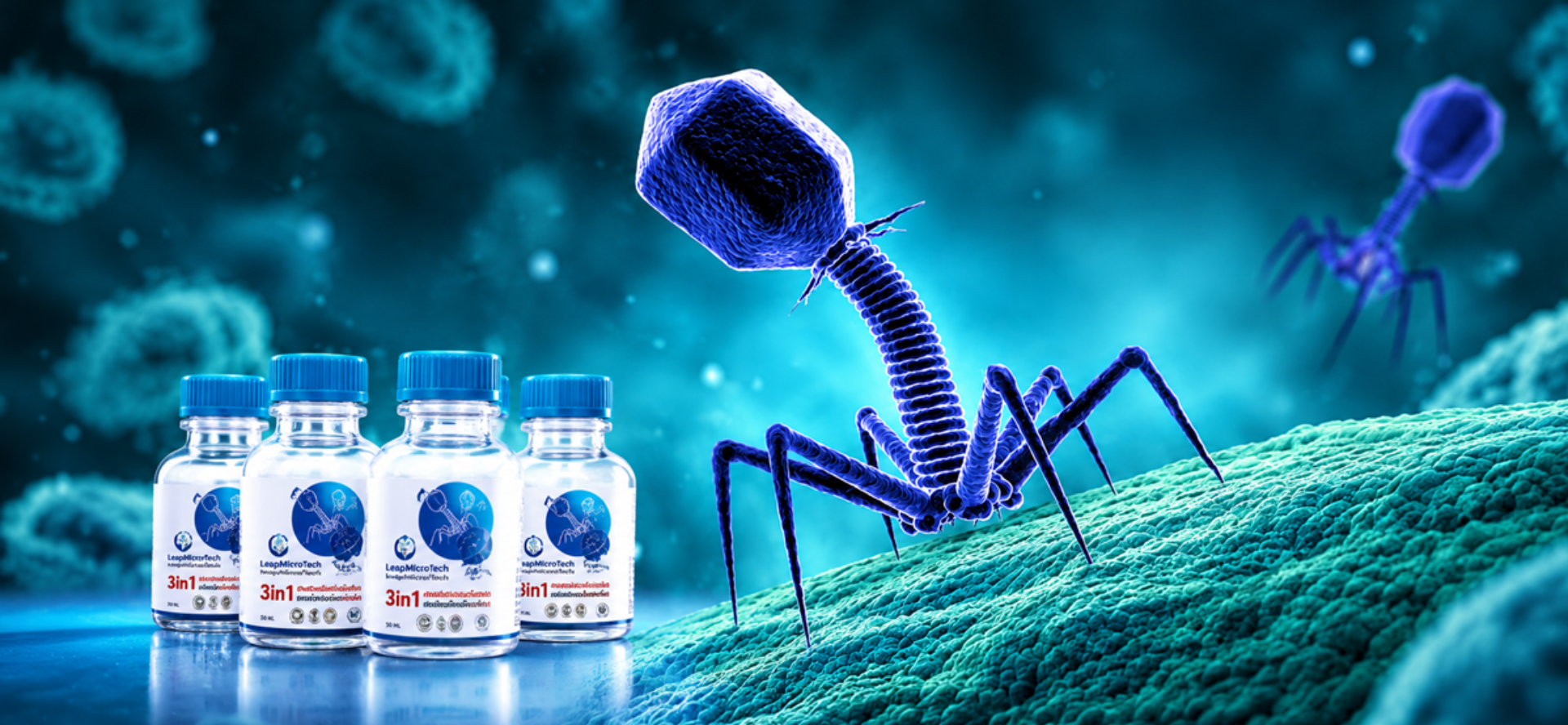
Currently, the research has advanced toward commercial development with the creation of LeapMicroTech’s “3in1 Jumbophage cocktail”, a phage-based biological solution designed for bacterial disease control in aquaculture.
“While this cocktail delivers a highly targeted approach for controlling bacterial outbreaks compared to conventional antibiotics, its broader value lies in its exquisite bacterial specificity. By selectively eliminating pathogens, it preserves beneficial microorganisms and provides a viable strategy to combat antibiotic-resistant strains,” Assoc. Prof. Vorrapon said.
Shrimp Mortality Control
One of the most dramatic field observations came from a commercial shrimp farm where shrimp disease known as Early Mortality Syndrome (EMS) had repeatedly threatened production. The team of researchers conducted a field comparison involving two neighboring ponds. One served as a comparison, while the other received phage-treated feed.
Around day 29 of the production cycle, a major die-off occurred in the untreated pond. According to the farm’s estimate, approximately 100,000 shrimp died in a single day. Samples showed evidence consistent with EMS.
The researchers then introduced their phage cocktail into the affected pond. Within a couple days, they observed no further shrimp deaths in the treated pond. Their analysis indicated that the bacteria associated with the disease had been eliminated following treatment.
Shrimp Mortality Control
The neighboring pond receiving phages as a feed supplement also experienced no shrimp mortality during the observation period described by the researchers. While such results require further controlled validation, they illustrate the potential of phage technology as a tool for managing bacterial disease in aquaculture.
The researchers concluded the outcomes of phage cocktail application on shrimp farms as follow:
· Reduced mortality caused by bacterial infections
· Potential replacement or reduction of antibiotic use
· Sustainable disease management for aquaculture
· Possibility of adapting the technology for other bacterial diseases in animals and humans
The Challenges Beyond the Science
Scientific discovery is only the beginning. For phage technology to become a widely used medical or agricultural product, researchers must also address regulation, intellectual property, manufacturing, quality control, farmer education and distribution.
Biggest challenge is human habits, Assoc. Prof. Vorrapon said and shared his concern that farmers who have relied on familiar products for years may naturally be cautious about a treatment based on viruses. Phages do not work like antibiotics, and their effects may need to be evaluated differently. That makes field demonstrations especially important. Real-world experience can help farmers understand not only what the technology does, but also how to use it effectively.
CAPSiD: Building a Library of Tiny Weapons
The researchers are thinking beyond individual phages such as Churi, Eric and Ariel.
Their longer-term vision includes the proposed CAPSiD Center, which would expand Thailand’s collection—or “library”—of phages available for research and development.
Assoc. Prof. Vorrapon highlighted the prospect of capsids researches, “Capsids are more than protective shells: their structures can potentially be adapted as nanoparticles, delivery systems, vaccine platforms and diagnostic tools.”
In creating CAPSiD Center, Assoc. Prof. Vorrapon hopes to bring together researchers, clinicians, veterinarians, industry partners, government agencies, and young scientists within one translational platform.
“My vision for CAPSiD – the Center for Applied Phage Science and Discovery is to create a national hub that bridges fundamental phage science with real-world applications. Thailand has strong biodiversity and significant potential for discovering novel bacteriophages, but discovery alone is not enough. We need an ecosystem that can move promising phages through characterization, formulation, validation, scale-up, regulatory approval, and ultimately commercialization.” - Assoc. Prof. Vorrapon Chaikeeratisak
In the long term, he hopes CAPSiD can help transform Thailand’s unique microbial biodiversity into high-value biological technologies and products. Instead of being only a source of biological resources, Thailand could become a developer and exporter of phage-based innovations, contributing to a sustainable bioeconomy and One Health solutions.
Each phage could potentially become a biological component of a future treatment. Beyond medicine, phages have tremendous potential in aquaculture, agriculture, food safety, and biotechnology. Therefore, the larger and more diverse the library, the more options researchers would have for developing cocktails against different bacterial targets. The idea is ambitious but straightforward: if bacteria continue to evolve, researchers need a diverse collection of biological tools that can evolve with them.
Beyond Shrimp
The same strategy could eventually be applied to other areas of agriculture.
Researchers have discovered numerous nucleus-forming jumbophages and are exploring their potential against bacterial diseases affecting livestock and poultry, including chickens and pigs.
These applications remain at earlier stages. Researchers must first identify suitable phages, develop cocktails and conduct laboratory testing before progressing to controlled trials in farming environments. This highlights a broader lesson: scientific discovery requires an ecosystem around it.
Researchers need access to bacterial strains, relationships with farmers, regulatory pathways, manufacturing capacity and practical knowledge of each industry. The Department of Fisheries provides an important bridge in aquaculture, and similar partnerships will be essential for expanding phage technology into other sectors.
The Future for Fighting Bacteria
The story of these phages stretches across very different worlds. It begins in soil beneath a fallen Chamchuri tree. It continues in laboratories studying microscopic viruses and drug-resistant bacteria. It reaches ocean samples collected near Songkhla and shrimp farms across southern Thailand. Along the way, it connects microbiologists, fisheries officials, farmers, clinicians and biotechnology researchers.
“Over the next 10 years, I expect research to move from describing these remarkable structures toward understanding their molecular mechanisms and eventually learning how to harness them. Their unusual biology may reveal new antimicrobial targets, enzymes, delivery systems, and biotechnology tools. Their ability to overcome some bacterial defense systems may also make them particularly interesting candidates for developing robust therapeutic phages.”
Assoc. Prof. Vorrapon believes that the next decade will be particularly exciting for nucleus-forming jumbophages. These phages have completely changed the perception of how sophisticated viruses can be. By constructing a nucleus-like compartment inside bacterial cells and organizing their own intracellular machinery, they reveal biological principles that we can only begin to understand.
For Thailand, the opportunity is especially significant. An enormous and still largely unexplored reservoir of jumbophages is provided by the country’s rich biodiversity. By integrating discovery, fundamental biology, engineering, translational research, and commercialization, these natural biological resources could be transformed into innovations for human health, livestock, aquaculture, agriculture, and food production.
“Ultimately, I hope Thailand can become not only a place where new jumbophages are discovered, but also a global center where their biology is understood and translated into technologies that contribute to health security, sustainable agriculture, and the bioeconomy.” Assoc. Prof. Vorrapon
Read more at: https://www.chula.ac.th/en/highlight/427670/