Sri Alem Br. Sembiring
Published on 24 August 2026




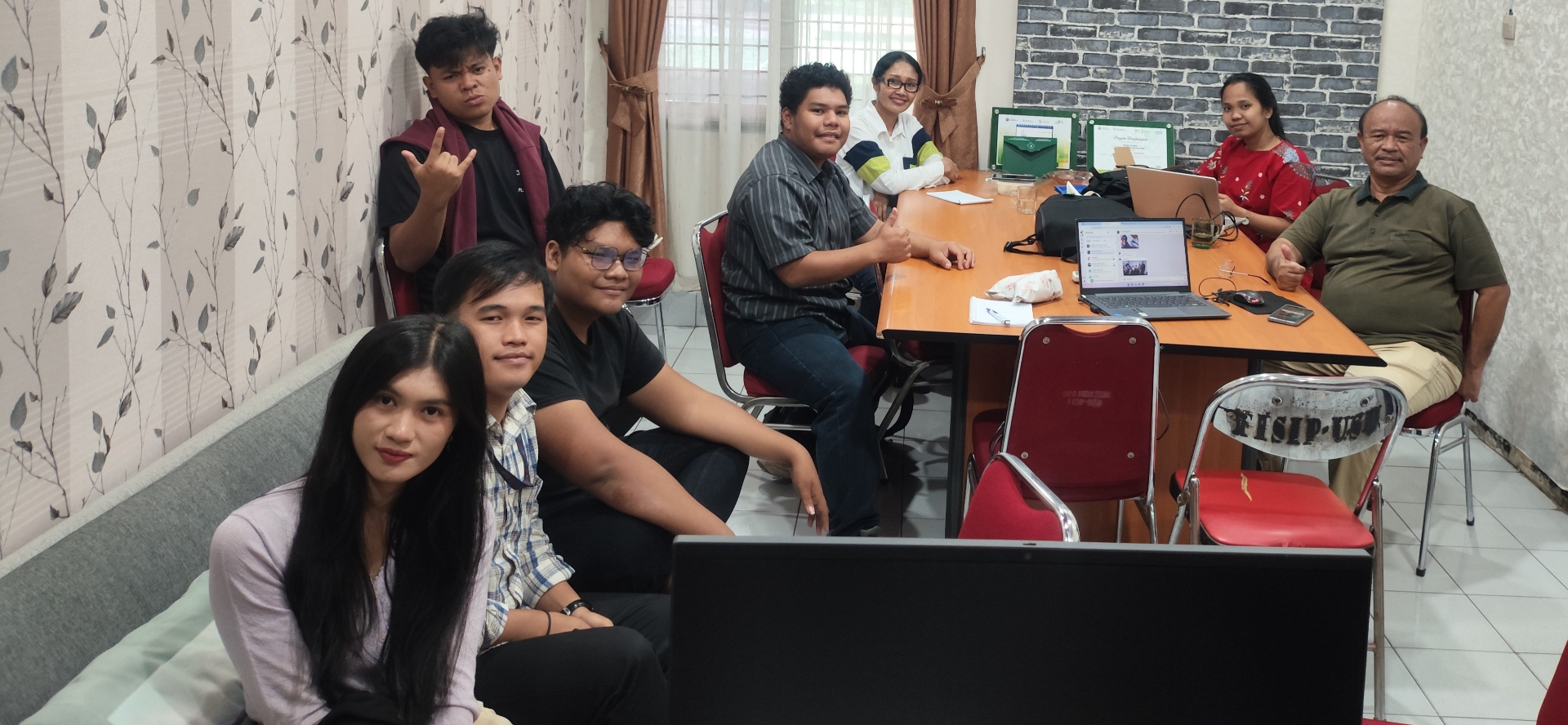
Eight srudents from the Faculty of Social and Political Sciences, Universitas Sumatera Utara (USU), with one field coordinator and two faculty supervisors, completed a 12-day social mapping fieldwork in North Tapanuli District, the first of two planned phases presenting findings on August 15, 2026, at the Department of Sociology, FISIP USU. The session, run with a private partner that requested anonymity, confronted a question fieldwork training rarely addresses: how a researcher's background shapes the data respondents share.
The discussion opened with a question from Dr. Muba Simanihuruk, M.Si (Department of Sociology): "What was your impression after finding that some respondents' expenditures were, on average, higher than their income?" Rather than treating this as an error, the supervisors used it to prompt reflection on the students' own positioning. Drawn from both sociology and anthropology, their backgrounds varied: one was from the same regency but a different subdistrict, others were ethnically Toba but not native to the villages studied, some of Nias descent, and several raised in Medan or Nias. Whether that mix shaped what respondents disclosed is itself one of the questions the second phase is designed to test.
As field assistants, students described building rapport quickly, navigating language barriers, and overcoming distrust, reframed not as biases to suppress but as reflexivity: a researcher's identity shapes what a respondent reveals, making it part of the data, not noise to filter out. This extended to fieldnote practice. Dr. Dra. Sri Alem Br. Sembiring, M.Si (Department of Social Anthropology) asked whether students had transcribed every exchange in full verbatim, or selectively recorded only what they deemed relevant. One said, "I only kept what was directly related to the topic; I deleted the jokes." Another student said, "I wrote down some of the jokes, but I decided for myself which ones were important." The split answers left an open question: how much of what was left unrecorded was a deliberate judgment, and how much simply disappeared. Responding directly to that gap, Dr. Sembiring said: "to anticipate that weakness, phase two will include further in-depth interviews, complete verbatim fieldnotes, and a Focus Group Discussion that emphasizes the seasonal calendar and livelihood cycle." Facilitated by the same students, the FGD will map livelihood sources and seasonal rhythms rather than ask directly why spending exceeds income, functioning, alongside the interviews, as triangulation for what phase one's data could not settle. This processes could capture comprehensive data reflecting economic life cycles of local communities.
Supervisors emphasized the issue as said this matters most for mixed methods design. Quantitative finding can flag an anomaly. Complete verbatim data explains them. Supervisors summed up the lessons as reflexive validity: researches awareness of potential bias in data acquisition, recognition of researcher presence shaping respondent and key informant articulation. Dr. Sembiring reaffirmed the discussion by citing Crane and Angrosino’s Field Projects in Anthropology: A Student Handbook (3rd-Edition, 1992), "an informant may end up telling the researcher only what seems expected, particularly when aslo serving as interpreter."
Related Tags: Indonesia, Universitas Sumatera Utara