





| Eric Schmidt, former CEO and Chairman of Google, co-founder of Schmidt Sciences, and leading architect in the era of Artificial Intelligence, will deliver the University of Arizona’s Commencement address on May 15. Few leaders have played a more defining role in shaping the future and advancing scientific frontiers through private investment, philanthropic giving, and private-public partnership. “Dr. Schmidt helped define the architecture of the internet and, under his leadership, guided Google to become one of the world’s most influential technology companies,” said University of Arizona President Suresh Garimella. “Today, through his investments in scientific discovery and emerging technologies, he continues to power research that shapes the future, including his partnership with our scholars to expand the frontiers of exploration. “For the Class of 2026 and their families, his career reflects what is possible when innovation is paired with purpose. It speaks directly to our commitment to success for every student and to preparing graduates not only to navigate a rapidly changing world, but to lead, discover and create opportunity within it. We are honored to welcome him to Arizona and look forward to the message he will share with our graduates.” Earlier this year, Schmidt Sciences announced the Eric and Wendy Schmidt Observatory System, one space and three ground-based observatories that aim to accelerate scientific discovery through innovative technology and open access to time and data. Schmidt Sciences is partnering with the U of A as a key collaborator on Lazuli – the world’s first fully privately funded space telescope. By combining the U of A’s leadership in precision exoplanet imaging with Schmidt Sciences’ emphasis on rapid innovation, this collaboration will help accelerate a new era of space exploration. “The University of Arizona embodies the curiosity, rigor, and bold imagination that will shape the next era of discovery – not just in science and technology, but in tackling the world’s greatest challenges,” said Schmidt. “The work being done here today will define what’s possible tomorrow. I am honored to address the Class of 2026 as they step into a pivotal moment in history, full of extraordinary opportunity and responsibility. Alongside founders Sergey Brin and Larry Page, Schmidt scaled Google globally to expand beyond search, going on to serve as chairman from 2011 to 2015 and later as executive chairman of Alphabet from 2015 to 2018. In 2021, he launched and now chairs the Special Competitive Studies Project, working to strengthen America’s long-term competitiveness in an AI-driven world, and regularly testifies in front of Congress to advise on matters of technology, energy, and national security. In 2024, Schmidt was awarded an honorary KBE by King Charles III for services to philanthropy. He is currently chair and CEO of Relativity Space, author of four New York Times best-selling books, and co-founder with his wife Wendy of several philanthropic organizations working to make the world healthy, resilient and secure for all. The couple founded the Schmidt Family Foundation, Schmidt Ocean Institute, and most recently, Schmidt Sciences. Schmidt will receive an honorary Doctor of Science from the U of A College of Science. He is one of five honorary degree recipients. Honorary degree recipients Alice Chaiten Baker will receive an honorary Doctor of Humane Letters from the College of Social and Behavioral Sciences. Baker has helped advance the arts and social sciences at the University of Arizona and in Tucson through years of philanthropy, community leadership and advocacy for education. Baker’s contributions have helped support the Arizona Center for Judaic Studies with the aim to help it become the state’s preeminent center for the study of Jewish life and history. Alice, alongside her husband Paul, has also supported endowments and visiting professorships that have expanded the college’s teaching and research capacity. Baker was raised in Tucson and graduated from the university, becoming the first of three generations of Wildcats. Gabrielle Giffords will be awarded an honorary Doctor of Letters from the College of Architecture, Planning and Landscape Architecture. A native Tucsonan, Giffords began her political career in 2001 when she won a seat in Arizona State House of Representatives and later served in the Arizona Senate. In 2006, she was elected to represent Arizona’s 8th Congressional District in Washington, D.C. On Jan. 8, 2011, a gunman opened fire at a “Congress on Your Corner” event Giffords was holding in Tucson; the attack killed six people and critically wounded Giffords. She stepped down shortly thereafter to focus on her recovery, but she later returned to public life as an advocate for gun violence prevention. Giffords co-founded Americans for Responsible Solutions, an advocacy and research organization later renamed GIFFORDS. F. Ronald Rayner will receive an honorary Doctor of Science from the College of Agriculture, Life and Environmental Sciences. A fourth-generation Arizona farmer and a first-generation college graduate, Rayner graduated with high distinction from the college in 1964 with a Bachelor of Science in agricultural education. Rayner, a former president and chairman of the National Cotton Council of America, is an innovator in arid-land agriculture, helping develop no-till and minimum-tillage systems designed to conserve water. Rayner has long advocated for student success at the U of A. His business, A Tumbling T Ranches, has become a de facto extension and research satellite for the college, sharing water-use data and expertise with students and researchers. Rayner also has provided funding support to Cooperative Extension, the Arizona Experiment Station, and renovations to the college’s main building. Scott Stuber will receive an honorary Doctor of Fine Arts from the College of Fine Arts. A proud alumnus of the college, Stuber has spent decades redefining how films are created, distributed and experienced. He is currently in a multi-year partnership with Amazon MGM Studios to relaunch the historic United Artists and to finance and release movies from his new production company. From 2017 to 2024, Stuber served as chairman of Netflix Films, guiding the company’s transformation into a global production and distribution leader. Under his guidance, Netflix released critically acclaimed titles like Alfonso Cuarón’s Academy Award–winning “Roma,” Martin Scorsese’s “The Irishman,” and Jane Campion’s “The Power of the Dog.” Stuber received the College of Fine Arts Professional Achievement Award in 2010 for his rising influence. Alumni Achievement Award recipient Cisco Aguilar will receive the university’s Alumni Achievement Award. Aguilar serves as Nevada’s Secretary of State, focusing on modernizing, innovating and building transparency in the office. Aguilar graduated from the University of Arizona in 2000 with a bachelor’s degree in business administration; 2004 with a master’s in business administration; and 2004 with a Juris Doctor. Under Aguilar’s leadership and vision as Secretary of State, the office took on two major technology projects to modernize the state’s elections and business filings. Thanks to dedicated efforts to expand access to the ballot box, tribal voting turnout increased by 34% during the 2024 election. Prior to being elected, Aguilar served 12 years as general counsel for Agassi Graf, the management company for Andre Agassi and Steffi Graf, and the Andre Agassi Foundation for Education. In 2020, Aguilar launched Blueprint Sports, a sports technology startup, facilitating over $140 million in name, image, and likeness earnings for over 25,000 NCAA student-athletes since 2021. |
Tag: University of Arizona
U of A professors Elaine Romero, Erika Hamden named 2026 Guggenheim Fellows

A pair of University of Arizona professors joined more than 200 people named Guggenheim Fellows by the John Simon Guggenheim Memorial Foundation on Tuesday. The annual grant supports artists and scientists as they pursue new projects and scholarship.
Elaine Romero, award-winning writer of 120 plays and a professor in the University of Arizona School of Theatre, Film and Television, and Erika Hamden, director of the Arizona Space Institute and associate professor of astrophysics, were both named 2026 fellows.
A passion for plays
Romero called the award a “life-changing opportunity” that she will use to support the development of her latest play, “Diablos Aquí.”
“What I love most about this fellowship is that it is equally valued among both artists and scholars,” Romero said. “I feel so excited, not only for myself but for the University of Arizona, the College of Fine Arts and the School of Theatre, Film & Television. From my weird corner of the world, I am able to have an influence on my institution and how we are seen in the world. That is a gift. I love the U of A, our students and our faculty, and I am proud of who we are.”
After applying for the fellowship several times over the years, Romero decided on a different strategy when filling out her paperwork last summer. She wrote the words “Guggenheim Winner” on a sticky note and placed it on the altar outside her home office. Passing the small reminder each day, the slip of paper helped center her intentions and focus on her goal.
Whether it was the note, the altar or her renewed sense of purpose, Romero’s dedication paid off when the foundation contacted her earlier this year with the good news.
“This is an extraordinary moment for Elaine and for the College of Fine Arts,” said Hasan Elahi, dean of the College of Fine Arts. “Her work exemplifies the power of imagination and storytelling to transform how we understand the world. Achievements like this are rare, and we are thrilled to celebrate the contributions she continues to make to the arts.”
Romero’s upcoming play borrows its name from William Shakespeare’s “The Tempest”: “Hell is empty and all the devils are here.” The story will be told through the eyes of two characters: a father and daughter born on either side of the U.S.-Mexico border who must deal with the consequences of their political reality.
Romero said the story will also further her exploration of “vertical time,” a technique that allows the past, present and future to intertwine in unexpected ways and guide audiences through moral questions and life lessons.
“We never know where we are in the timeline of history, but as a writer I’m sitting right in the middle of it,” Romero said. “As a playwright, I am sorting through my predictions and looking at the past, present and future – all in one play. I am asking: who are we as a country? Who were we, and who do we want to be?”Mentors, memory and craft
Now a Guggenheim Fellow, Romero’s love of the written word began before she set foot in a classroom. She traces her creative roots to her family, particularly her grandmother, who guided her through the alphabet with drawings of letters in the shapes of people. Her mother taught her to write even as she was still learning to form letters. Before long, the young girl was compiling some of her earliest stories.
That passion took Romero from her native California to Japan, where she studied at Kanto Gakuin University while earning a bachelor’s degree in creative writing from Linfield University and a master’s degree in dramatic art from the University of California, Davis.
A young writer with a lot to say, but lacking somewhat in confidence, Romero recalls feeling like her early work was never good enough to publish. She often refused to submit or made changes that were ultimately detrimental to her work.
Romero credits her shift in confidence and perspective to María Irene Fornés, a playwright, director and teacher who spent much of her career at New York University.
“She would often tell us to lend our plays our preoccupations, and I believe that’s what I’ve done over the years,” Romero said. “She and my other mentors – including people who weren’t playwrights – helped me find my voice. I learned not to try sounding like other writers, and that’s something I believe as a professor.”
After college, Romero found herself in Tucson in the early ’90s, the first step in a career that took her around the world before returning to the U of A in 2014. Now a professor of playwriting and dramaturgy within the Lived and Screened Performance program, Romero treasures the opportunity to help shape and guide the next generation of prolific writers.
Romero most recently closed out the New Directions Festival, an annual event that allows advanced dramaturgy students to develop, cast and perform their own short performances on a professional stage. Hosted at the Tornabene Theatre on the U of A campus, the festival featured nine performances by up-and-coming playwrights.
“What inspires me now are my students,” Romero said “The timelines they were born into, the country they’ve experienced, and the things they know that I don’t. I approach my work with a beginner’s mind, humility and curiosity. Each play has its own shape, its own language, and playwriting is the form I’m in love with. I haven’t uncovered everything it has to offer yet, and my voice hasn’t said everything that needs to be said. So, as long as that’s true, I’ll keep writing.”A journey through space and light
Hamden, who also serves on the State of Arizona Space Commission, investigates how stars and galaxies formed from primordial hydrogen by developing and creating space technology with a focus on detectors and telescopes. She is the principal investigator of the Eos Mission and deputy principal investigator of the Aspera Mission – both NASA astrophysics missions that will include space telescopes designed to observe distant stars and galaxies from low-Earth orbit.
Hamden will use the fellowship to continue her pursuit of finding better and more precise ways of sensing light “in order to measure every atom that exists.”
“Being named a Guggenheim Fellow feels pretty incredible,” she said. “The detector development we do in my lab is important for future astronomical observations, and it’s extremely cool to receive this kind of support. The full range of work the other fellow do is so comprehensive and world-spanning and can change people’s lives.”
Hamden’s pursuit begins with the hydrogen atom and is currently working with a silicone-based sensor called a Skipper CCD that she believes will revolutionize astronomy based on its ability to distinguish between individual photons as they arrive at the detector.
Hamden’s own academic journey at Harvard College, where she studied astronomy and astrophysics, before eventually earning a Ph.D. in astronomy from Columbia University and completing postdoctoral work at the California Institute of Technology.
She is also the author of the science book, “Weird Universe,” and hosts the television show “New Frontiers” on PBS.
“I could not be doing this work without the support of the university, the Steward Observatory and the Office of Research and partnerships,” Hamden said. “My lab setup exists because of funding from the university, and their support for my time has been instrumental.”
U of A named a top producer of Gilman Scholars
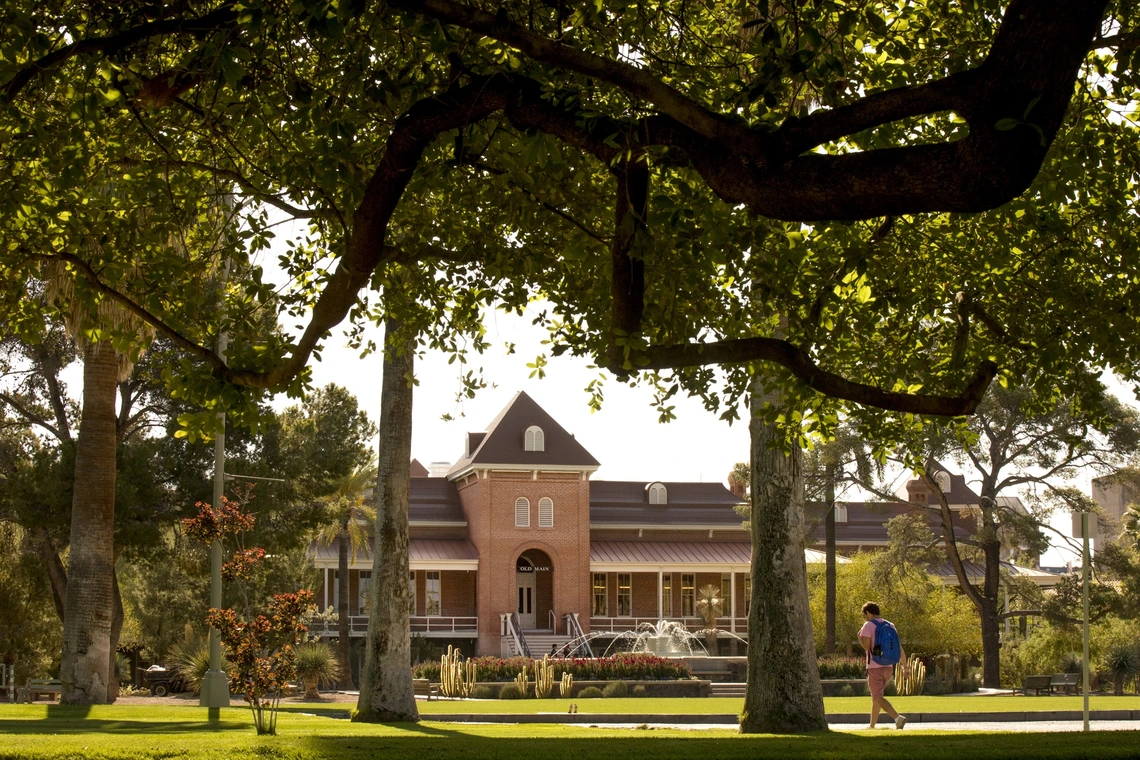
The University of Arizona was recognized on Thursday by the Benjamin A. Gilman International Scholarship Program, which named the U of A as one of the top producers of Gilman Scholars in the nation. The university ranked No. 4 among institutions with more than 15,000 students.
Administered by the U.S. Department of State and hosted by the Bureau of Cultural and Educational Affairs, the Gilman Program offers need‑based scholarships to undergraduate students with limited financial means in order to study or intern abroad for college credit while gaining valuable international experience, language and critical thinking skills. The program is named after the late New York Congressman, Benjamin A. Gilman, and has been administered by The Institute of International Education since its inception in 2001.
Every year, nearly 3,000 students across the country are awarded Gilman scholarships of up to $5,000, which defrays the cost of tuition, room and board, international airfare and other expenses. Students must be receiving a Federal Pell Grant to be eligible for the program
Gilman Scholars at the U of A are supported by Study Abroad within Arizona International. Study abroad programs at the university include a wide range of formats, from short-term, faculty-led courses to semester and yearlong programs in more than 30 countries.
“Being named one of the nation’s top producers of Gilman Scholars is a testament to the hard work we do every day to provide access to our students, and it’s amazing to see that work recognized at a national level,” said Harmony DeFazio, executive director of Study Abroad. “At its core, this office is a tool that supports student success at the University of Arizona, and this scholarship is an important part of that work.”
The U of A was recognized for its contribution to the program over the last 25 years, over which time more than 600 Wildcats have earned more than $2.3 million in scholarships – with an average award amount of $3,700 per student. Study Abroad has also demonstrated consistent success in helping students secure Gilman funding: The university’s award rate averages 30%, compared to the 20% national average.
Peer-driven student success
Supporting students through their Gilman journey often begins with peer advisors like Alyssa Ortega, a senior studying information science in the College of Information Science. Last summer, Ortega traveled to Seoul, South Korea as a Gilman Scholar to study at UA Seoul, a partnership with Hanyang University. While there, she advanced her academic goals while immersing herself in Korean culture and daily life.
Back in Southern Arizona, Ortega now helps her fellow Wildcats through their application process. Alongside her fellow advisors, Ortega hosts open office hours to help students begin their application and sift through the finer details of essays and personal statements.
“Students are often worried about the costs of studying abroad and applying for a nationally competitive scholarship, and what I’ve found to be most helpful is actually sitting down and walking them through the process,” she said. “I can guide them through the various scholarship websites and provide one-on-one feedback on their application and essays. I make sure they know I can always lend a hand if they need it.”
According to Dafne Johnson, program director of Study Abroad scholarships, students like Ortega play a crucial role in the university’s recognition from the Gilman Program.
Johnson’s primary goal is to help Wildcats reach their full potential by experiencing other cultures and sharing a piece of Southern Arizona while they study abroad. She called the Gilman Scholarship “a key tool” in accomplishing that work because the program supports students in realizing their dreams without worrying about financial constraints.
“Gilman is one of the first scholarships we tell our students about because it supports those who couldn’t otherwise afford the experience,” Johnson said. “I think the Gilman program presents a wonderful opportunity for students because it’s a nationally competitive scholarship that shows students what they want to accomplish is possible.”
In addition to the Gilman Scholarship, Johnson and her staff assist students applying to the Garcia Family Foundation Scholarship for Study Abroad, established last September to expand access to credit-bearing U of A Study Abroad programs for students with financial need.
International education and collaboration at the U of A was previously recognized by the Fulbright Program, which in February named the university one of the nation’s top producers of Fulbright Scholars. The university also earned the Senator Paul Simon Award for Campus Internationalization from NAFSA: Association of International Educators for implementing innovative strategies and partnerships fostering global learning opportunities.