


QS Editorial
Published on 15 April 2026




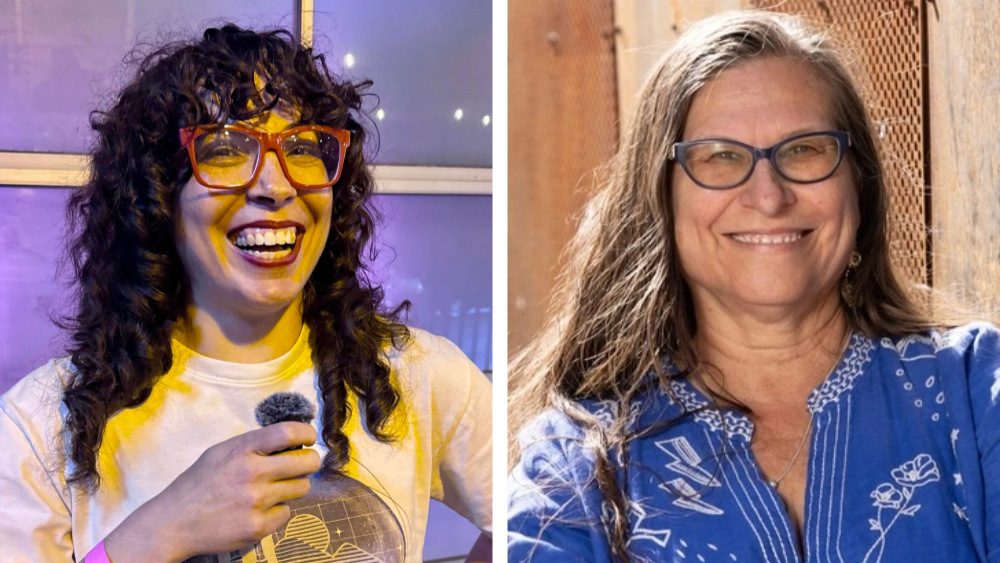
A pair of University of Arizona professors joined more than 200 people named Guggenheim Fellows by the John Simon Guggenheim Memorial Foundation on Tuesday. The annual grant supports artists and scientists as they pursue new projects and scholarship.
Elaine Romero, award-winning writer of 120 plays and a professor in the University of Arizona School of Theatre, Film and Television, and Erika Hamden, director of the Arizona Space Institute and associate professor of astrophysics, were both named 2026 fellows.
A passion for plays
Romero called the award a "life-changing opportunity" that she will use to support the development of her latest play, "Diablos Aquí."
"What I love most about this fellowship is that it is equally valued among both artists and scholars," Romero said. "I feel so excited, not only for myself but for the University of Arizona, the College of Fine Arts and the School of Theatre, Film & Television. From my weird corner of the world, I am able to have an influence on my institution and how we are seen in the world. That is a gift. I love the U of A, our students and our faculty, and I am proud of who we are."
After applying for the fellowship several times over the years, Romero decided on a different strategy when filling out her paperwork last summer. She wrote the words "Guggenheim Winner" on a sticky note and placed it on the altar outside her home office. Passing the small reminder each day, the slip of paper helped center her intentions and focus on her goal.
Whether it was the note, the altar or her renewed sense of purpose, Romero's dedication paid off when the foundation contacted her earlier this year with the good news.
"This is an extraordinary moment for Elaine and for the College of Fine Arts," said Hasan Elahi, dean of the College of Fine Arts. "Her work exemplifies the power of imagination and storytelling to transform how we understand the world. Achievements like this are rare, and we are thrilled to celebrate the contributions she continues to make to the arts."
Romero's upcoming play borrows its name from William Shakespeare's "The Tempest": "Hell is empty and all the devils are here." The story will be told through the eyes of two characters: a father and daughter born on either side of the U.S.-Mexico border who must deal with the consequences of their political reality.
Romero said the story will also further her exploration of "vertical time," a technique that allows the past, present and future to intertwine in unexpected ways and guide audiences through moral questions and life lessons.
"We never know where we are in the timeline of history, but as a writer I'm sitting right in the middle of it," Romero said. "As a playwright, I am sorting through my predictions and looking at the past, present and future – all in one play. I am asking: who are we as a country? Who were we, and who do we want to be?"Mentors, memory and craft
Now a Guggenheim Fellow, Romero's love of the written word began before she set foot in a classroom. She traces her creative roots to her family, particularly her grandmother, who guided her through the alphabet with drawings of letters in the shapes of people. Her mother taught her to write even as she was still learning to form letters. Before long, the young girl was compiling some of her earliest stories.
That passion took Romero from her native California to Japan, where she studied at Kanto Gakuin University while earning a bachelor's degree in creative writing from Linfield University and a master's degree in dramatic art from the University of California, Davis.
A young writer with a lot to say, but lacking somewhat in confidence, Romero recalls feeling like her early work was never good enough to publish. She often refused to submit or made changes that were ultimately detrimental to her work.
Romero credits her shift in confidence and perspective to María Irene Fornés, a playwright, director and teacher who spent much of her career at New York University.
"She would often tell us to lend our plays our preoccupations, and I believe that's what I've done over the years," Romero said. "She and my other mentors – including people who weren't playwrights – helped me find my voice. I learned not to try sounding like other writers, and that's something I believe as a professor."
After college, Romero found herself in Tucson in the early '90s, the first step in a career that took her around the world before returning to the U of A in 2014. Now a professor of playwriting and dramaturgy within the Lived and Screened Performance program, Romero treasures the opportunity to help shape and guide the next generation of prolific writers.
Romero most recently closed out the New Directions Festival, an annual event that allows advanced dramaturgy students to develop, cast and perform their own short performances on a professional stage. Hosted at the Tornabene Theatre on the U of A campus, the festival featured nine performances by up-and-coming playwrights.
"What inspires me now are my students," Romero said "The timelines they were born into, the country they've experienced, and the things they know that I don't. I approach my work with a beginner's mind, humility and curiosity. Each play has its own shape, its own language, and playwriting is the form I'm in love with. I haven't uncovered everything it has to offer yet, and my voice hasn't said everything that needs to be said. So, as long as that's true, I'll keep writing."A journey through space and light
Hamden, who also serves on the State of Arizona Space Commission, investigates how stars and galaxies formed from primordial hydrogen by developing and creating space technology with a focus on detectors and telescopes. She is the principal investigator of the Eos Mission and deputy principal investigator of the Aspera Mission – both NASA astrophysics missions that will include space telescopes designed to observe distant stars and galaxies from low-Earth orbit.
Hamden will use the fellowship to continue her pursuit of finding better and more precise ways of sensing light "in order to measure every atom that exists."
"Being named a Guggenheim Fellow feels pretty incredible," she said. "The detector development we do in my lab is important for future astronomical observations, and it's extremely cool to receive this kind of support. The full range of work the other fellow do is so comprehensive and world-spanning and can change people's lives."
Hamden's pursuit begins with the hydrogen atom and is currently working with a silicone-based sensor called a Skipper CCD that she believes will revolutionize astronomy based on its ability to distinguish between individual photons as they arrive at the detector.
Hamden's own academic journey at Harvard College, where she studied astronomy and astrophysics, before eventually earning a Ph.D. in astronomy from Columbia University and completing postdoctoral work at the California Institute of Technology.
She is also the author of the science book, "Weird Universe," and hosts the television show "New Frontiers" on PBS.
"I could not be doing this work without the support of the university, the Steward Observatory and the Office of Research and partnerships," Hamden said. "My lab setup exists because of funding from the university, and their support for my time has been instrumental."

