Berkeley partnership provides Chula students opportunity to innovate with Silicon Valley giants

A newly signed partnership between the Chulalongkorn School of Integrated Innovation (ScII) and the Sutardja Center for Entrepreneurship and Technology (SCET) of the University of California Berkeley will furnish opportunities for Asian students to initiate start-up projects to innovate alongside Silicon Valley giants.

This partnership brings ScII students and faculty face-to-face with the Silicon Valley innovation ecosystem. In addition, they will participate in the Berkeley Method of Entrepreneurship Bootcamp, Silicon Valley Innovation Leadership Program, and Engineering Leadership Global Hybrid Program.

Furthermore, the partnership facilitates the transfer of knowledge related to SCET teaching methodologies, such as Innovation Engineering and the Berkeley Method of Entrepreneurship (BMoE).

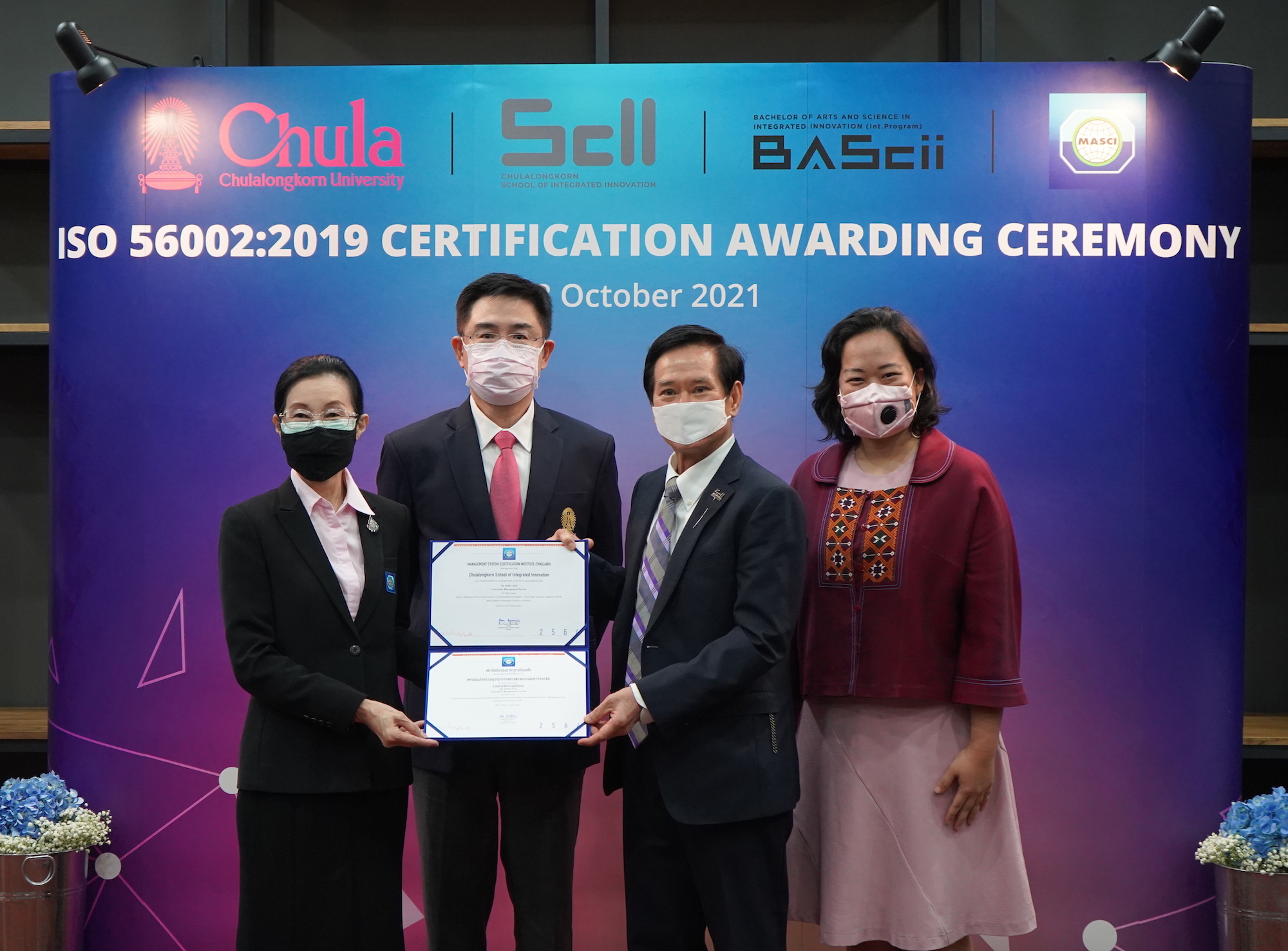
Signing the agreement on September 2, 2021, ScII Executive Director Professor Worsak Kanok Nukulchai invited SCET faculty members to offer online courses for ScII students as a customized course or to allow our students to take their courses online with credits transfer, which could lead to the development of an international online platform for all SCET’s international partners.

We are pursuing a long-term partnership because ScII and Sutardja Center for Entrepreneurship and Technology share the same vision, Prof. Worsak noted.

“We have the same passion and are two vital forces contributing to the sustainable future of humanity.”

Worsak also noted that both SCET and ScII are founding members of the League of Global Entrepreneurship Programs alongside MIT Legatum, Stanford University, Harvard University, Cambridge University, Mexico’s Tecnológico de Monterrey, and several other higher education institutions.

“It is my pleasure to be part of this project, and I look forward to many new things we will develop together in addition to benefiting from this experience,” said Dr. Ilkhlaq Sidhu, Director of SCET at UC Berkeley.

Since its inception, SCET has sought to broaden engineering by encouraging a greater understanding of whether a problem is worth solving, what to do after solving the problem, and how to elevate, lead, and connect engineering with other disciplines.

“At SCET, students participate in a topic while it is still new and growing,” Dr. Sidhu noted as he welcomed the partnership with ScII.

Chulalongkorn University Vice President for Strategic Planning, Innovation and Global Engagement Associate Professor Natcha Thawesaengskulthai noted that SCET’s approach to education and building global innovation and entrepreneurship aligns with SCI’s core disciplines and specializations.

“This integrated critical approach to technology and entrepreneurial innovation jointly pursued by SCET and ScII should serve as a polestar for future endeavours,” she added.

Susan L. Giesecke, Director of Global Engagement at SCET, welcomed the SCET-SCII partnership, stating that Chulalongkorn University is a highly regarded institution and that SCET’s agreement with ScII portends to an excellent partnership.

She added that students at ScII will have an opportunity to interact and engage with Silicon Valley innovators and UC Berkeley alumni.

The Sutardja Center for Entrepreneurship & Technology is the premier institution on the UC Berkeley campus for studying and practising “technology-centric” entrepreneurship and innovation.

Since 2005, SCET has created the foundation of Berkeley’s entrepreneurship ecosystem, including SkyDeck, the Fung Institute, the Engineering Leadership Professional Program, Global Venture Lab, and an extensive ecosystem of Silicon Valley and Global partners.

SCET’s mission has been to equip engineers and scientists with the skills to innovate, productize, and commercialize the technology in the global economy. Initially established as CET, it acquired a new name after receiving support from the Sutardja family, the force behind the Marvell Technology Group.

ScII is the newest school at Thailand’s oldest and most prestigious university, Chulalongkorn University. The university currently offers a bachelor’s degree program called the Bachelor of Arts in Science in Integrated Innovation (BASCii).

CICM partners with Central Lab to boost agricultural research and development

The Chulabhorn International College of Medicine, Thammasat University (CICM) led by Professor Dr Adis Tasanarong, Dean of the Chulabhorn International College of Medicine, signed a memorandum of cooperation with Central Lab (Thailand) Co Ltd. and was honoured by Mr Chakrit Tiebtienrat, Managing Director, Central Lab (Thailand) Co Ltd on 11 June 2021 at Rangsit Center, Thammasat University.

This cooperation is aimed at improving the capacity of laboratory research analysis and testing and evaluations to improve agricultural product standards along with developing joint publishing and patents in the area of agricultural analysis research and development including training of personnel and students for research and development in the area of education.

Prof. Dr Adis Tasanarong, Dean of the Chulabhorn International College of Medicine, Thammasat University, stated this cooperation will promote activities in missions related to the process of improving analysis and testing of both parties for consistency with the country’s needs and preparations to expand overseas markets in the future, particularly in the area of new value-generating economic crops such as hemp and marijuana, which must be cultivated and harvested to meet criteria and standards of good agricultural practices (GAP: Propagation and Cultivation) and acquire good raw materials without contaminants at sufficient amounts.

Mr Chakrit Tiebtienrat, Managing Director, Central Lab (Thailand) Co., Ltd., stated that Central Lab Thai is a laboratory with capacity for analysis and testing and the global. He believes cooperation between Central Lab Thai and the Chulabhorn International College of Medicine and the joining of forces will improve Thailand’s capacity for broader development in the area of analysis and testing to support research, analysis, testing and services to meet international standards in compliance with government policies.

Furthermore, integration of analysis and testing cooperation will increase confidence in the analysis and test results along with making analysis and test methods consistent with laboratory principles and standards, which can help in building analysis and testing networks for coverage until the country’s economy and knowledge base can be driven and built in the future.

Chula students win prizes at national and international food innovation contests

Three student teams from the Department of Food Technology, Faculty of Science, won prizes from the national and international food innovation concept contests.

Competing against students from 54 universities, flying in from 13 countries, several of Chulalongkorn University’s finest were awarded a prize in the ASEAN Innovation Challenge – ProVeg International 2021, the international plant-based food innovation concept contest held during January – June 2021.

Chula’s team of graduate students, Mr. Nuti Hutasingh (Ph.D. student), Miss Varanya Techasukthavorn (Ph.D. student), and Mr. Natchanon Srangsomjit (M.S. student), won the first prize for their product, “Marble Booster: 100% plant-based ready-to-eat meal of marbled meat slices fortified with natural immune boosters from curcumin and black pepper”.  The team was coached by CPF (Thailand) PCL.

Moreover, a team of 3rd-year undergraduate students, coached by Nestlé, including Miss Tornton Chainithikan, Miss Paweekorn Wongrattanapiboon, Miss Pattamaporn Kuprasert and Miss Pichamon Pecharanond, won special prize for their creation, “Zainty: non-dairy avocado and coconut milk-based ice cream in parfait style”.

At the national level, another team of students from Chula ranked 5th in the FoSTAT Food Innovation Concept Contest 2021, held during January – June 2021.  Under the theme “Smart Food for the New Normal”, a group of Chula 3rd year undergraduate students, Mr. Saksorn Techasutjalidsuntorn, Miss Tornton Chainithikan, Miss Paweekorn Wongrattanapiboon, Miss Pattamaporn Kuprasert, Miss Pichamon Pecharanond and Miss Issariya Thunyateerepong, came in 5th place among all the participating teams from Bangkok.

The team’s proposal for the contest was “Tep Tep: tempeh pudding with coconut crumble”.  All three student teams were supervised by Assoc. Prof. Kanitha Tananuwong and Asst. Prof. Varapha Kongpensook.

Thammasat University signs Memorandum of Academic Cooperation with HK Management & Service

The Faculty of Engineering, Thammasat University (TSE), represented by Associate Professor Dr. Tira Jiasiripongkul, Dean of the Faculty of Engineering, and Associate Professor Dr. Plaiwan Suttanon, Dean of the Faculty of Allied Health Sciences, have signed a memorandum of academic cooperation with HK Management & Service Co., Ltd. represented by Miss Hemnarat Kitiyanan, the Managing Director.

The memorandum of cooperation was prepared with the objective of promoting cooperation in testing a UVC sterilizer called “Smart Handy” manufactured by HK Management & Service Co., Ltd. Assistant Professor Dr Pratchaya Prempranirat from the TSE Department of Mechanical Engineering calibrated the Smart Handy machine to sterilize effectively.

In addition, with cooperation from Associate Professor Dr Worada Samosornsuk from the Faculty of Allied Health Sciences who tested sterilization efficiency. This machine can be used to prevent and ease COVID-19 infections.  Furthermore, future sterilizers can be developed based on this device.

Thammasat University signs MOU with Beihai Asia International Arbitration Centre

Beihai Asia International Arbitration Centre( BAIAC) and the Faculty of Law, Thammasat University (TU Law), Bangkok, have entered into a cooperation Memorandum of Understanding (MoU) on 1 May 2021.

Faculty of Law, Thammasat University is the oldest law school in Thailand and is highly regarded for producing the country’s eminent leaders and figures since its inception in 1934. Beihai Asia International Arbitration Centre (BAIAC) is a Singapore based arbitration centre established by the Beihai Arbitration Commission focusing on international commercial disputes arising from ASEAN, China and the BRI countries.

With the signing of the MoU, the parties hope to develop mutually beneficial cooperation in the area of arbitration training, education and research involving the ASEAN region with a focus on Thailand, Singapore, and Guangxi. In addition, the parties would also be working on a pilot program to train faculty members of TU Law as international arbitrators and experts.

Innovation in Cancer Prevention: Bio-robots transporting cordyceps extract

Researchers from Chulalongkorn University celebrate the success of Active Targeting, a revolutionary innovation in the medical industry using bio–robots to deliver targeted cordyceps extract to halt cancer with reduced side effects.

Dr. Teerapong Yata, Lecturer of the Biochemistry Unit, Department of Physiology, Faculty of Veterinary Science, and Dr.  Waranyu Pooncharoen, Department of Pharmacognosy and Pharmaceutical Botany, Faculty of Pharmaceutical Sciences, Chulalongkorn University have collaborated with the National Nanotechnology Center (NANOTEC) to conduct a research to address this question through a delivery system aided by bio-robots to carry the “Cordycepin” to targeted cancer cells more precisely.

Dr. Teerapong explained that taking cordyceps or cordyceps extracts, as they are sold and consumed today, may have benefits in terms of general health maintenance, but almost no effect in terms of inhibiting cancer cells.

“We have to extract the substance. “Cordycepin” and see how it can be brought to the cancerous tissue in the body, as the intestine can absorb very little of it.  Therefore, NANOTEC has developed bio-robots called the “Nanoparticle Delivery System” to distribute the extract to the targeted location where we want the extract to be active.”

The nanotechnology delivery system is one answer to the cancer treatment problem. By bringing the active substance to its target and helping the body absorb Cordycepin better, the delivery system also reduces the chance of drug residue and toxicity in the body.

“There is no definite conclusion which substance in cordyceps causes side effects or is toxic to the body, such as stomach, liver, kidneys, so if we have a conductor to encapsulate only important substances and target the delivery to destroy only the cancer cells, it will help reduce the side effects, especially the toxic effects on the liver.”

Dr. Teerapong explained further that the “controlled release” of the nanoparticles can reduce potential toxicity affecting the liver or kidney.

The research on “bio-robots” does not stop here. According to Dr. Teerapong, “currently, the process of “active targeting” is being studied.  It is the use of targeted molecules to deliver important substances to the desired organs as precisely as possible. This is because this innovative robot of the future is not created to cure cancer alone, but can also serve to encapsulate substance and deliver it to the area that needs treatment.”

Recently, researchers have started to use bio-robots to transport important substances, both medicines, and vaccines.  Different types of substances need different designs which should be done under the guidance of the doctors.  Moreover, at present, bio-robots are being used to treat animals as well, Dr. Teerapong concluded.

Thammasat University students compete in John Molson Undergraduate case competition

Thammasat Business School was invited to be a part of John Molson Undergraduate case competition  2021 along with other 28 undergraduate business schools from over the world.

John Molson Undergraduate case competition is the largest international undergraduate case competition organized by the John Molson School of Business at Concordia University. The competition is a weeklong event and consists of multiple levels of challenges in both short and long cases.

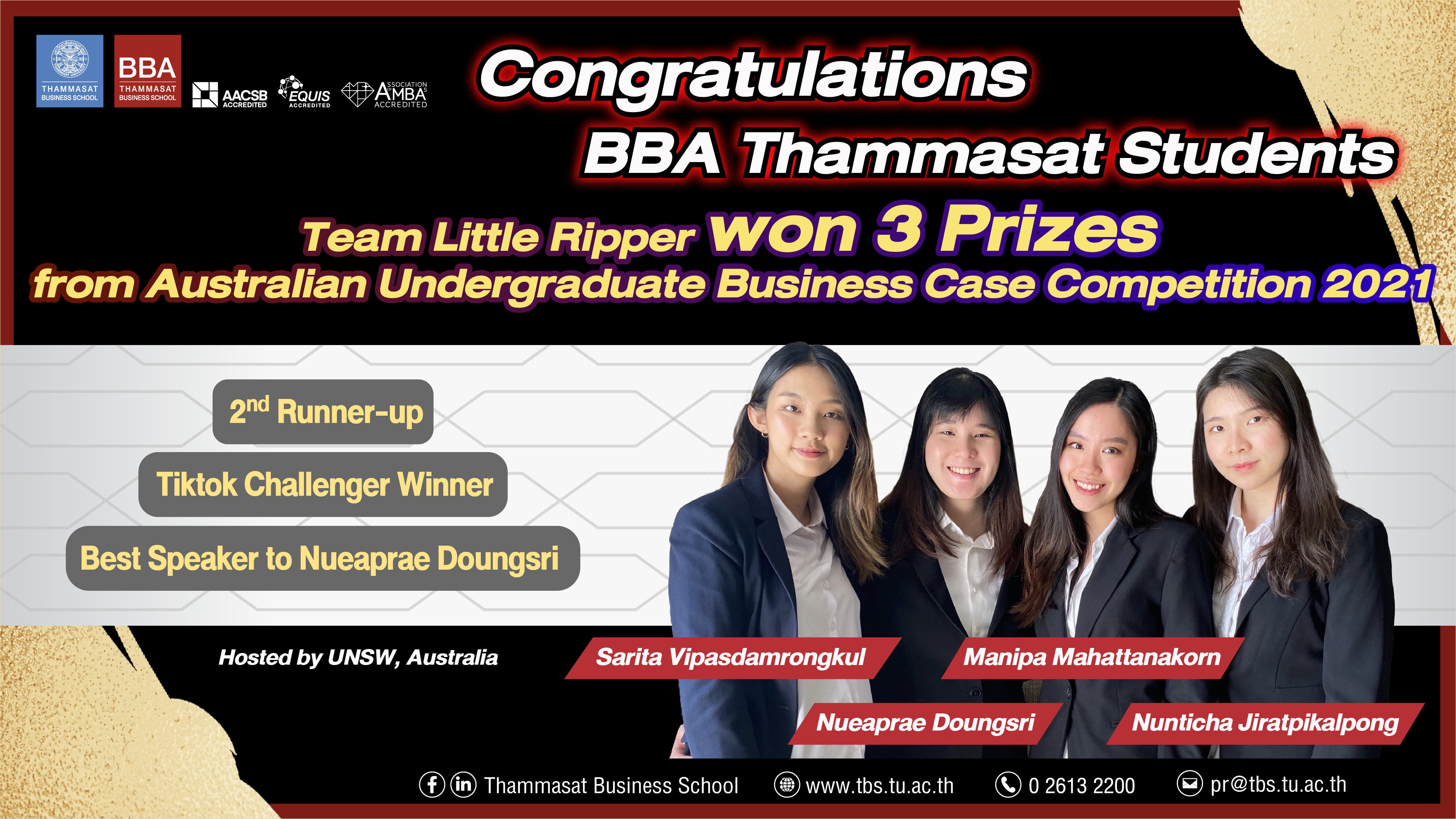
The team comprised of four BBA students: Kanlyaruk Tantisirivat, Nichamon Pananurak, Nueaprae Doungsri ), Arnon Ariyawatkul. Even though the entire competition was conducted virtually, that did not make the competition less challenge since our team was requested to solve 3 cases: 3-hrs, 5-hrs, 24-hrs long, throughout the week without physical meeting due to the competition’s policy.

The team finished with second place in the division. The team emphasises that apart of the success, they value the  the new skills they learned during the competition.

The team appreciates the guidance and support of their advisors, Prof. Supawat Likittanawong and Dr Worapong Janyanyuen.

Thammasat University wins the regional round of ASCM Case Competition 2021

A team of students from BBA, Thammasat University have won the regional round of 2021 ASCM Case Competition.

The team comprised of students, Tantisuwankul, Phasinee Saengthong, Nutrara Suangthonglang, and Nithid Pongcharoen. They competed with 331 other teams who participated in the competition.

There were only 64 teams in the regional round. In this round, the team solved an 8-hour case about supply chain management and emerged as the winner of the region which consisted of 6 countries: Australia, China, Malaysia, Singapore, Thailand, and Vietnam.

The 2021 ASCM Case Competition is organized by ASCM in collaboration with Deloitte Consulting LLP. Participating teams had to present solutions to an exciting end-to-end supply chain management problem, as they competed for prize money and recognition.

ASCM is proud of a rich tradition of student team case competitions. The program began as a grassroots-level event, with many APICS chapters, colleges and universities taking part.

The program challenged students to test the supply chain knowledge with real consulting cases curated by Deloitte. Deloitte is a world leading provider of audit and assurance, consulting, financial advisory, risk advisory, tax and related services.

Over the years, the Case Competition has evolved into a flagship event touching students at universities across Africa, Asia, Europe, and both North and South America.


Thammasat University students among the top 10 semi finalists at ASEAN Inter-Varsity Retail Challenge 2021

A team of Thammasat University students from the B.E. Faculty became one of the top 10 semi-finalists ASEAN Inter-Varsity Retail Challenge 2021 competition held online hosted by the Singapore Management University (SMU).

The “Teletubbies” team representing Thailand comprised of Athicha Korkiertsatean, Pitchaporn Inthisorn, Praewnapa Chaisaengjan, and Thanachote Phokakul.

The team mentioned that participation in the competition significantly improved their hard skills and soft skills, including analytical thinking. data analysis, data structure, communication, and teamwork.

The team also stressed that the competition was a good platform to apply the skills learned in class to real-life situations.

Chula professor successfully converts carbon dioxide to methanol

An Engineering professor, Chulalongkorn University has successfully converted carbon dioxide to methanol via a thermochemical method that consumes less energy and provides more yield, providing an alternative solution to reduce greenhouse gas emissions and stimulate the circular economy.

“Most of today’s methanol is synthesized from natural gas, which normally releases carbon dioxide during the production process. We, therefore, studied the production of methanol directly from carbon dioxide, which means that this helps to reduce carbon dioxide and also brings the gas back to some use and increases its economic value as well,” Asst. Dr. Pattaraporn says.

Dr Pattaraporn revealed the concept of a sub-research project under the Carbon Dioxide (CO2) Conversion to Higher-Valued Products with support from the “Research Cess Fund” (RCF) from the Malaysia-Thai Joint Authority (MTJA) for the research team from the Faculty of Engineering, Faculty of Science, the Metal and Materials Research Institute Chulalongkorn University, and other institutions to study different technologies and methods to recover carbon dioxide.

“In general, methanol is synthesized from natural gas by thermochemical method, which produces one ton of methanol and emits about 0.5-1.5 tons of carbon dioxide.” Asst. Prof. Dr. Pattaraporn explained.

“Therefore, we studied how methanol is produced directly from carbon dioxide, which is a promising alternative to the environment and also enhances its economic value.”

Asst. Prof. Dr. Pattaraporn elaborated that methanol can be expanded into a wide range of environmentally friendly green chemical products, such as Dimethyl Ether (DME), used as heating fuel, and Dimethyl Carbonate (DMC), which is used in many industries such as the paint industry, and adhesive industry.  Dimethyl carbonate is used as a binder and is classified as a type of plastic material. It is also mainly used as an electrolyte in lithium-ion batteries used in electric vehicles, which are becoming increasingly in demand.

“Nowadays, the production of dimethyl carbonate mainly uses phosgene, a highly toxic chemical that can cause death or serious health problems even with low concentrations. Therefore, dimethyl carbonate production from methanol and urea, or even from carbon dioxide directly is an interesting production pathway.”

Asst. Prof. Dr. Pattaraporn elaborated more on the fact that the carbon dioxide management approach that amine solutions are generally used to capture carbon dioxide and then separate it by heat until pure carbon dioxide is obtained. After that, the captured carbon dioxide can be further managed in two ways.

For this research, Asst. Dr. Pattaraporn chose the process of thermochemical conversion to convert carbon dioxide in which she used a reactor to generate heat and pressure, then induce a chemical reaction by adding hydrogen to carbon dioxide (CO2 hydrogenation) until it becomes methanol.

However, the thermochemical method demands intensive energy for the reaction and the methanol yield is low. Asst. Prof. Dr. Pattaraporn then finds a way to eliminate this drawback with the use of some alcohol as a catalytic solvent with copper-zinc oxide base catalyst (Cu/ZnO) to increase the methanol yield, and reduce energy consumption in the carbon dioxide conversion process.

Despite the research success, there are still many obstacles, such as the relatively high cost of CO2 capture, energy used in the CO2 conversion process, production costs and sources of hydrogen, market size constraints, and lack of investment incentives. So, if it receives support from the government in terms of policy, cost incentives, taxes, etc, this technology will become more competitive in the future.

“We have a plan to work with the industry sector to push forward the research to provide Thailand with new environmentally friendly products, create economic value for waste, and stimulate a circular economy. This is an important issue to which people today need to pay attention. We must try to save the environmental capital as best as possible to pass it on to the next generation so as to assure them of a better life.” Asst. Prof. Dr. Pattaraporn concluded.