Grant-based education at top foreign universities: New horizons for entrants, students of Satbayev University

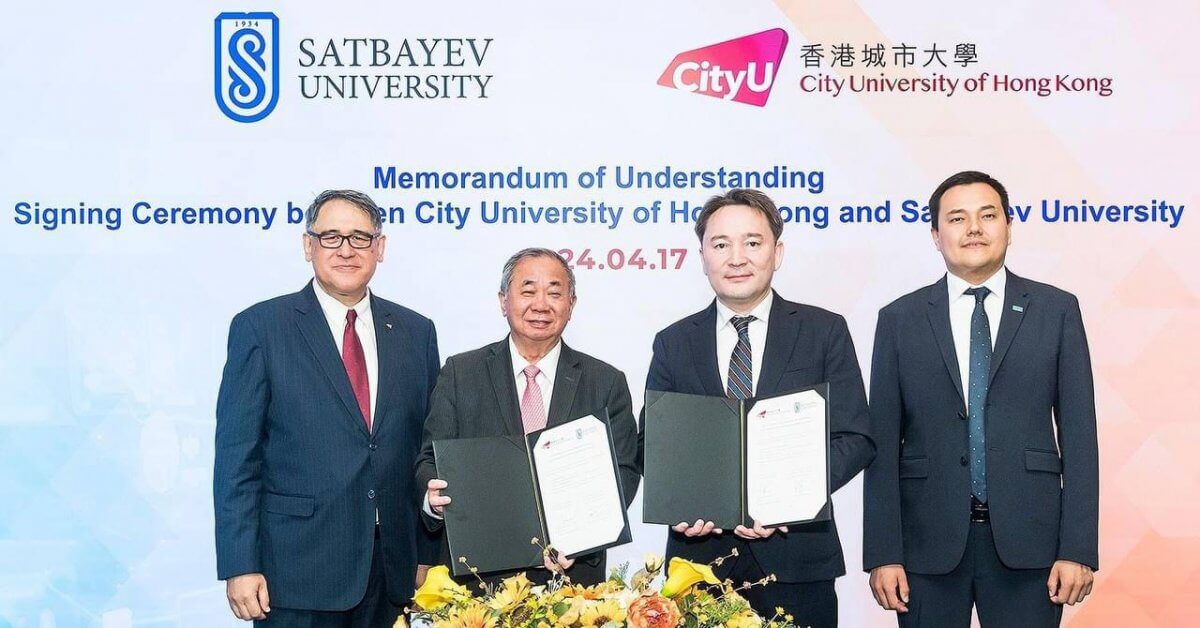
In 2024, about two hundred students and teachers of Satbayev University will have the opportunity to study and work at top universities in the world: Pennsylvania State University, USA, Songyungwan University, South Korea, Glasgow University, Great Britain, as well as in CIS countries and neighboring countries. The signing of Memorandum of strategic partnership with CityU in Hong Kong also allows National Research Technical University to train bachelors and doctoral students, exchange personnel and conduct research with one of the best universities in the world.

“Satbayev University and CityU are preparing the younger generation for society evolvement of their countries and the whole world. We are proud to cooperate with the oldest technical university in Kazakhstan,” said Lester Huang, Chairman of CityU Board.

Mr. Lester Huang noted that after several months of fruitful dialogue and preparation for launching the double-degree programs, universities are ready to start their implementation.

During working meetings at CityU, the working groups including Rectors and Vice-rectors of universities, departments’ and laboratories’ heads worked out in detail further steps to organize a joint educational process in artificial intelligence, materials science, construction spheres and implementing the scientific projects.

“We are interested in close cooperation. The joint work of our students, undergraduates and doctoral students will ensure not only the exchange of knowledge, but also intercultural interaction,” says Professor Freddy Boy, President of CityU HK.

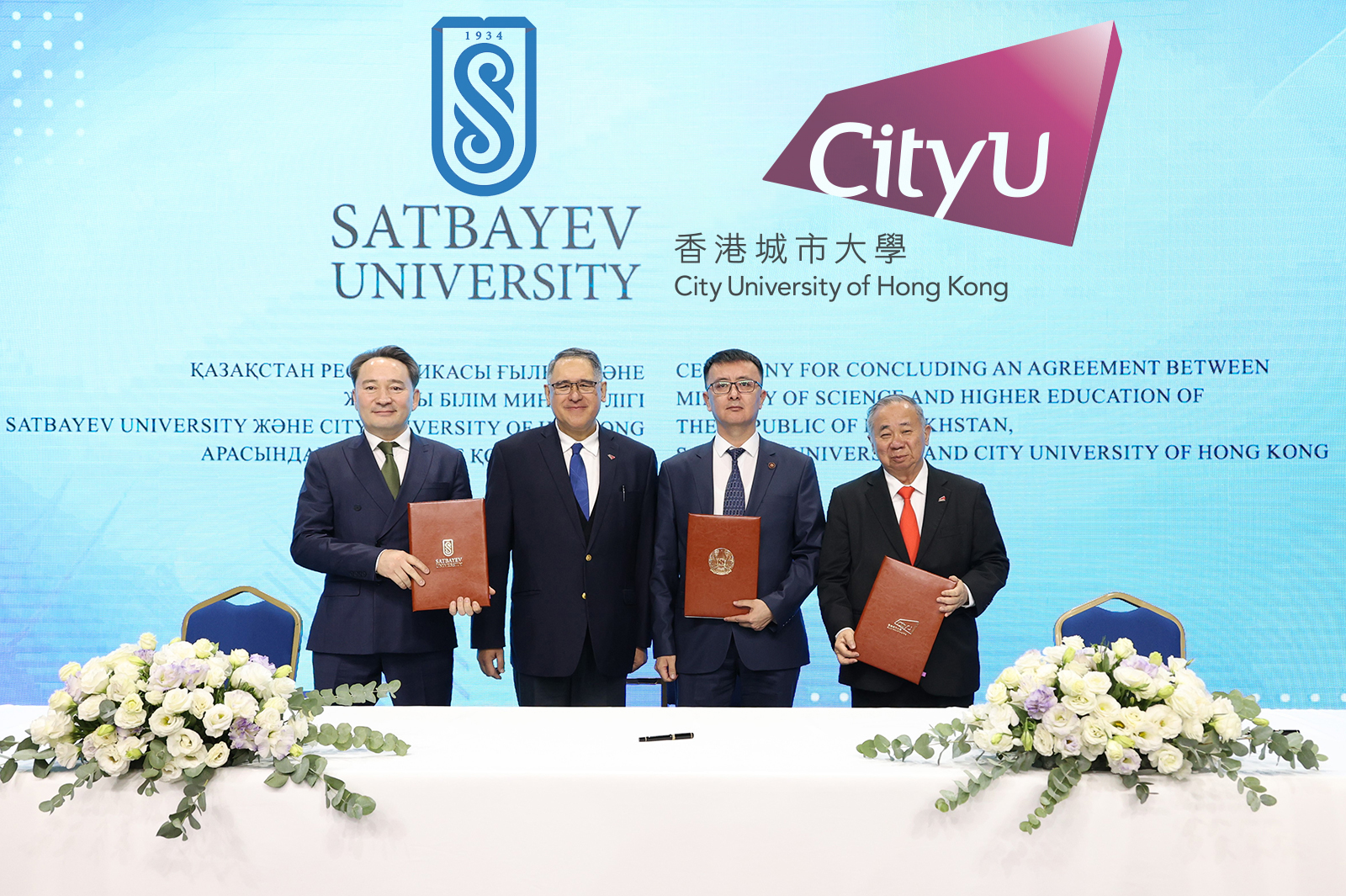
Satbayev University’s Rector Meiram Begentayev, and CityU President Freddy Boy, signed documents that make it possible to open joint degree programs for Bachelor’s, Master’s and PhD degrees.

In his speech at the signing ceremony, Satbayev University’s Rector Meiram Begentayev noted: “From this moment on, a new era in the development of Polytech begins, which we open with the partnership agreement in the field of science and higher engineering education with one of the best universities in the world.”

Satbayev University delegation also got acquainted with the activities of CityU laboratories. Kazakh scientists have agreed with the heads of the best of them to conduct joint scientific research.

The project is being implemented with the support of Minister of RK Science and Higher Education Sayassat Nurbek. The signed memoranda were witnessed by Lester Huang and Mr. Almas Seytakynov, Consul General of the Republic of Kazakhstan in SAR Hong Kong and Macao.

Satbayev University is actively working in the academic mobility field – in 2023-2024, the range of international partners of University was expanded at the expense of the USA, Hong Kong, Britain, South Korea and other countries’ universities.

MIT plans to conduct research in conjunction with Satbayev University

Collaboration of Satbayev University with one of the most prestigious technical universities in the world, Massachusetts Institute of Technology (MIT, USA), will allow creating the innovations aimed at ensuring the scientific and technological development of Kazakhstan’s economy.

During the visit of Satbayev University delegation to MIT, the university leaders discussed ways of cooperation in education and science sphere. Organization of joint research projects, the exchange of students and teachers, open up new opportunities for evolving the education and science in Kazakhstan and technology transfer.

Enjin Deng, senior program manager at MIT Center for Quantum Engineering (CQE), shared the prospects for cooperation in the field of quantum engineering and scientific projects. Tom Girty, Director of Communications and Initiatives, presented MIT’s laboratory capabilities for collaborative research in nanotechnology sphere.

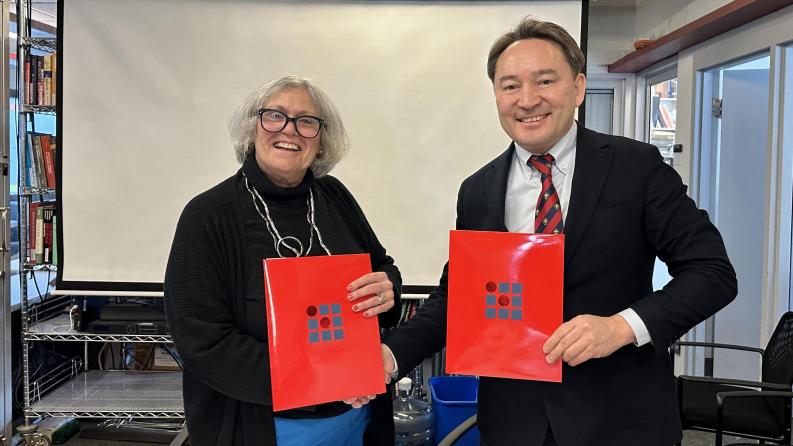
Also, an agreement was signed within the walls of MIT on the accession of Satbayev University to the Fab Lab Network, an international network of laboratories that brings together research engineers and practitioners from all over the world using digital technologies. The agreement, signed by Sherry Lassiter, founder and head of Fab Foundation, and Satbayev University Board Chairman-Rector Meiram Begentayev will provide the talented youth and scientists with access to tools, knowledge and financial resources for learning, innovation and inventions.

“Cooperation with the world’s leading universities allows Satbayev University to fully implement “learning through research” principle, as well as advance the practical skills of future engineers, combine the efforts of inventors and researchers to achieve a better and more sustainable future for all,” says Satbayev University’s Rector Meiram Begentayev.

Massachusetts Institute of Technology is one of the most prestigious technical educational institutions in the United States, a university and research center with the world’s largest research infrastructure. It occupies 1st place in the global ranking of universities of QS World University Rankings.

Satbayev University, Penn State has been strengthening the collaboration

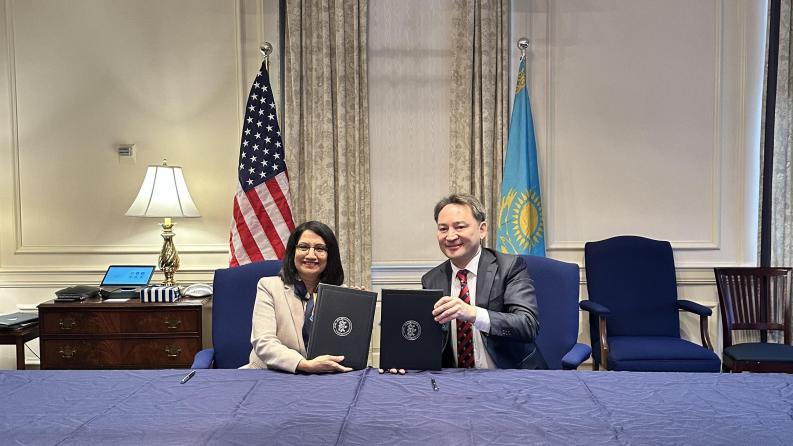
Satbayev University and Pennsylvania State University (Penn State, USA) have signed a cooperation agreement.

The given document has launched a new stage of academic and scientific partnership between the two universities, which closely cooperate in petroleum engineering sphere. The agreement was signed by Penn State President Nili Bendapudi and Satbayev University Board Chairman-Rector Meiram Begentayev.

The deepening of cooperation between the two universities was the result of the work of RK Science and Higher Education Ministry within the framework of implementing the international agreements, as well as working trips to the USA by Science and Higher Education Minister Sayassat Nurbek, during which new agreements were reached on evolving the strategic partnership between the two countries in higher education sphere.

Based on the agreement, collaboration program between the two universities will be expanded in such areas as materials science, cybersecurity and geology. Universities are going to continue to implement double-degree education programs in the format 3+1+1 (Bachelor + Master’s), as well as the exchange of teaching staff, students, conducting the joint scientific research.

This year, the recruitment of entrants, undergraduates, as well as 3rd year students who want to study at Penn State from September 2024 will begin.

Satbayev University delegation worked out all the details of future degree programs with the leadership of Penn State, departments’ representatives: Material Sciences and Geology, and also met with the representative of Institute for Computational and Data Sciences, Dr. Guido Cervone.

It should be noted that Pennsylvania State University is a public research university in the United States, located in State College city, Pennsylvania. It is one of the top 15 public universities in the USA, with almost 90 thousand students that makes it one of the largest in the USA and the world.

Diamond-drilling tool laboratory opens at Satbayev University

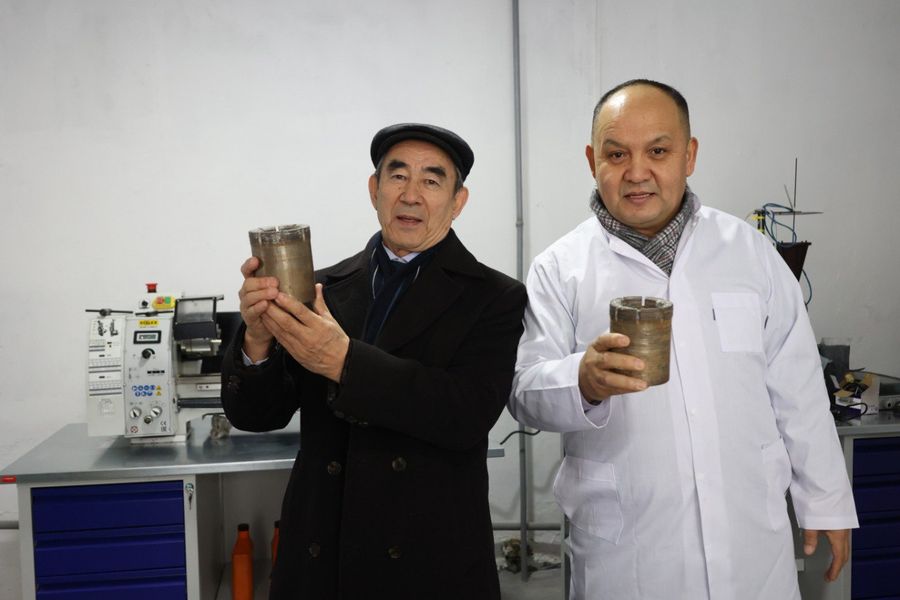
“Diamond Drilling Tool” scientific and production laboratory has been opened at Satbayev University, opened on the initiative and under the scientific supervision of Doctor of technical sciences, professor, academician Boranbai Ratov.

The first tests of the new equipment were carried out at Karsakpai field, where Kanysh Satbayev lived and worked. The equipment for the copper smelter at this deposit was brought from England, from Germany, from the Singer factories and has been preserved to this day. It was at this enterprise that new equipment was tested, which showed very high results and high efficiency when drilling the deep wells. The creators of crowns expect that they will bear fruit in the form of fast drilling, high-quality drilling, saving time and money.

Creating the drilling tools is a complex process that unites industries such as metallurgy and mechanical engineering. Scientists use special equipment to process materials without human intervention. They are also studying the various technologies and alloys to improve the quality of future drill bits.

This is an actual elaboration aimed at changing the situation on the global market of drilling tools and creating domestic analogues for expensive foreign developments. The opening of the laboratory will accelerate the commissioning of abrasive deposits and strengthen the mineral resource base of the Republic of Kazakhstan.

Satbayev University, City University of Hong Kong sign agreement on creating innovative strategic partnership

On the last days of November, Satbayev University was visited by the delegation of Hong Kong City University, also known as CityU University, headed by Chairman of University Board, Lester Huang Yi. During the visit, a trilateral agreement was signed on the opening of CityU’s branch on the basis of Satbayev University. The agreement was signed by CityU President, Professor Freddy Boy, Vice Minister of Science and Higher Education of Kazakhstan Darkhan Ahmed-Zaki and Satbayev University’s Rector Meiram Begentayev. The agreement was possible owing to Minister of RK Science and Higher Education Sayassat Nurbek.

“Today we are signing the historic document, the agreement on cooperation between the two leading universities,” Minister said in his video message in honor of signing the agreement. “We expect that the partnership will be long-term, fruitful and beneficial for both sides.”

Within the framework of cooperation, it is planned to train the highly qualified specialists in such fields as engineering and artificial intelligence in Kazakhstan. Kazakhstani students enrolled in new international programs will have the opportunity to receive Bachelor\’s and Master\’s degrees and spend a year in Hong Kong based on \”3+1+1\” format. The programs will be developed under the academic supervision of CityU University using the CityU virtual learning environment, and the final exams will be held according to the international standard. A program of joint research in such areas as digitalization, logistics, urban planning, digital medicine and agriculture is being planned as well.

“Both universities share the idea of inspiration, innovation and internationalization,” Mr. Huang said at the signing ceremony. “Together we will define the future of higher education and create an environment for innovation, cooperation and cultural exchange.”

On the first day, representatives of the two universities had the opportunity to get to know each other better and finalize the future agreement details. CityU’s representatives presented in detail their work and achievements and shared their vision of cooperation with Kazakh colleagues. \”We don\’t need templates, we need talents,\” said Freddie Boy, President of CityU, in the conversation. Hong Kong delegation also got acquainted with the rich scientific infrastructure of Satbayev University, its achievements and projects, as well as with the abundant culture of Kazakhstan.

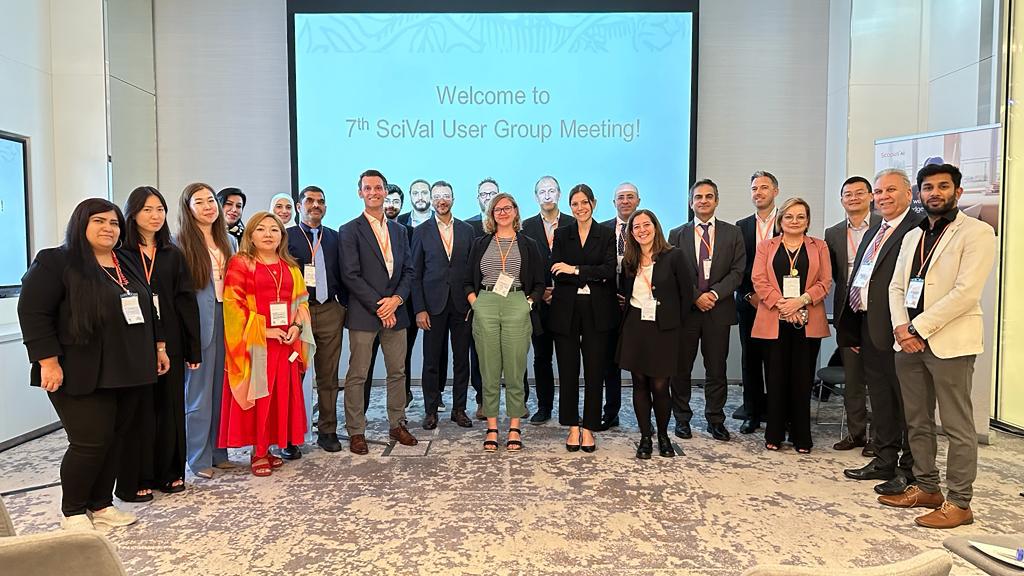
Satbayev University’s specialist took part in SciVal users’ meeting

The annual meeting of SciVal user group was held in the UAE. Gulziya Burshukova, head of Publication Activity and Scientific Publications Department at Satbayev University, made a report on behalf of Kazakhstan.

Her report was devoted to the nuances of working in the SciVal system and how Satbayev University systematically analyzes its work results both at the basic and in-depth levels with its help.

If you look at University’s data as a whole in the period from 2018 to 2023, the following is seen:

  • the total number for 5 years is 2076 publications;
  • the number of authors who participated in the writing of publications – 1502;
  • the total h-index is 25.

The review may include information on the structure of research activities based on disciplines. This helps to identify the strengths of University and its expert areas, and it is also possible to find data on international cooperation and partnerships in these expert areas. This is useful for strategic planning and identifying the future research directions of scientists and University as a whole.

University can identify the key publications that attract the attention of the world scientific community and form strategies to promote scientific research. SciVal provides real-time information, which allows University to quickly respond to changes in the scientific environment and quickly adapt its strategies.

SciVal is an analytical system designed to analyze publication activity in Scopus bibliographic database. It empowers to process huge amounts of statistical data and is intended for scientists and University staff. With the help of this system, it is possible to analyze publications, the results of researchers and groups of scientists, research areas, countries, arrays of publications and visualize the results.

Satbayev University strives to maintain the high standards of scientific research and with the help of SciVal conducts a comparative analysis of its productivity in comparison with other universities. This not only helps to identify competitive advantages, but also creates opportunities for collaboration and exchange of experience.

Virtual reality laboratory opens with support of Porsche at Satbayev University

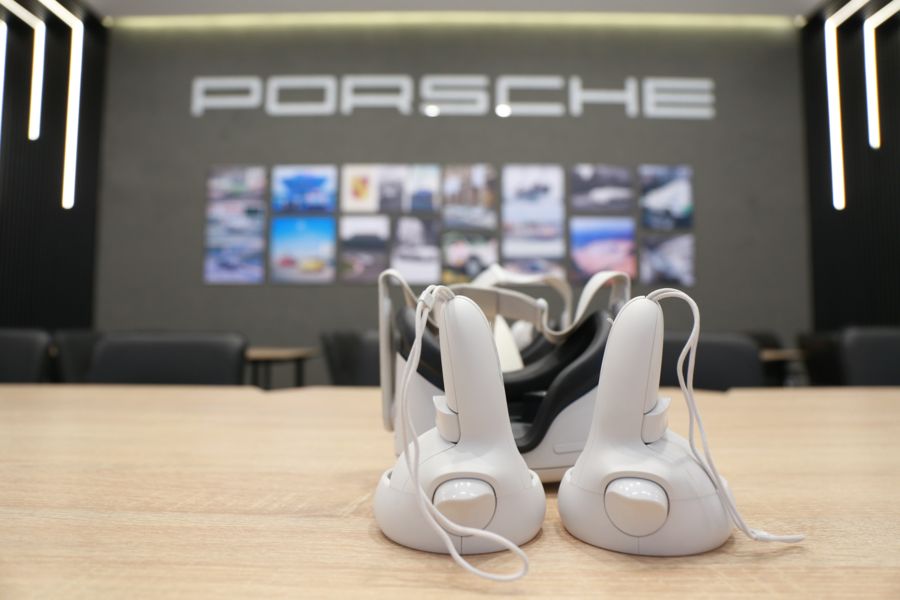
On September 22, Satbayev University hosted the grand opening of a VR laboratory that allows students to visually study high technologies owing to virtual reality systems. The project was implemented within the framework of cooperation between Satbayev University and the official importer of Porsche in Kazakhstan. German manufacturer representatives noted that the support of education and culture is a long tradition of Porsche.

Equipped with the support of auto brand specialists, the virtual reality laboratory was named Porsche Learning Centre. Students of the “Transport Engineering” degree program are already studying the practical aspects of modern mechanical engineering technologies here. Now, wearing virtual reality glasses, students can use the example of Porsche cars to study the entire process of creating the car – from design and testing to the assembly of serial samples. Training takes place directly in the classroom due to the same VR laboratory: wearing virtual reality glasses, university students can hone their skills in car maintenance and repair. Virtual reality technologies allow each student to fully immerse themselves in the learning process, and in the most realistic conditions, directly interacting with 3D objects: for instance, to look inside the assembled engine or gearbox, to examine all the details up close from all sides, to understand the device and principles of operation of all the main components of the car.

At the opening ceremony of the laboratory, the University’s Rector, Meiram Begentayev, noted that within the framework of cooperation with the automaker, the University receives valuable opportunities both for effective technical practice and for real “immersion” of students in the high technologies world.

— Last year, together with Satbayev University’s teachers, we developed and introduced into the educational process a digital laboratory for the repair and maintenance of electric vehicles and cars with internal combustion engines. In turn, the official importer of Porsche in Kazakhstan supported the idea and provided the University with a platform and its specialists for shooting the training videos used in the VR laboratory. To date, more than 110 students have already been trained in these modern technologies at Satbayev University. In addition, using virtual reality technologies, we held an Olympiad among college and university students. About 80 students are scheduled to study using the digital VR laboratory for the current academic year, — Meiram Begentayev said.

University talked about the advantages of mastering technical knowledge using virtual reality. According to the teachers, within the framework of cooperation with Porsche, the University got the opportunity to hold regular joint seminars and scientific and practical conferences with the German enterprise. Such a format significantly increases the value of students’ research work and also forms a stable interest among young people in the application of theoretical knowledge in practice.

In turn, the company director – the official importer of Porsche in Kazakhstan Gauhar Gabdrakhimova noted that the importer will continue to provide all the opportunities for filming the training videos in the car center’s workshops. According to her, new 3D videos are needed to ensure that the base of training material in the University’s VR laboratory is always relevant and that students’ knowledge corresponds to the most advanced trends in the global automotive industry. Thanks to the constant updating of information, Kazakhstani students can now study not on archival materials, but on the latest and modern technological achievements of the global automotive industry, being aware of the most relevant innovative solutions.

– The company is pleased to contribute to improving the training of Kazakhstani students in technical specialties. This is a long-standing principle of Porsche – to support innovation, to develop the desire for modern knowledge in society, and to stimulate scientific and research activities. Porsche Kazakhstan always supports talented young people and encourages the introduction of innovative technologies in education. The company does this to improve the quality and practical value of the knowledge received by young people. Internship at the enterprise is also very important, and assist in the further employment of specialists who show the best results. We are happy to help such a prestigious Kazakh University with a remarkable history and deep academic traditions as Satbayev University to improve the training base of specialists. We are focused on long-term cooperation for the sake of the technological development of Kazakhstan, — said Gauhar Gabdrakhimova, director of the official importer of Porsche in Kazakhstan.

It is noteworthy that as a sign of long-term cooperation, the Company placed a life-size model of the Porsche Taycan electric sports car on the main facade of the university. According to Gauhar Gabdrakhimova, this has become one of the symbols of the University’s cooperation with the famous world automobile brand, as well as an additional inspiration for university students. “Life is a road, and the road should lead us to our innermost dreams. No wonder Porsche’s slogan sounds like “Driven by Dreams”. There is a deeply symbolic and philosophical connection here: for many young people, the university is actually the beginning of their life path, which symbolizes the road to the future. Every journey begins with a dream, and everything must be done to make it come true,” said the head of Porsche in Kazakhstan.


Kazakh entrepreneurs, scientists agree to implement joint projects

RK Science and Higher Education Ministry represented by Science Foundation, together with Satbayev University and Autonomous Cluster Fund “Park of Innovative Technologies” – Tech Garden, organized a dialogue platform on integrating the science and business “Reactor of Technology Commercialization.”

Within the framework of the platform, Kazakh scientists presented 10 projects in subsoil use field. Each participant’s task was to convey the commercial value of their scientific development to potential business partners and investors in 3 minutes.

Among the submitted projects – technology of enhanced oil recovery for hard-to-recover reserves, installations for processing hydrocarbon-containing waste, a system for forecasting deposits and sediments, the introduction of devices for cleaning the geo-technological and oil wells, monitoring of the flooding front of oil and gas fields “NOAH”, bio-meliorant based on industrial waste, a highly efficient mill for fine and ultrafine grinding of ore materials, cry-adsorbent for metal extraction, technology for treating the wastewater contaminated by subsurface use, method of complex processing of large data arrays of areal and borehole geophysics “Pollok”.

The event was attended by representatives of Association of Organizations of oil-gas and energy complex “Kazenergy”, “Kazmunaygas”, Republican Association of Mining and Metallurgical Enterprises, Association of producers and consumers of petrochemical products, experts, scientists, inventors and business representatives.

In his welcoming speech, Chairman of Board of Science Foundation Abdilda Shamenov noted the practical effect of holding such meetings – “according to the results of the commercialization Reactors conducted earlier, 31 out of 63 scientific projects have found their potential business partners for joint implementation.”

Satbayev University’s Rector Meiram Begentayev noted in his speech: “Currently the whole world is promoting sustainable development goals and in this regard Satbayev University is no exception. The commercialization reactor, which is carried out within the walls of University, is also an indicator of SDG achievement, the unification of business and science, the topic of environmentally friendly subsoil use is one of the active goals of sustainable development and ESG.”

By the way, Satbayev University, today, is implementing 24 projects through Science Foundation. Among them are the serial production of charging stations for electric vehicles with the improved characteristics, intelligent unmanned lethal systems, the production of modules for solar electric panels, as well as other projects in the agro-industrial and mining sectors, construction and pharmaceuticals.

In turn, Autonomous Cluster Fund “Park of Innovative Technologies” – Tech Garden has the potential for active development and implementation of innovations in digital technologies and industrial solutions sphere. “Technology Commercialization Reactor” was another step in achieving the given goal.

Following the results of the event, an agreement was reached on joint activities between business enterprises and scientific organizations.

An affordable water purification system developed by Satbayev University scientists

Water is the source of life. And this, in general, is not news. But lately, we have been hearing more and more about the shortage of water resources, which can become a global problem. According to World Bank forecasts, the volume of water resources in Kazakhstan will decrease from 90 to 76 m3 per year by 2030. This means that the water shortage in the country in 8 years will be about 12-15 m3 per year, that is, about 15%. By the way, residents of remote Kazakh villages have been living without clean drinking water for decades. And this problem persists to this day.

Slow-acting filters are the first type of filters that have begun to be used in the practice of water treatment. In 1829, John Simpson built sand filters for the London water supply, which were called English, or slow.

“Slow-acting filters are used for non-reactive clarification and partial water discoloration from surface sources if its color does not exceed 35-50 degrees. According to the method of regeneration of the filter loading, the following designs are distinguished: with the removal of the polluting layer and washing it outside the filter, with the washing of the contaminated layer in the filter during mechanical loosening and flushing of impurities,” the scientists explain.

Slow filters have a unique ability to remove not only turbidity and color from the water but also specific organic, and inorganic contaminants and bacteria. At the same time, no chemical reagents are used.

“The filter has a double bottom: its lower part is solid; the upper part is perforated. A drainage space is formed between them, into which the filtered water enters. A layer of crushed stone or gravel (0.4-0.45 m thick) is placed on the upper part of the bottom, and a filter layer of quartz sand (0.8-0.85 m) is placed on it, to which the purified water is supplied. The filtration process on a slow filter approaches the natural one: water passes through the filter slowly, at a speed of 0.1-0.2 m/h. Under such conditions, almost complete clarification of water and its purification from microorganisms by 95-99% is achieved.”

As the water is filtered, a biological film is formed on the surface of the filter layer of sand from the retained organic residues, minerals, colloidal particles, and a large number of microorganisms. It is formed within a few days – this period is called the period of “maturation” of the filter. This film retains a fine suspension that would pass through the pores of the sand. That is, film filtration of water takes place on a slow filter. The film itself also contributes to mineralizing the organic substances, the destruction of microflora, and the reduction of oxidation and color.

The use of crushed shungisite (expanded clay, zeolite, volcanic slags, burnt rocks, clinoptilolite) instead of quartz sand reduces the formation time of a biologically active film by 3-5 times.

The process of “maturation” lasts until the number of bacteria in the filter decreases to 100 colonies (A colony is a visible isolated cluster of representatives of one type of microorganisms. – Note of the author.) per 1 ml of water. That is until the water meets the requirements for drinking water quality. After that, the water can be eaten.

“The useful operation period of the filter continues until the available pressure is exhausted (usually it reaches 15-30 days, sometimes more). After that, the filter is stopped and the regeneration of the upper layers of the load is started, removing a 2-3-centimeter layer or loosening it with simultaneous water supply to the filter surface to flush the impurities into the sewer collector,” say scientists of KazNRTU named after K.I. Satbayev.

Traditional technologies of water treatment and water purification provide a complex technology consisting of several processes: settling, filtering, and disinfection. At the same time, the existing treatment facilities no longer give the desired result due to the heavy pollution of reservoirs. Slow filters, scientists say, are easy to build, and low-cost to maintain, while they can provide clean water to a small village. The project is being implemented with the support of the Ministry of Science and Higher Education of the Republic of Kazakhstan.

Satbayev University opens School of Transport Engineering and Logistics

The opening of M. Tynyshbayev School of Transport Engineering and Logistics took place at Satbayev University. It is a higher educational institution that combines the rich experience of teachers and the achievements of Satbayev University’s scientists in implementing research projects for Kazakhstan’s transport and logistics industry.

The new school, where engineers will be trained in “Transport” and “Logistics” degree programs, is named in honor of M. Tynyshbayev, the first Kazakh railway engineer, public figure, Prime Minister of Turkestan autonomy, an active participant in designing and constructing the Turkestan-Siberian railway.

To ensure high-quality training of specialists, Satbayev University signed a cooperation agreement with Xi’an Railway Vocational Technical Institute (PRC), opened a two-degree Master’s degree program “Transport Technologies” together with Silesian University of Technology (Poland), and also created a consortium with Railway Transport Institute (Riga, Latvia). Degree programs for training engineers in road and rail transport are certified by international and domestic agencies for accreditation of degree programs: ASIIN (Germany), IKAQAE, and IARA.

— Cooperation with universities of countries that are experiencing rapid growth in the transport and logistics industry will ensure not only high-quality training of specialists but also the transfer of new technologies to Kazakhstan,” said Seidulla Abdullayev, Director of M. Tynyshbayev School of Transport Engineering and Logistics.

The school’s opening ceremony was attended by representatives of the transport and logistics industries, as well as the son and granddaughter of Mukhamedzhan Tynyshbayev Davlet Sheikh-Ali and Zhunissova Nurshaken Apa.

State’s Head K. K. Tokayev in his Message to Kazakhstan’s people noted that strengthening the position as a nodal transit hub in Eurasia is a strategic task for our country. President set a goal to increase the share of the transport and logistics sector in the GDP structure to 9% in the next three years. The opening of M.Tynyshbayev School of Transport Engineering and Logistics will contribute to advancing the human resources and scientific research for Kazakhstan’s transport and logistics region.