





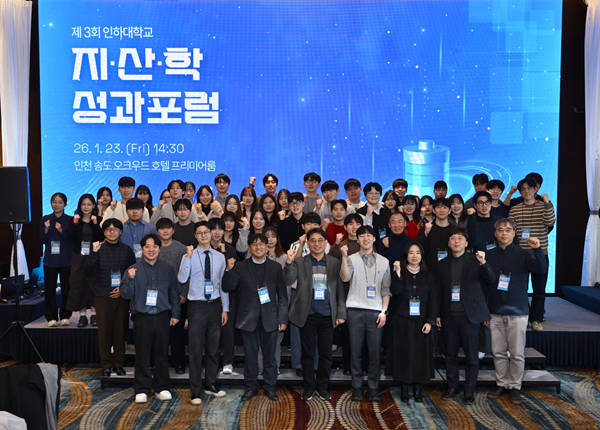

▲Participants pose for a commemorative photo at the 3rd Jisan-Hak Performance Forum.
Inha University held the 3rd Jisan-Hak Performance Forum on the 23rd to share the achievements and outcomes of collaborative initiatives jointly developed by regional education, industry, and the university.
The forum was organized to review the outcomes and progress of local industry university (Jisan-Hak) cooperation, aimed at strengthening region-based talent development and industrial linkages, while exploring directions for future advancement.
The event brought together a diverse range of stakeholders, including industry professionals, university faculty members, researchers from government-funded research institutes, and students. Participants shared field-oriented experiences and practical outcomes derived from Jisan-Hak collaboration.
Outstanding students were recognized for their accomplishments in Jisan-Hak collaborative curricula. Presentations were also delivered on exemplary educational operation models, supporter program cases, and best practices in linking student career development with employment. In particular, cases demonstrating the organic integration of school education, university expertise, and industry demand drew strong interest from attendees.
Key sessions highlighted how students are accumulating hands-on problem-solving experience beyond theory-based learning through various extracurricular activities, such as secondary battery competitions and global projects. These experiences were shown to broaden students’ career exploration and expand their options for major selection.
Industry representatives noted that incorporating real-world contexts into learning from the educational stage has significantly enhanced the quality of talent development.
A senior-to-junior scholarship presentation ceremony for the secondary battery major was also held. Alumni Ahn Chi-wan (Class of 2019, Department of Chemical Engineering), CEO of WorkX and a second-cohort graduate of the secondary battery major, donated a scholarship fund to support junior students, expressing his strong commitment to the academic community. Ahn recently received the 2025 Korea Talent Award.
Ahn stated, “My learning experience in the secondary battery major and the Jisan-Hak collaborative education program became an important foundation for my entrepreneurial journey,” adding, “I made this scholarship donation in hopes that my juniors can continue to challenge themselves and grow in a more stable environment.”
The university expects that this scholarship donation will further invigorate education and research in the secondary battery major, while strengthening the cooperative network between alumni and current students. The institution plans to continue building a sustainable, major-based talent development system.
To enhance employment competencies in the secondary battery industry, experts from academia, research institutes, and industry also participated as speakers in special lectures for students, receiving positive feedback.
Choi Jin-seop, Head of the Secondary Battery Project Group, said, “This 3rd Jisan-Hak Performance Forum provided an opportunity to confirm the outstanding result of our educational incubating efforts, while sharing a vision for an educational ecosystem aligned with Incheon’s advanced talent development strategies.” He added, “We will continue to expand models that support student growth and promote mutual development with regional industries through Jisan-Hak collaboration.”




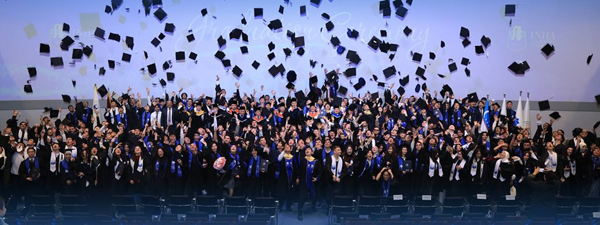

 ▲ Sung Yong-rak, Chair of the Jungseok-Inha Foundation, delivers congratulatory remarks at the 8th IUT Commencement Ceremony.
 ▲ President Myeong Woo Cho delivers a congratulatory address at the 8th IUT Commencement Ceremony.
 ▲ National Assembly member Kim Kyo-heung delivers congratulatory remarks at the 8th IUT Commencement Ceremony.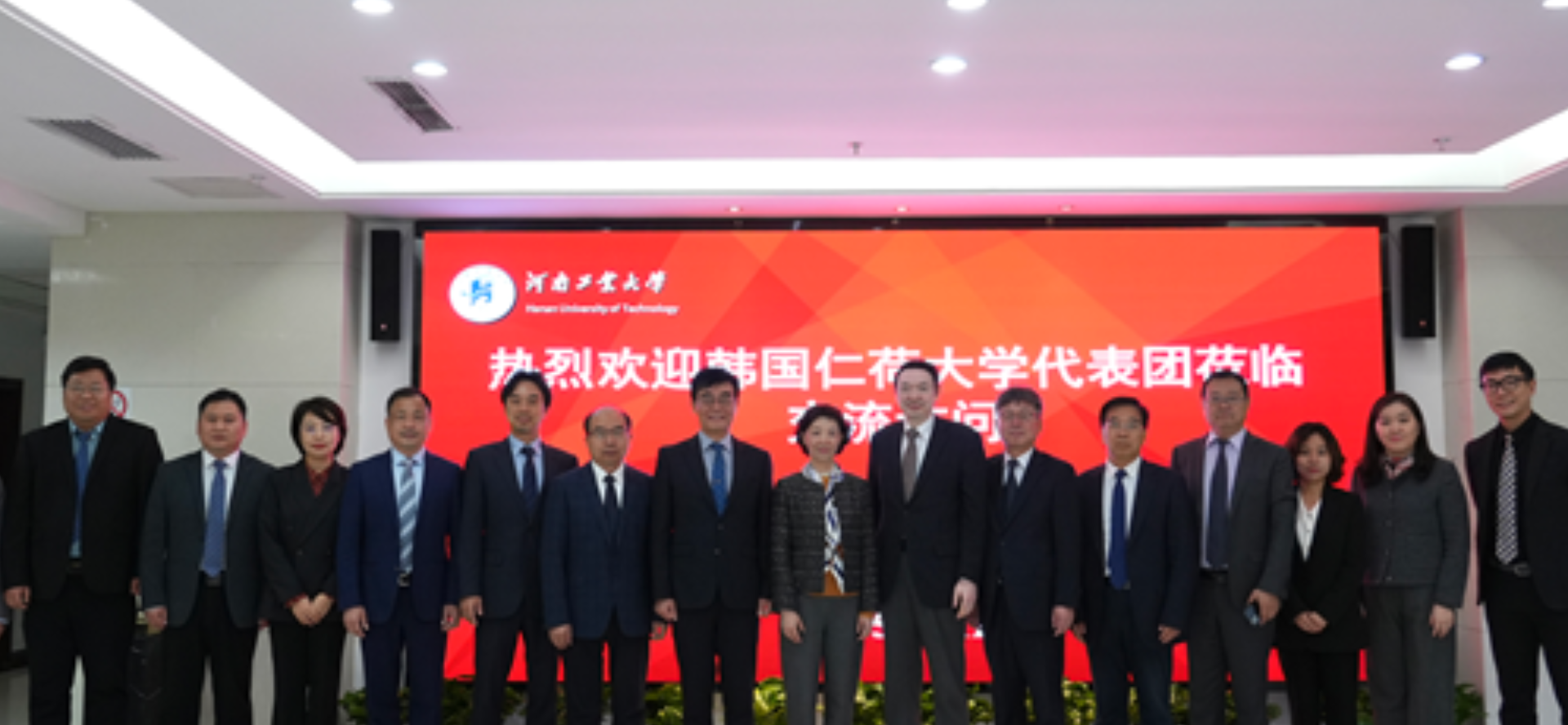
.png) ▲Attendees pose for a commemorative photo at the launch ceremony of the Inha Institute of Technology, a Sino-foreign cooperative education institution established by Henan Polytechnic University and Inha University.
▲Attendees pose for a commemorative photo at the launch ceremony of the Inha Institute of Technology, a Sino-foreign cooperative education institution established by Henan Polytechnic University and Inha University.