Sogang University
Published on 11 June 2026




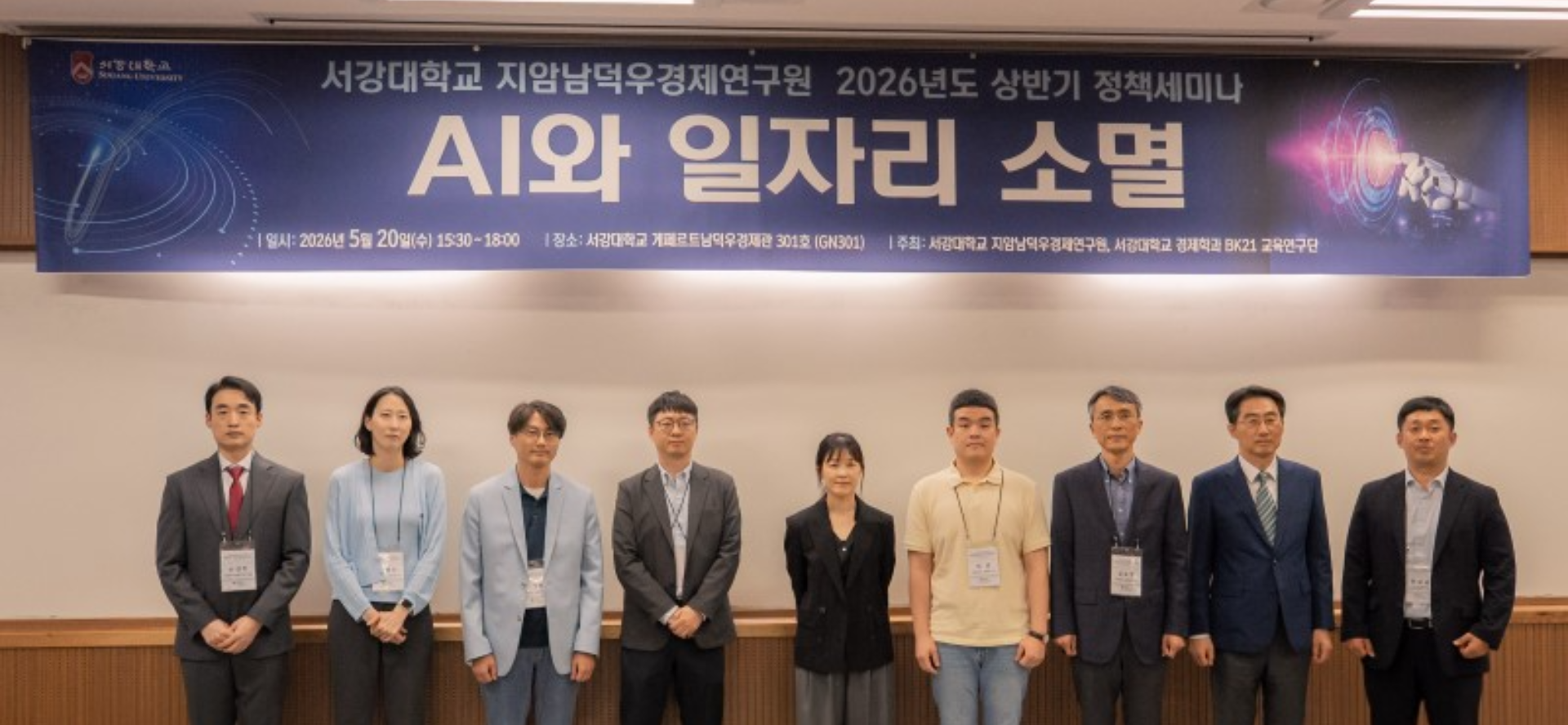
On May 20, Sogang University's Nam Duck-Woo Economic Research Institute hosted a policy seminar titled "AI and Job Displacement" at the Geppert Nam Duck-Woo Economics Building. The session brought together economists and policy researchers to examine how the spread of AI technologies is affecting labor market structures and to discuss what employment and industrial policy responses are needed.
Two presentations anchored the discussion. Ahram Moon, Group Leader of the AI Economic Policy Group at the Korea Information Society Development Institute, addressed the labor market implications of AI development under the theme of "labor-friendly responses" — arguing that as AI reshapes job structures, policy frameworks must be designed with worker protection as a core objective rather than an afterthought.
Hoon Choi, Professor at Chung-Ang University School of Economics, presented findings from an analysis of Korea's AI Voucher Program, examining how firm-level AI adoption affects employment outcomes. His research suggested that while AI adoption does not uniformly reduce total employment or wages, it may have a disproportionately negative effect on new hiring — particularly among young workers and those in temporary or daily employment. The paper's title, "The Erosion of Entry-Level Jobs: AI Adoption and Firm Outcomes from Korea's AI Voucher Program," points to a concern that is often underrepresented in aggregate employment statistics.
The discussion session, moderated by a Sogang faculty member, examined whether the employment effects of AI are best understood as a technological shock or as a function of policy design — with participants noting that outcomes are likely to vary significantly depending on the type of AI being adopted, its stage of development, and the institutional context in which it is deployed. Speakers converged on the view that AI diffusion policies should be accompanied by employment impact assessments, job transition support, and reskilling infrastructure.
Director Hyunbae Chun of the Nam Duck-Woo Economic Research Institute described the seminar as an opportunity to examine the effects of AI on labor and industry from multiple angles, and expressed hope that it would contribute to policy thinking that balances technological innovation with employment stability.