National Taiwan University
Published on 25 August 2026




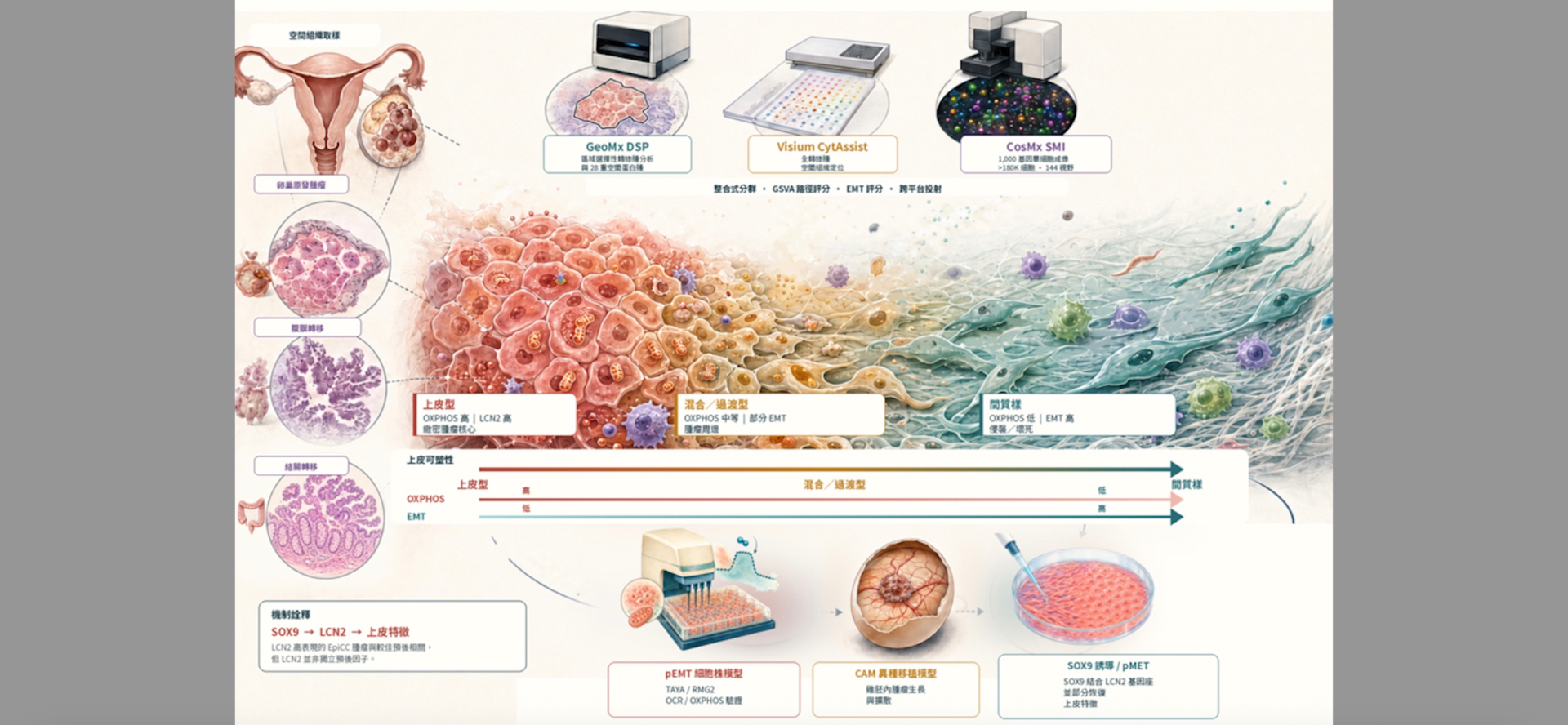
Ovarian clear cell carcinoma (OCCC) presents a significant clinical challenge due to its high prevalence in East Asian populations and notorious resistance to chemotherapy. To break through these therapeutic bottlenecks, an interdisciplinary team from National Taiwan University (NTU) and NTU Hospital, led by Professor Ruby Yun-Ju Huang, recently published groundbreaking research in the prestigious journal Nature Communications. By integrating multi-platform spatial transcriptomics with advanced functional models, the team successfully created the world's first "spatial atlas of OCCC", precisely detailing how cancer cells adapt across various tumor microenvironments.
The study revealed that OCCC is not a homogeneous mass but exhibits immense spatial heterogeneity. Researchers discovered distinct differences in metabolism and epithelial-mesenchymal transition (EMT) between the tumor's center and its periphery. Cancer cells at the core showed higher oxidative phosphorylation (OXPHOS) and epithelial traits, which correlated with better patient prognoses driven by the LCN2 gene. Conversely, cells near invasive or necrotic edges displayed lower metabolic activity and higher EMT. The team further identified the SOX9-LCN2 axis as a crucial regulatory mechanism governing this cellular plasticity, proving that re-inducing SOX9 can restore epithelial functions and offering a promising target for precision treatments.
Beyond scientific breakthroughs, this milestone underscores NTU’s exceptional capacity for fostering inclusive, interdisciplinary talent. Co-first authored by international doctoral candidate Le Truong Thang and NTU medical graduate Dr. Yi-Te Wang, the collaboration seamlessly bridged smart medical technology with clinical expertise. By institutionalizing diverse academic partnerships across high-impact research platforms, NTU continues to leverage its capacity to address complex health challenges, paving the way for next-generation clinical solutions in global oncology.