National Taiwan University
Published on 24 November 2026




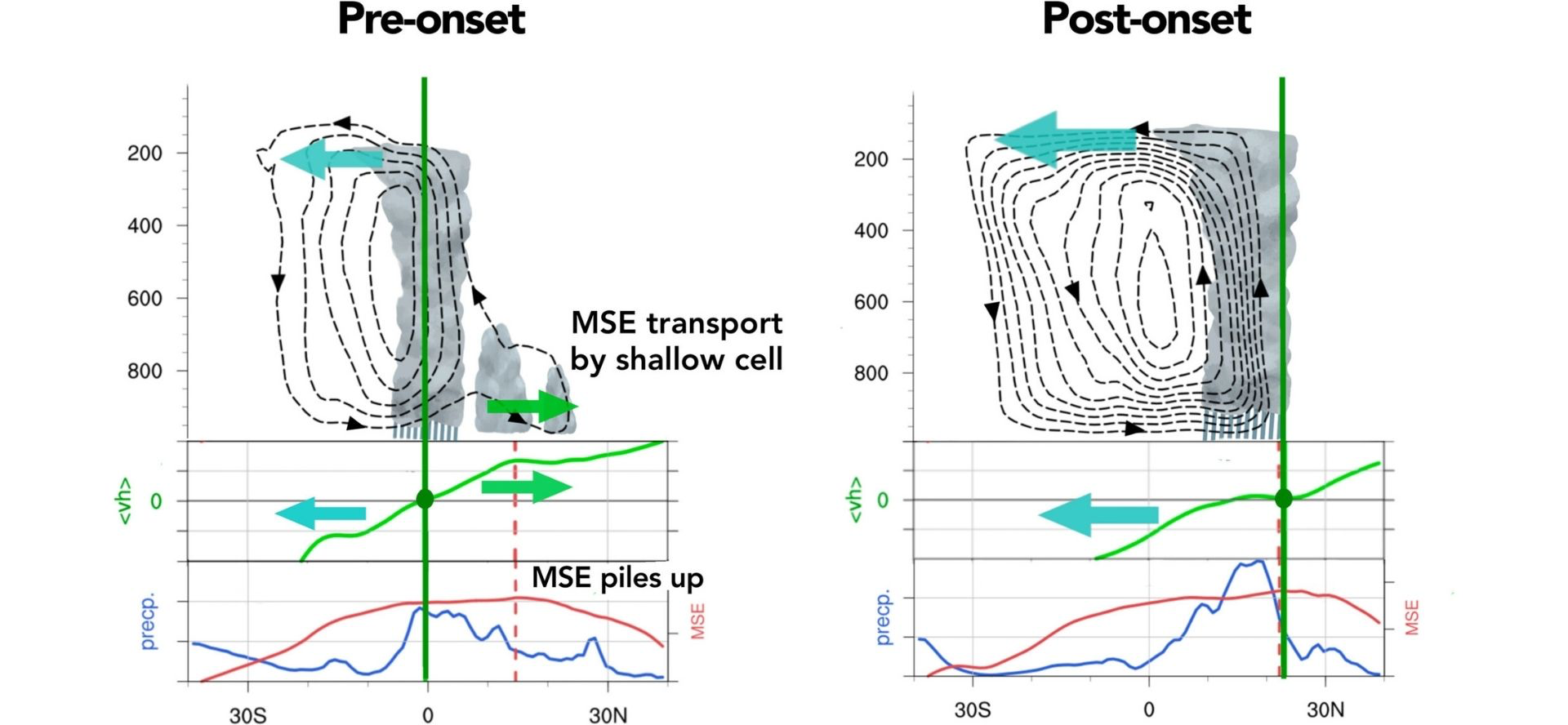
As summer approaches, the South Asian monsoon brings essential rainfall supporting agriculture, water supplies, and daily life for billions of people. However, shifts in its timing or intensity often lead to severe droughts, flash floods, and extreme precipitation. While traditional observational analyses explain monsoon behavior under static conditions, predicting how monsoons respond to a warming climate requires understanding complex interactions between small-scale cloud convection and large-scale atmospheric circulation. Addressing this challenge, researchers from National Taiwan University (NTU) utilized the multiscale SP-CAM climate model to enable direct interactions between clouds and global circulation systems.
Led by PhD candidates Yong-Zhen Chen and Ding-Rong Wu, the interdisciplinary team published two interconnected studies illuminating the dynamic transition of monsoon onset. The first study tracks atmospheric changes weeks prior to outbreak, revealing that shallow convection in the Northern Indian Ocean emerges nearly three weeks early, acting as a conveyor belt that transports low-level heat and moisture northward to fuel cross-equator circulation. The second study delves deeper into cloud-convective aggregation, showing how diverse cloud types organize shallow circulation by concentrating moisture into humid zones rather than dispersing it, thereby dictating the speed of monsoon establishment.
This multi-year research represents a collaborative breakthrough across several NTU Atmospheric Sciences laboratories, directed by Profs. Yen-Ting Hwang, Wei-Ting Chen, Chien-Ming Wu, and Kai-Chi Tseng, with multiscale climate simulations executed by PhD student Kuan-Ting Kuo. By bridging large-scale angular momentum physics with small-scale convection theory, the team establishes a vital physical foundation. These findings pave the way for combining global high-resolution modeling with artificial intelligence to better forecast extreme weather patterns in a changing world.