INHA University
Published on 23 June 2026




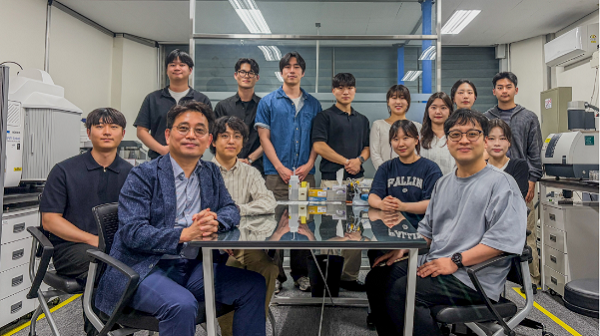
▲The research team led by Professor Choi Jin-seop of the Department of Battery Convergence Engineering.
A research team led by Professor Choi Jin-seop from Inha University’s Department of Battery Convergence Engineering has recently synthesized lithium iron phosphate (LFP) cathode materials using waste stainless steel resources, presenting the possibility of utilizing them as recycled battery materials.
As the electric vehicle (EV) and energy storage system (ESS) markets grow rapidly, the importance of resource circulation and recycling technologies for battery materials is increasing. However, in actual recycling processes, various metal components are mixed together, leaving impurities such as nickel and chromium in iron-based precursors. Until now, complex high-purity refining processes have been applied to remove these impurities, but high costs and energy consumption have posed an industrial burden.
Through experimental analysis and density functional theory (DFT) calculations, the research team confirmed that nickel and chromium impurities play different roles within the lithium iron phosphate structure.
The study found that small amounts of nickel are stably incorporated into the lithium iron phosphate crystal structure, promoting charge transfer and lithium-ion movement while showing excellent high-rate performance. In contrast, chromium is unable to be stably incorporated into the structure and instead separates into an inactive oxide phase, interfering with lithium-ion movement and reducing electrochemical performance.
In particular, the research team confirmed that the best performance balance appears at a nickel content of approximately 1 mol%. They also identified that performance decreases beyond a certain level due to increased structural distortion and defects.
This study is meaningful because it moves beyond the conventional view that impurities must always be removed, presenting a new direction in which impurities can be managed and utilized depending on their type and concentration.
In addition, the study was conducted based on impurity conditions that may occur in actual recycling environments, comprehensively analyzing the structural, electronic, and electrochemical effects of impurities in recycled iron precursors. It also proposed realistic design directions and impurity tolerance standards for recycled lithium iron phosphate cathode materials.
The research results were published in the international academic journal Advanced Science (Impact Factor 14.1 based on 2024 JCR). The study was carried out as part of the Ministry of Trade, Industry and Energy’s project, “Development of New Smelting and Extraction Process Technologies for Extracting and Materializing Nickel and Chromium from Waste Scraps Containing Nickel and Chromium.”
Professor Choi Jin-seop, the corresponding author, said, “This study is meaningful in that it systematically presents which impurities can be tolerated and up to what level.” He added, "In the future, material design strategies that focus on understanding and managing impurity behavior, rather than completely removing impurities, are expected to become increasingly important.”