


Chulalongkorn University
Published on 3 March 2026





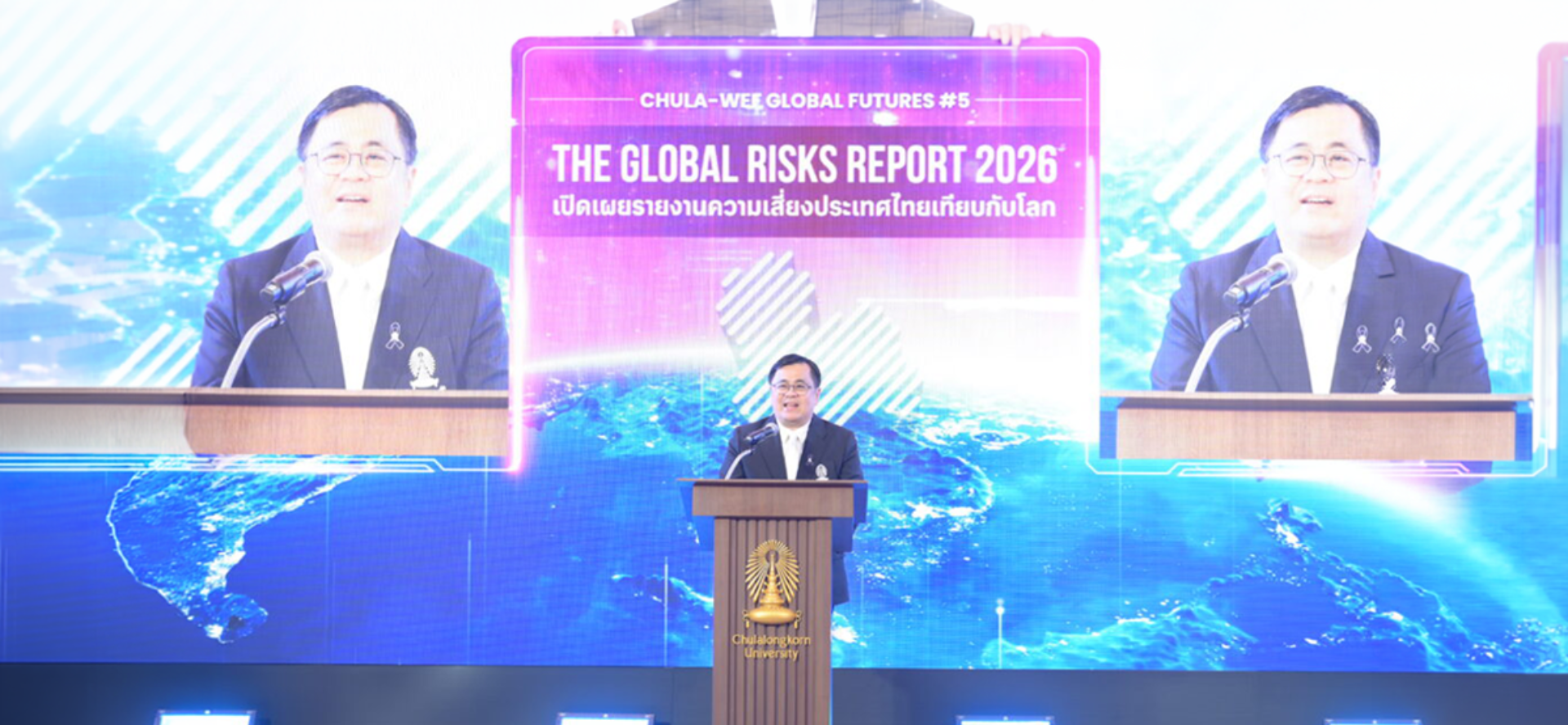
Professor Dr. Wilert Puriwat, President of Chulalongkorn University, presented key findings from The Global Risks Report 2026, for which Chulalongkorn University serves as the sole partner institution in Thailand collaborating with the World Economic Forum. He was joined by Associate Professor Dr. Kanyarat Sanoran, Assistant to the President for Research with International Organizations and Institutional Partnerships, as co-presenter, while Assistant Professor Dr. Nhabhat Chaimongkol, Assistant to the President for Administration and Deputy Spokesperson, served as the moderator.
The report presents assessments of various risks faced by countries worldwide, including Thailand, over the short, medium, and long term. The analysis is based on surveys of 1,300 experts from academia, business, government, the international community, and civil society, as well as 11,000 business leaders from 116 countries and 160 subject-matter experts across the World Economic Forum’s platforms and diverse global networks.
The report identifies critical threats that must be addressed to navigate global volatility and competition, spanning five dimensions of risk: economic, environmental, geopolitical, societal, and technological. It highlights clear differences in risk perceptions at the global, regional, and national (Thailand) levels. Globally, the findings point to concerns over geoeconomic confrontation, state-based armed conflict, extreme weather events, societal polarization, and misinformation and disinformation. In contrast, Thailand faces a distinct set of economic challenges that differ markedly from those of its Southeast Asian neighbors and the global context.
Thailand’s top five risks in 2026 clearly underscore economic concerns. Ranked first is debt (encompassing public debt, corporate debt, and household debt), which stands at only 17th globally. This is followed by economic downturn, lack of economic opportunity or unemployment, adverse outcomes of artificial intelligence technologies, and inequality (encompassing wealth and income). These concerns differ significantly from global and Southeast Asian risk profiles, which do not prioritize debt and inequality to the same extent. The findings indicate that Thailand’s risks are deeply rooted in economic security, highlighting urgent issues that require focused attention and accelerated policy action.
At the global level, the 10-year outlook (to 2036) shifts decisively toward environmental threats. Extreme weather events, biodiversity loss and ecosystem collapse, and critical change to Earth systems rank among the most severe long-term risks. Misinformation and disinformation (currently a major short-term concern) remain significant in the long run, alongside adverse outcomes of artificial intelligence technologies.
The report outlines key strategies for addressing these risks, including national and local regulations, financial instruments, public awareness and education, research and development, corporate strategies, development assistance, multi-stakeholder engagement, minilateral treaties and agreements, and global treaties and agreements. For Thailand, adopting these approaches can enhance resilience to economic instability and emerging environmental threats, in alignment with global best practices.
Professor Dr. Wilert Puriwat emphasized that The Global Risks Report 2026 highlights Thailand’s unique position amid economic and environmental challenges, which differ from global and regional priorities. Thailand must strike a balance between immediate economic recovery and long-term sustainability to ensure a stable future. The report serves as a call to action for policymakers, businesses, and communities to respond with urgency.
Read more at: https://www.chula.ac.th/en/news/290089/

.jpg)

