Chonnam National University
Published on 24 November 2026




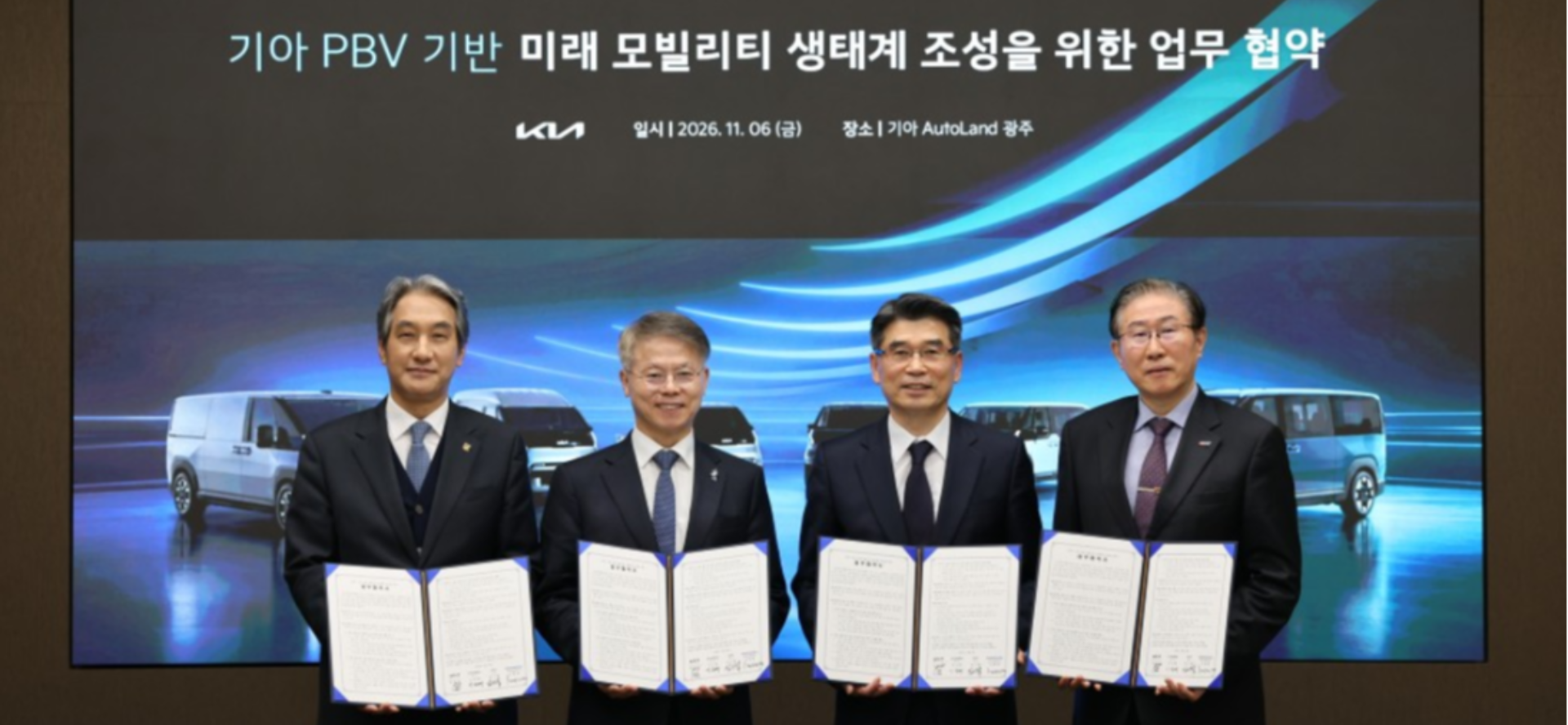
Chonnam National University (CNU) has signed a memorandum of understanding with Kia Corporation, the Jeonnam-Gwangju Special Metropolitan City and the Gwangju Institute of Science and Technology (GIST) to build a PBV-based future mobility ecosystem in the region.
The agreement is attached to a substantial industrial commitment. Kia plans to invest about 3 trillion won (US$2.24 billion) around its AutoLand Gwangju plant to convert the site to next-generation vehicle production by 2029, with advanced manufacturing systems, expanded autonomous driving demonstrations and higher electrified vehicle output.
PBVs are vehicles built around a specific service rather than a single model, and the agreement sets out four demonstrations: a demand-responsive transport vehicle, an autonomous shuttle, remote driving on the wheelchair-accessible PV5 WAV aimed at people with limited transport access, and Easy Swap technology that lets one vehicle switch between freight and passenger use.
Under the agreement, CNU will assign faculty and graduate researchers to the four projects, build training programmes for PBV operations, autonomous driving and mobility service design, run joint industry-academia studies on the operating data the demonstrations produce, and manage commercialisation of the technologies that emerge. CNU students and researchers will work with production vehicles and live operating data from the demonstrations.
The longer commitment is the workforce behind it: the 2029 conversion will require engineers and technicians trained in the region itself.
AI mobility is one of the region's four growth engines, alongside semiconductors, future energy, and next-generation vaccines and precision medicine. CNU has expanded semiconductors and future energy under the government's package-support university programme.
"Chonnam National University will make active use of its capabilities to support the development of the industry," President Lee Keun Bae said.
Kia said it expects the agreement to strengthen the region's PBV industry base. Individual pilots are to be defined and scheduled by the four participating organisations.