Chulalongkorn University
Published on 2 July 2026




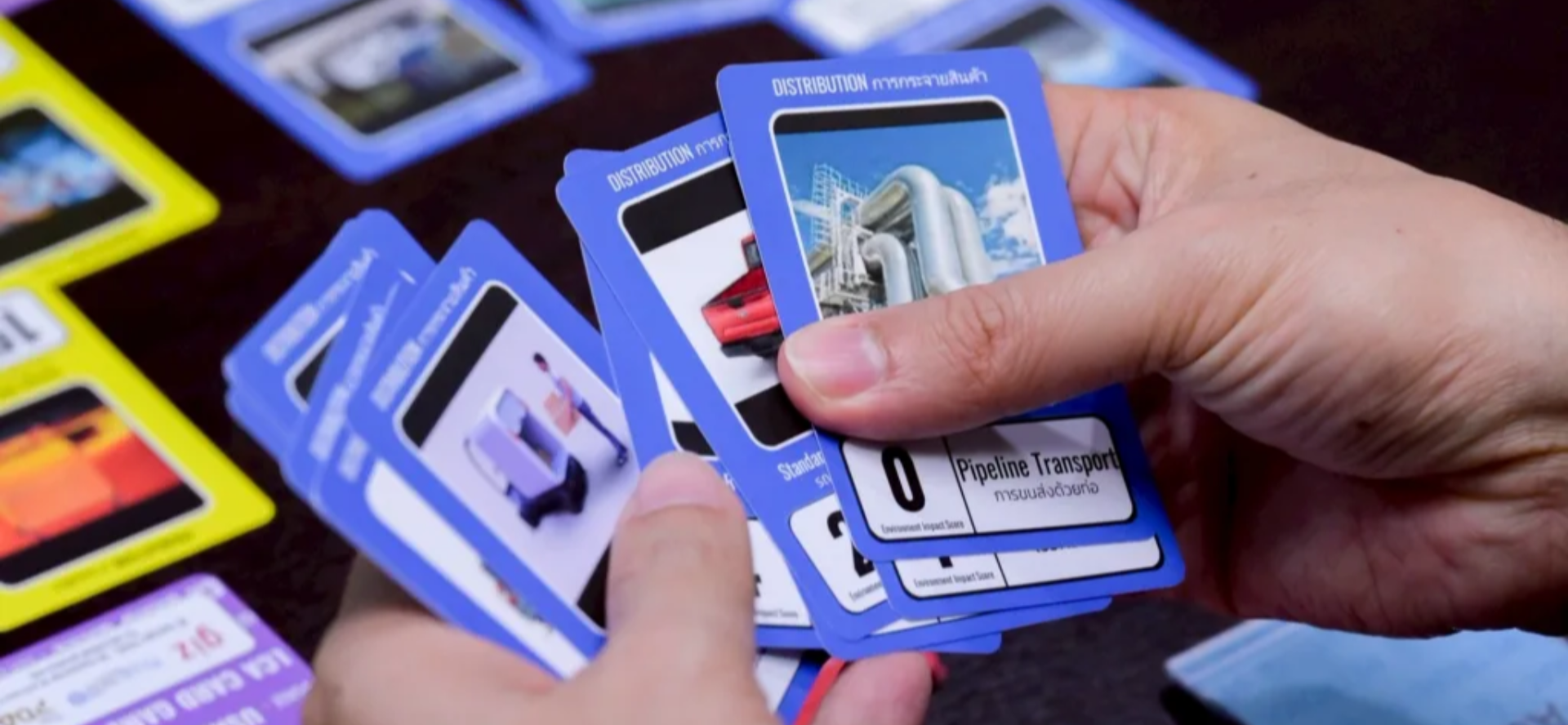
At a time when everyone talks about Net Zero and Carbon Neutrality, many still don’t understand what a “Carbon Footprint” is. Varoon Varanyanond, Industrial Partnership Advisor to the Center of Excellence on Petrochemical and Materials Technology (PETROMAT), Chulalongkorn University, chose not to lecture but instead invited people to play the fun card game, Every Day CO₂ Challenge, to understand the meaning of these terms for themselves.
When lectures don’t work, games are the answer.
The story of this game originated with the MA-RE DESIGN project, funded by GIZ (Deutsche Gesellschaft für Internationale Zusammenarbeit), an agency under the German Ministry of Environment, with the main objective of reducing the amount of unmanaged plastic waste flowing into the sea.
Varoon Varanyanond, Industrial Partnership Advisor to the Center of Excellence on
Petrochemical and Materials Technology (PETROMAT), Chulalongkorn University
As an expert in Life Cycle Assessment (LCA), Varoon participated in this project as an Eco Design consultant, focusing on product design that considers impacts from upstream to downstream. However, he discovered during his work that the understanding of LCA in Thailand was still limited. Although this principle is used as an international standard worldwide,
“When I was a speaker at various forums and projects, it became increasingly clear that this concept was difficult for the average person to understand. Traditional lectures were no longer sufficient. ” Varoon recounts the story that sparked the Every Day CO₂ Challenge card game.
What is LCA, and why is it important?
Life Cycle Assessment (LCA) is an international methodology used to measure the environmental impacts of a product throughout its life cycle, from beginning to end. The LCA methodology is accepted worldwide.
The 5 Stages of the Product Life Cycle (LCA)
Stage 1 — Acquisition of Raw Materials: Where do the materials come from, and how are they produced?
Stage 2 — Production: How are raw materials transformed into finished products?
Stage 3 — Transportation: How are products delivered from the factory to stores and consumers?
Stage 4 — Usage: How are products used, and for how long?
Stage 5 — Disposal: How are products disposed of, recycled, or otherwise managed at their end-of-life stage?
The problem is that most people focus only on a product’s use and disposal, overlooking the many processes a water bottle or mobile phone undergoes before reaching our hands, as well as the amount of greenhouse gases emitted at each stage.
Why a “Card Game”?
Varoon himself has loved playing games since childhood, both computer games and card games. He believes that if complex content is incorporated into a game, people can have fun while learning. He spent a long time searching for a game that could teach people about LCA and Carbon Footprint, but when he couldn’t find one that met his needs, he decided to create his own.
A card game was chosen because it has several features that meet his needs: it creates interaction between players, encouraging discussion and exchange; it can be played in about 20-30 minutes, suitable for short training sessions; and most importantly, card games are fun and exciting, a timeless appeal for both children and adults.
The game is designed for a wide range of players, from elementary school students to teachers and members of the general public interested in the topic. It supports 3-8 players (6-8 players for maximum fun). Each player receives 5 cards, each card representing a stage of LCA: Raw Materials, Production, Transportation, Usage, and Disposal.
The points on each card represent the amount of greenhouse gas (CO₂) emissions generated at each stage. The lower the score, the lower the emissions and the better the outcome for the environment. Players aim to collect cards with the lowest total score.
The game is divided into 3 main rounds. In the first round, players look at their cards and assess their scores. In the second round, players begin discarding and swapping cards while explaining why they discarded them. The game becomes even more exciting with the addition of Action Cards—special blue cards that allow players to swap cards with one another, introducing an element of surprise, bluffing, and strategic decision-making. The player with the lowest total score at the end of all rounds wins.
What makes this game unique is the role of the “Game Master,” who asks players questions during card discarding. “Why is this card discarded?” “Why is the score high?” or “Why is air transport more expensive than sea transport?” When players are fully engaged in the game, asking questions can help deepen their understanding and reinforce key concepts.
The scores on each card are based on data from internationally recognized environmental impact assessment databases and have been adapted for the card game purpose. For example:
Virgin aluminum has a high score, but recycled aluminum has a much lower score.
Using solar power in the manufacturing process results in a lower score than heat treatment.
Bicycles have a lower carbon footprint than cars.
Cars have a lower carbon footprint than air transport.
Single-use goods have a high score.
Recyclable or repairable goods have a lower score.
Most importantly, these numbers are for learning and comparison purposes only, not for academic research. However, comparing “whether this card is higher or lower” still reflects the reality of the LCA cycle.
From Simple Paper Cards to the First 50 Sets of Recycled Plastic Cards
The game began as a set of simple printed paper cards. After the Thai Packaging Design Association (ThaiPDA) recognized its potential and supported its development, the project secured private-sector support through GIZ. This led to the production of 50 beautifully designed bilingual (Thai-English) sets made from recycled plastic.
The game was subsequently tested with a wide range of participants, including elementary and high school students, university students, faculty and staff from various institutions, seminar participants, and members of the public from the business sector. It received positive feedback from all groups.
Most interestingly, many players began asking questions during the game, such as “Why does virgin aluminum have a higher score than recycled aluminum?” or “Why do single-use items have such high scores?” This is the ultimate goal of the game: not just to memorize, but to encourage questioning.
Why a game in an era where AI can answer everything better than a human teacher?
One of the most interesting questions in this era is, when AI can explain complex topics better than experts, is traditional teaching still necessary? Varoon clearly answered that what AI is unable to replace is “the fun that comes from actually sitting together.”
“AI is far superior to us in terms of content now. They have all the information and can explain things in more detail than I can. Therefore, we have to adapt that content and transform the teaching format to make it fun, concise, and not overly complex,” Varoon explained.
The game incorporates key gamification elements, including competition, rewards, interaction, and the unpredictability introduced by Action Cards, which can change the outcome at any moment. Active learning is woven throughout the game, requiring players to explain their decisions and engage in discussion prompted by the game leader. The goal is to achieve a “just-right” balance between knowledge and enjoyment—not so much content that it feels like a lesson, but not so little that learning is lost.
Future Game Development
When asked about future plans, Varoon clearly stated that they would not develop an online game because it would lose the interaction between players, which is the heart of learning. “The fun of sitting together, laughing together, and bluffing each other face to face cannot be replaced by any screen.”
What they are currently developing is a new game with the same concept, but aimed at the organizational level rather than the product level, to help personnel within organizations understand environmental impacts in a broader dimension. Currently, they are refining the format to make it fun and not overly complex.
The Power of the New Generation: Learning, Awareness, Action
He left three messages for the new generation:
Raise awareness: Acknowledge that the environmental problems created by previous generations will inevitably affect you. Don’t lose hope, but use that energy to push those in power today to make changes.
Learn deeply: In an age of abundant information from AI and the internet, it is important to distinguish between topics that require a broad understanding and those that warrant deeper investigation, while also identifying the root causes of complex issues.
Change behavior: When buying things, don’t just look at whether they are “pretty” or “cheap,” but think about “what it’s made of, how it’s transported, and how the waste will be disposed of after use.” Looking at the big picture across all five steps is the first step towards an environmentally friendly lifestyle.
Varoon concluded by saying, “Don’t give up, and don’t wait for change to happen on your own. The strength of the younger generation lies in inspiring others, parents, bosses, or community leaders, to believe that small actions can make a difference and that meaningful change is possible when we act together.
Read more at: https://www.chula.ac.th/en/highlight/415033/