INHA University
Published on 2 July 2026




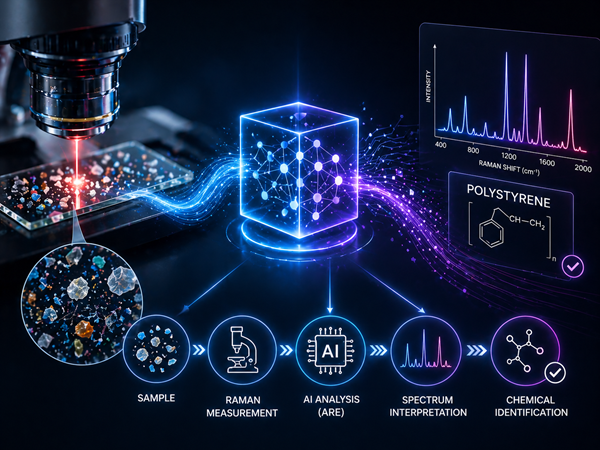
▲Conceptual diagram of the AI-based autonomous Raman analysis system, “Artificial Raman Expert (ARE)”
A research team led by Professor Shin Dong-ha from Inha University’s Department of Chemistry has developed an AI-based analysis system called Artificial Raman Expert (ARE), enabling artificial intelligence to perform Raman spectroscopic analysis.
Raman spectroscopy is a representative technique used to analyze the chemical structure of materials, but it has traditionally depended heavily on expert experience for setting measurement conditions and interpreting data.
The ARE system developed by the research team allows artificial intelligence to carry out this expert analysis process. When sample information and analysis objectives are entered, the system independently plans laser conditions and measurement strategies, evaluates the analytical results, and readjusts the measurement conditions through an autonomous analysis process.
A paper on the ARE system was published in the international academic journal ACS Sensors (Impact Factor 9.1, top 5% in JCR) and was also selected as an Editors’ Choice article—a distinction awarded by the journal’s editors to particularly significant research.
In addition, the research team proposed statistical analysis standards to improve the reliability of nanoplastic analysis data. The study suggested that at least approximately 510 particles must be analyzed to estimate plastic composition with an accuracy of ±5% at a 95% confidence level.
These findings were recently published in the international journal Trends in Environmental Analytical Chemistry (Impact Factor 13.4, top 1% in JCR), a leading journal in environmental analytical chemistry.
Professor Shin Dong-ha said, “This research presents a way to simultaneously solve two major challenges in Raman-based nanoplastic analysis: data reliability and analytical automation. We plan to apply AI-based analytical technologies to a wide range of environmental and materials analysis fields in the future.”

▲Conceptual diagram illustrating the statistical limits in nanoplastic analysis