Chulalongkorn University
Published on 29 May 2026




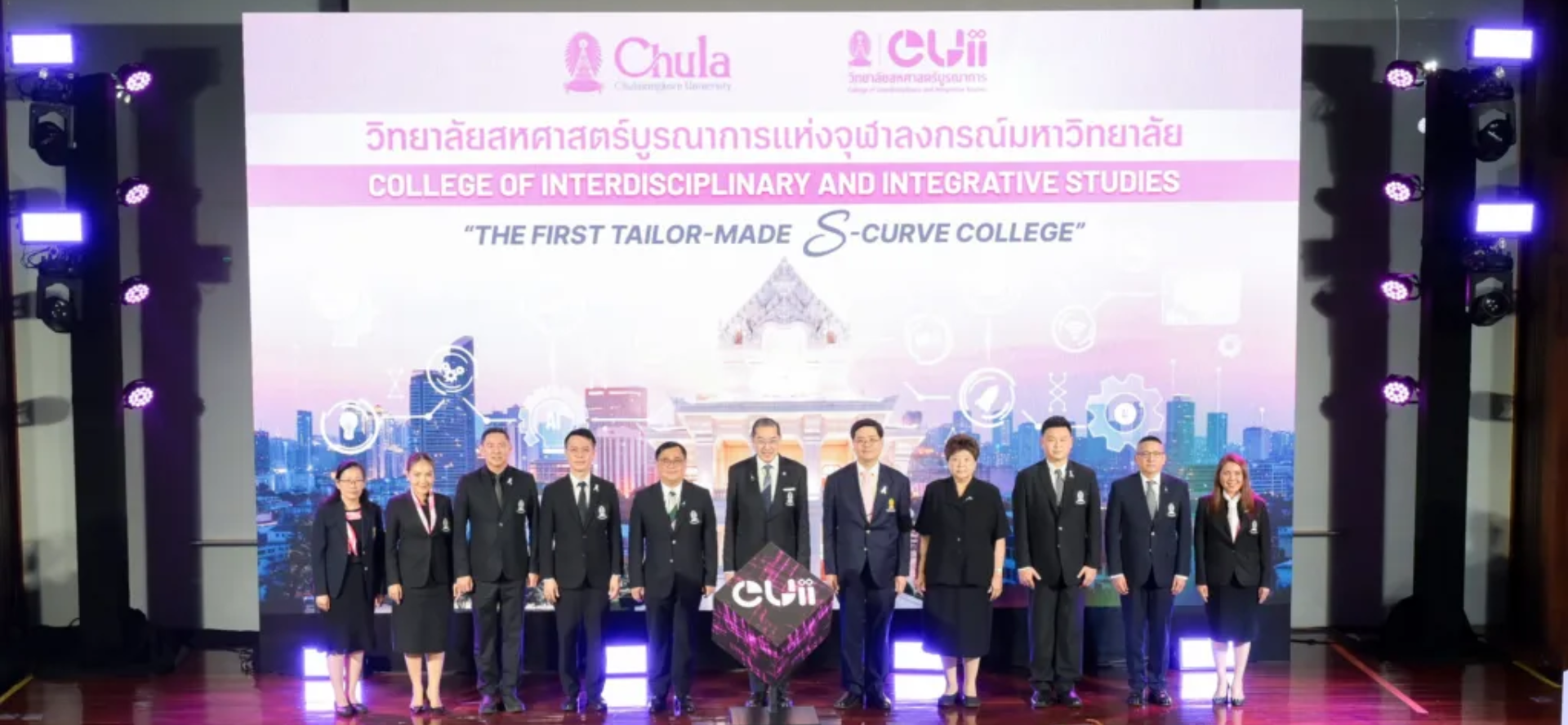
Chulalongkorn University held a press conference to officially launch the Chulalongkorn University College of Interdisciplinary and Integrative Studies (CUii) to advance interdisciplinary education in response to the demands of the modern world. The college will offer programs from undergraduate to doctoral levels under the concept of The First Tailor-made S-Curve College. CUii will serve as a central platform for integrating knowledge across disciplines to cultivate highly capable individuals who can drive the country’s future through innovation and integrated solutions to global challenges.
The press conference took place on May 19, 2026, at the Chalerm Rajakumari 60 Building (Chamchuri 10). The event was presided over by Prof. Dr. Surakiart Sathirathai, Chairman of the Chulalongkorn University Council who delivered the opening remarks. Prof. Dr. Wilert Puriwat, President of Chulalongkorn University, shared the university’s vision for shaping the future of education, while Assoc. Prof. Dr. Thiti Bovornratanaraks discussed the background, mission, and role of CUii in developing an education system that truly responds to global transformation.
Prof. Dr. Surakiart Sathirathai, Chairman of the Chulalongkorn University Council, stated that the establishment of CUii is a strategic initiative designed to address major global shifts, including artificial intelligence (AI), demographic transformation, and geopolitics. The establishment was officially announced in the Royal Gazette and became effective on January 24, 2026. He described it as a historic milestone that marks the transition of universities from merely “adapting to the world” to actively “shaping the future” by producing graduates capable of solving complex challenges facing Thailand and the global community.
He further emphasized that today’s global challenges—including AI, climate change, aging societies, and geopolitical tensions—cannot be solved through a single discipline alone. Interdisciplinary integration among faculties and academic fields is therefore essential for developing future-ready curricula and talent. He also highlighted the importance of lifelong learning, enabling students, staff, and the general public to continuously upskill and reskill. In addition, he noted that the role of educators must evolve from “knowledge transmitters” into “coaches” or “mentors” with real-world experience promoting action-based learning in collaboration with businesses, government agencies, and civil society.
Prof. Dr. Wilert Puriwat, President of Chulalongkorn University, stated that the launch of CUii marks a significant step in educational development to meet contemporary global challenges. The college aims to create a lifelong learning ecosystem that connects knowledge across faculties and disciplines, allowing learners to integrate multiple fields of study in practical ways. He noted that the modern world requires individuals who can think across boundaries, collaborate with experts from diverse backgrounds, and tackle complex national issues. CUii is therefore positioned as a center for integrated knowledge, connecting government, industry, and international networks to develop innovations with practical and measurable impact.
Prof. Dr. Wilert stressed that CUii is not merely an academic space but also a collaborative culture that transforms diversity into creative power. Its mission is to nurture a new generation capable of moving beyond traditional academic boundaries and contributing to the future direction of Thai society. The college is already advancing through interdisciplinary programs that clearly respond to the demands of learning and work in today’s world.
“Universities today can no longer focus solely on producing specialists in isolated fields. The AI and innovation era requires people with multidisciplinary knowledge who can integrate expertise to solve real-world problems. The College of Interdisciplinary and Integrative Studies therefore aims to promote interdisciplinary learning and develop a new generation equipped with both specialization and broad-based capabilities. The university’s role must evolve from being a ‘follower’ to becoming a ‘future shaper’ through curriculum design and skill development aligned with the future workforce and global society,” said the President of Chulalongkorn University.
CUii also revealed that the university has transformed the former Graduate School into the College of Interdisciplinary and Integrative Studies in order to support interdisciplinary education at all levels, from undergraduate and graduate programs to lifelong learning.
The college focuses on integrating interdisciplinary knowledge with modern technologies such as artificial intelligence (AI) and digital innovation to enhance teaching, learning, and research quality. It also aims to develop learners with well-rounded capabilities, including creativity, analytical thinking, and entrepreneurial skills.
CUii additionally serves as a hub for collaboration among faculties, institutions, and sectors both domestically and internationally to support joint knowledge creation and innovation. At the same time, it seeks to strengthen General Education (GenEd) courses to foster broader perspectives and sustainable social value.
The event also featured a panel discussion titled “Interdisciplinary Programs for the Future: Designing Learning to Meet a Changing Society,” where experts from various fields exchanged perspectives and experiences on developing interdisciplinary curricula for practical implementation. Asst. Prof. Dr. Pichaya Rachdawong from the Energy Technology and Management Program and Asst. Prof. Dr. Kavin Asawanant from the Technology and Innovation Management Program (CU TIP) shared approaches to curriculum development aligned with industrial transformation. Mr. Krida Kritiyachotipakorn, Deputy Director General, Revenue Department presented examples of academic collaboration in developing the Master of Arts Program in Taxation Management, demonstrating the practical application of interdisciplinary knowledge.
Meanwhile, Asst. Prof. Dr. Amornpun Sereemaspun from the Biomedical Sciences and Vela programs, together with Asst. Prof. Dr. Sojiphong Chatraphorn at the Faculty of Science, presented interdisciplinary curriculum development in quantum technology to prepare future talent for scientific and technological advancement. Pensiri Na Nakhon Phanom, a student in the CU TIP program, also shared her experience applying interdisciplinary knowledge to business development and entrepreneurship.
The launch of CUii represents more than a transition from the former Graduate School; it signifies the elevation of the institution into a center for interdisciplinary integration that connects academia, industry, and society to develop learning models aligned with social transformation and national needs.
Currently, CUii offers master’s and doctoral degree programs across 21 academic disciplines and 37 programs, covering four major clusters: Health Sciences, Science and Technology, Humanities and Social Sciences, and Interdisciplinary Studies. The programs are designed to promote integrated learning and develop a workforce prepared for social, economic, and technological change.
Read more at: https://www.chula.ac.th/en/news/409684/