CUHK leads international conversation at APAIE 2026

The “Study in Hong Kong” brand shone brightly in February, as The Chinese University of Hong Kong (CUHK) welcomed over 3,500 delegates from 72 countries and regions to the Asia‑Pacific Association for International Education (APAIE) 2026 Conference and Exhibition – one of the world’s three most prominent international education conferences.

Over five days, delegates explored the future of higher education under the theme “Asia‑Pacific Partnerships for the Global Good”. Across some 130 sessions, universities and education leaders exchanged ideas and strengthened Hong Kong’s role as a bridge between East and West.

Setting the tone for a purposeful week

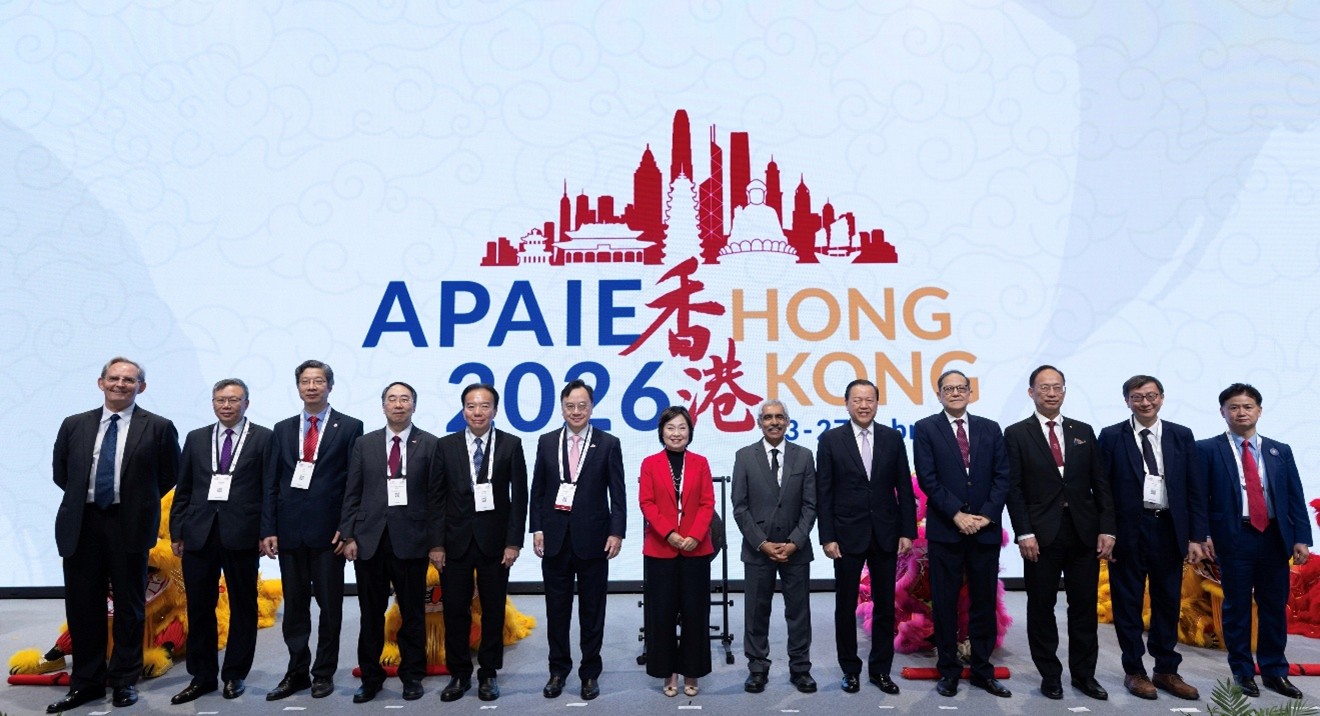
The conference opened with remarks by APAIE President Professor Venky Shankararaman, CUHK Vice‑Chancellor and President Professor Dennis Lo Yuk-ming, and HKSAR Secretary for Education Dr Christine Choi Yuk‑lin.

Professor Shankararaman highlighted three enduring Asian principles – interdependence, harmony and universal responsibility – as values that offer strikingly modern answers to the sector’s most urgent questions and underscore the power of partnership for the global good.

Professor Lo expressed gratitude for CUHK’s opportunity to host the event again after 13 years, and emphasised this year’s theme captured a shared responsibility among universities worldwide to contribute diverse strengths and perspectives across borders and disciplines.

The ceremony also featured a spirited lion dance and eye‑dotting ceremony, hallmark of Hong Kong’s traditions. Award‑winning Hong Kong filmmaker Robin Lee shared insights from his documentary Four Trails, noting that Hong Kong’s cultural diversity is a prime attraction for international students. He encouraged the audience that everyone has their own four trails, each meaningful and unique.

Trust and resilience at the top

At the Presidents’ Dialogue, 25 university presidents and 45 senior leaders discussed intertwined risks reshaping higher education, from disruption driven by artificial intelligence to geopolitical tensions, climate change, demographic shifts and the spread of misinformation and disinformation. Under the theme “Building Resilience and Trust in an Era of Global Risks”, they explored strategies to future‑proof educational systems, accelerate innovation and cultivate resilient partnerships.

The leaders expressed optimism about the value of collaboration. Professor Lily Kong, President of Singapore Management University, highlighted the abundance of avenues that international engagement could unlock. She added that APAIE’s gathering of delegates from across the world signalled a strong appetite for collaboration and left her with optimism and hope.

Professor Helena Ramalhinho, Vice‑Rector for Internationalisation at Pompeu Fabra University in Spain, said that today’s problems could not be solved by a single city or country; for students and researchers alike, understanding global issues made international partnership indispensable.

International students’ voices

The Student Plenary, “Global Perspectives on Student Success in Hong Kong”, co‑chaired by CUHK’s Professor Irwin King and Hong Kong Baptist University’s Dr Albert Chau, gave eight students from seven countries a platform to reflect on how the city had shaped their academic journeys and personal growth.

Shiven Garg from India, a CUHK PhD student, shared how joining student clubs built his leadership skills and praised Hong Kong’s innovation ecosystem. “Hong Kong is the Silicon Valley of Asia. If you have an idea and want to bring it to reality, Hong Kong is the right place to be.”

Across the panel, students emphasised Hong Kong’s combination of academic rigour, innovation and unparallelled global connectivity, which empowers graduates to build networks that extend far beyond the region.

This event brought together all eight University Grants Committee funded universities to showcase Hong Kong’s worldclass academic excellence, innovation driven economy and cosmopolitan character. As a founding APAIE member and the 2026 lead host, CUHK reaffirmed its commitment to developing impactful global partnerships and nurturing future global citizens.

A photo feature on APAIE 2026 can be found here.
From safer prenatal tests to early cancer detection

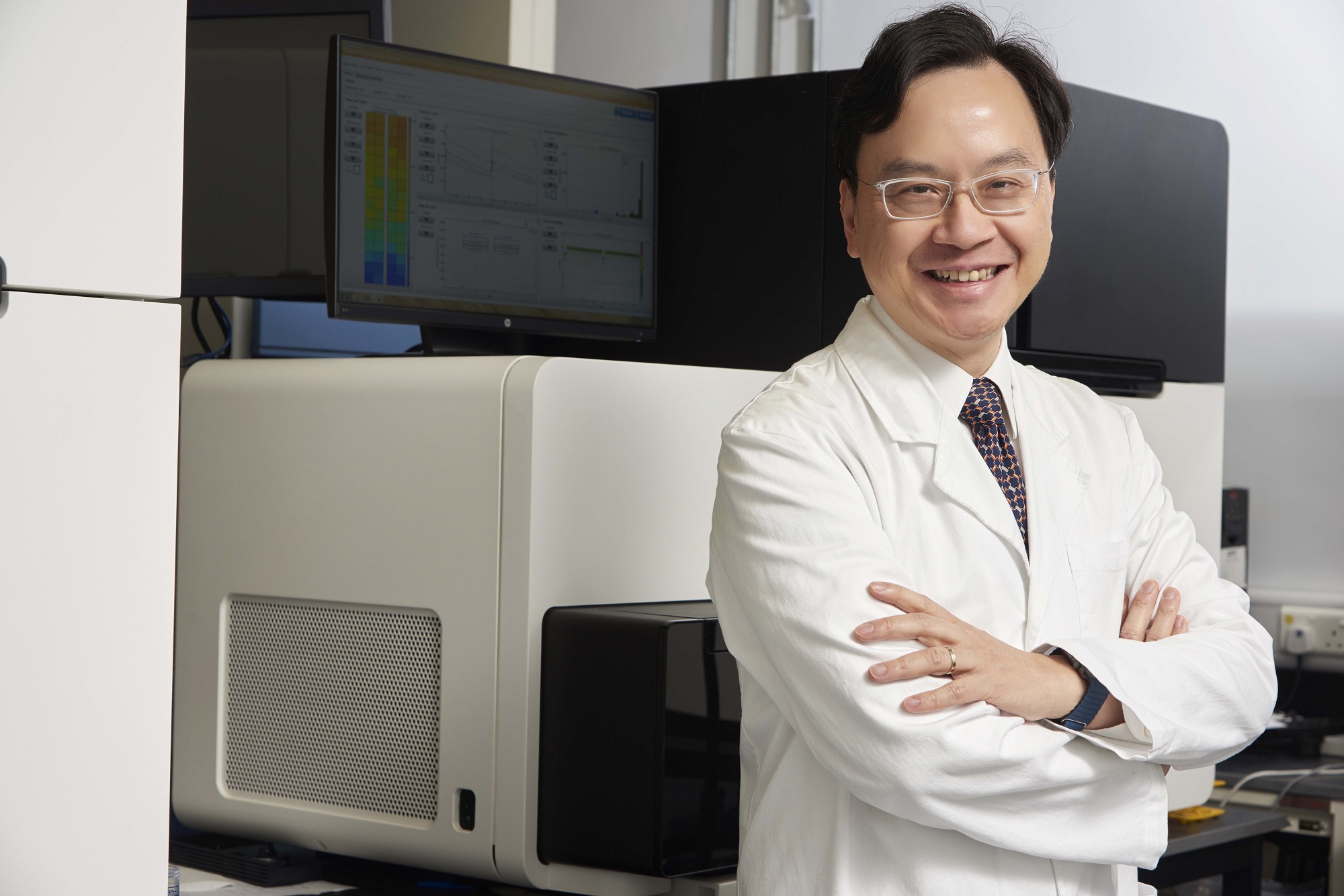
CUHK’s Faculty of Medicine is home to a team of leading researchers who contribute extraordinary expertise to Hong Kong’s public healthcare system. Among them is Chemical Pathology Professor Dennis Lo Yuk-ming, often referred to as the “father” of Non-invasive Prenatal Testing (NIPT). Last year, he was awarded America’s top biomedical research prize for his discovery, which has revolutionised prenatal testing for Down syndrome. That clinical breakthrough has also laid foundations for the early detection of multiple types of cancer, creating life-changing impacts on patients around the world.

About one in 700 children around the world is diagnosed with Down syndrome, a chromosomal disorder caused by the presence of an extra copy of chromosome 21 in a human embryonic cell, itself associated with delayed physical growth and intellectual disability.

Traditionally, expectant mothers opting to take early pregnancy tests to detect whether their children might have Down syndrome bore the risk of miscarriage, as certain tests needed to penetrate the womb near the foetus. That changed after Professor Lo, who is also Associate Dean (Research) of CUHK’s Faculty of Medicine, entered the international research scene. “Previous testing methods such as nuchal translucency scan and blood testing did not have high accuracies,” says Professor Lo. “Amniocentesis, another invasive test with relative higher accuracy could cause miscarriages. I was therefore motivated to develop a safe alternative with a high accuracy.” He started working on a solution in 1989, while still a medical student at the University of Oxford.

A correct hypothesis

Professor Lo’s approach was to search and test for foetal cells in pregnant women’s blood, balancing research while studying for finals. “At first, the research didn’t go very smoothly – the number of foetal cells was too small to be translated into clinical medical diagnosis,” recalls Professor Lo.

He returned to join CUHK in 1997, determined to make a breakthrough. “I came across two articles about cancer patients carrying cancer DNA in their plasma or serum, from which I thought – tumours grow in patients’ bodies in a way somewhat similar to foetuses developing in wombs. While many scientists at that time had a general assumption that DNA belonged only within a cell, I took the bold move to propose that foetal markers could also be found in maternal plasma. It turned out to be a correct hypothesis.”

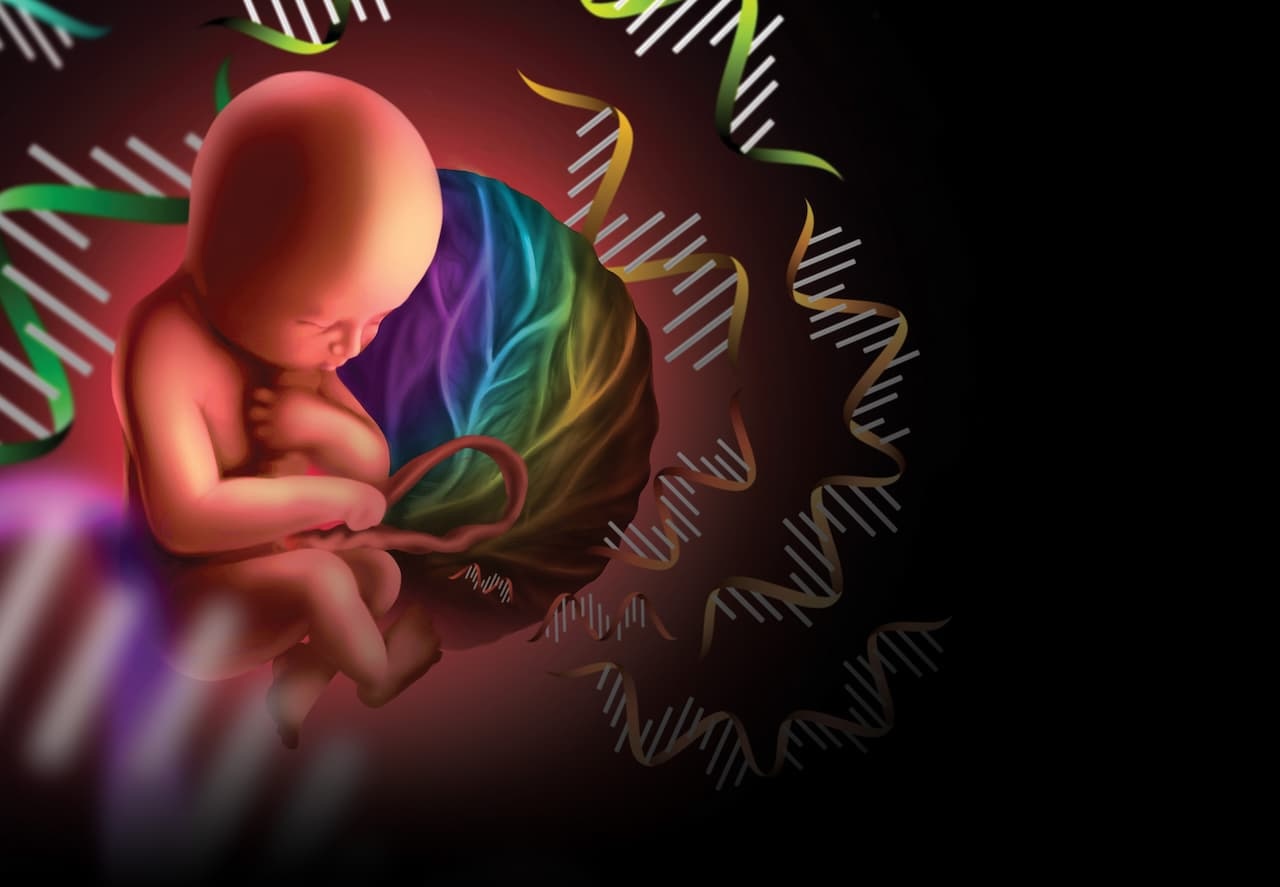
Building on the momentum, Professor Lo’s team eventually identified the ratio of chromosomes via massive parallel sequencing to efficiently use the information stored in plasma DNA. They found a way to use critical information stored in plasma DNA to detect the presence of a foetus with Down syndrome to an accuracy higher than 99%.

A paradigm shift

“Our research created a paradigm shift in prenatal medicine,” Professor Lo acknowledges. Since its introduction to clinical practice in 2011, NIPT has been adopted globally, helping expectant mothers in over 60 countries. “The technology has now become the standard prenatal testing method for Down syndrome, obviating the need for invasive methods in many pregnant women.”

The Hong Kong Hospital Authority has been providing NIPT tests for free since 2019. On the mainland, over 60% of expectant mothers each year have taken the test, and some insurance companies overseas now include it in their policy coverage.

Professor Lo credits CUHK with its comprehensive platform for conducting research. “CUHK demonstrates its leading practices in intellectual property and patent creation. It allows my teammates and me to conduct research in a friendly and supportive environment. Our team has developed a close relationship with other departments of the University,” says Professor Lo.

From womb to head and neck

For Professor Lo, success in Down syndrome detection was just the beginning. “While insights into cancer is where I got my burst of inspiration for NIPT, I started probing cancer screening by developing ‘NIPT-like’ technologies. Our team began with asymptomatic nasopharyngeal carcinoma (NPC), which is the 12th leading cause of cancer deaths in Hong Kong.

“In 2017, we demonstrated that plasma Epstein-Barr virus (EBV) DNA analysis is useful in screening for NPC. Previously, most NPC patients in Hong Kong were identified at stages 3 and 4. With this technology, 70-75% can be identified at stages 1 and 2,” says Professor Lo.

In 2019, Professor Lo became the co-founder of healthcare startup Take2 Health at the Hong Kong Science Park which offers NPC screening services in Hong Kong.

The NPC study gave rise to a multi-cancer early detection (MCED) test, a method to screen for many types of cancer simultaneously. The test enables cancer markers to be detected through a simple blood draw, a landmark achievement hailed as one of Time magazine’s best inventions of 2022.

Freer flows, bigger samples

Efforts by Professor Lo to achieve even greater impact with his research face hurdles outside the laboratory. “Barriers in the flow of samples are making research a more challenging task,” he says. “I hope that the flow of samples between Hong Kong and the mainland can be strengthened. Apart from innovative ideas and insights, access to large sample sizes is always crucial for clinical research.”

More than just a clinician, Professor Lo is also a medical scientist and an entrepreneur. “Having received training as a scientist, I am well aware of the development of latest scientific technologies. As a doctor, I am more sensitive to how these technologies can possibly help patients. My entrepreneurial expertise enables me to venture beyond laboratories. I actively engage with the real world and thoroughly understand the actual needs of society while remaining down-to-earth. It also allows me to draft more comprehensive patents for inventions,” he says.