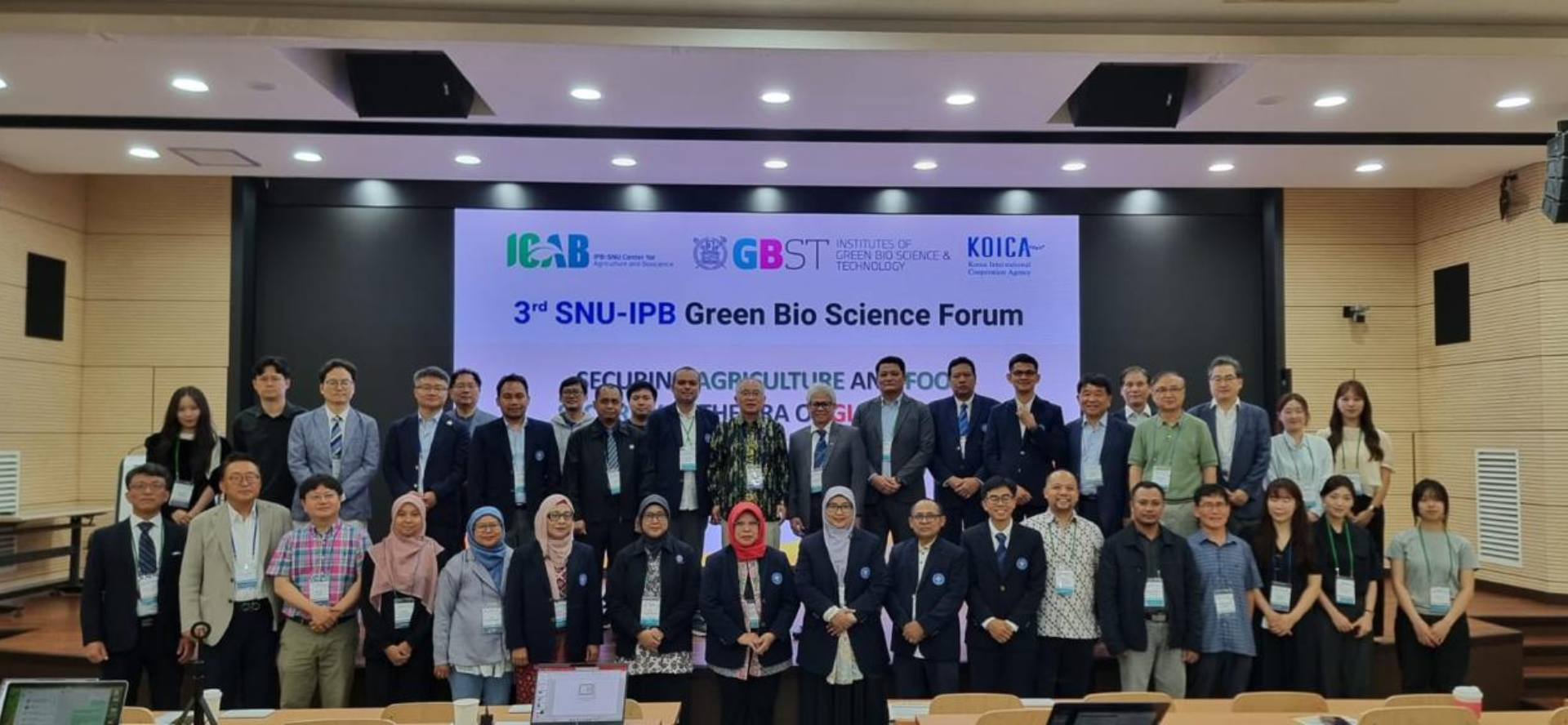
IPB University, in collaboration with Seoul National University (SNU) supported by the Korea International Cooperation Agency (KOICA), continues to advance the KOICA–ICAB Project: Capacity Building for the Center for Agriculture and Bioscience of IPB University in Indonesia.
This seven-year initiative (2022–2028), valued at USD11 million, aims to establish the National Instrumentation Center for Agriculture and Bioscience (NICAB) as a national shared research facility supporting innovation, advanced research, and sustainable development.
Since its launch in 2022, the project has focused on strengthening research facilities and infrastructures, as well as enhancing human resource capacity and fostering innovation in the green biosciences. Key activities include the construction of new laboratories, the modernization of existing facilities, and the provision of advanced academic and professional training programs. The project supports IPB University’s mission to become a leading center of excellence in bioscience and environmental management.
As of October 2025, several major milestones have been achieved. The architectural design for the NICAB building has been finalized, the Advanced Research Laboratory (ARLab) remodeling has been completed, and the Animal Cell Culture Laboratory was officially inaugurated during the second KOICA–ICAB Steering Committee Meeting in September 2025. In addition, eight training programs have been conducted, four IPB faculty members are currently pursuing Ph.D. degrees at SNU, and three faculty members from the National University of East Timor (UNTL) are undertaking graduate studies at IPB University, one of whom completed an M.Sc. last year.
The beneficiaries of the project include IPB faculty members, researchers, and students, as well as academic partners from Universidade Nacional Timor Lorosa’e (UNTL), Timor-Leste. With active involvement from Indonesia’s Ministry of Higher Education, Science, and Technology; Ministry of Forestry; and the National Research and Innovation Agency (BRIN); the KOICA–ICAB project also strengthens cooperation between academia, industry, and government.
Through the KOICA–ICAB Project, IPB University reinforces its role as a leading center of excellence in agriculture and bioscience, while further deepening cooperation between Indonesia and the Republic of Korea. By 2028, NICAB is expected to be fully operated as a national shared research facility.
and bioscience, while further deepening cooperation between Indonesia and the Republic of Korea. By 2028, NICAB is expected to be fully operated as a national shared research facility.