Sogang University
Published on 25 August 2026




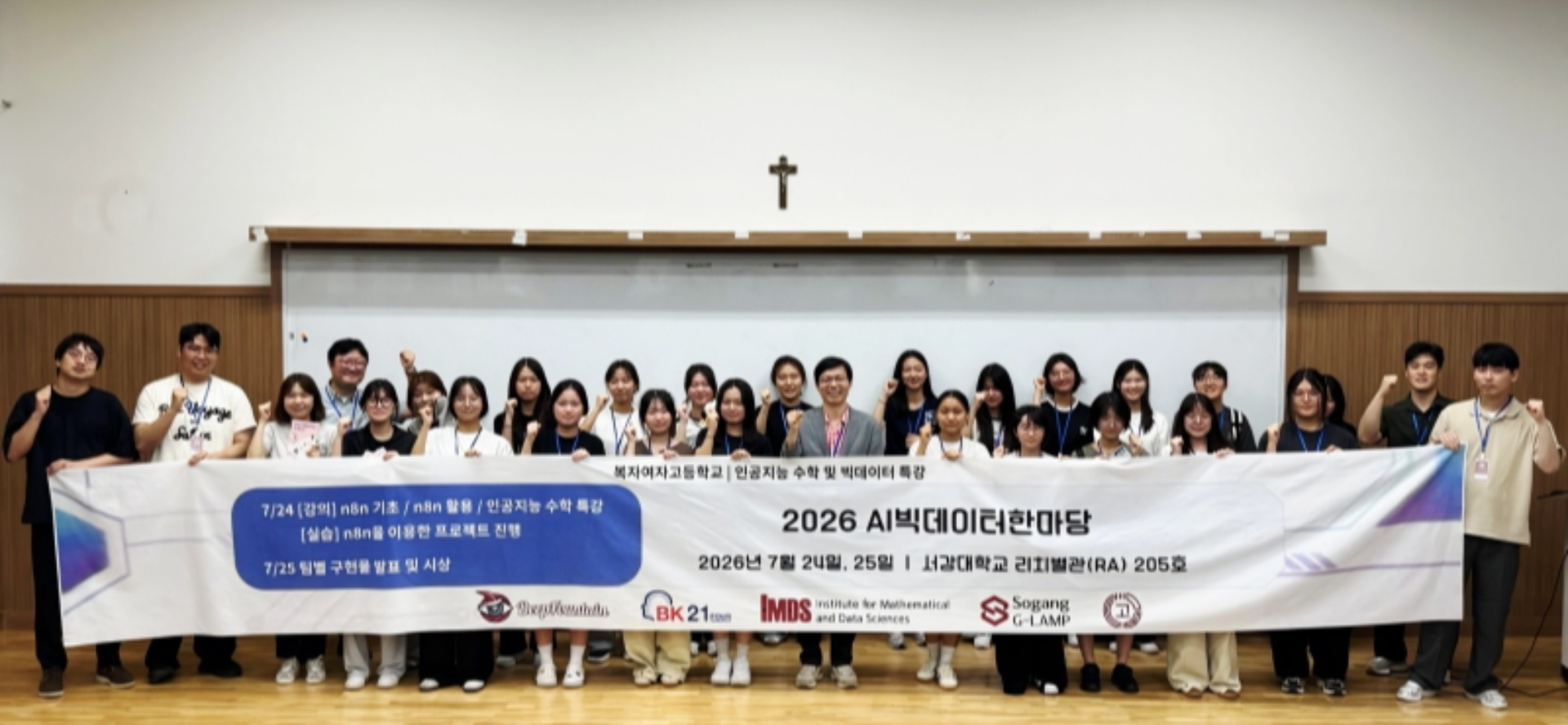
On July 24 and 25, Sogang University hosted the 2026 AI Big Data Festival, bringing together 22 students and 3 teachers from Bokja Girls' High School alongside 6 members of Professor Jon-Lark Kim's research team from the Department of Mathematics. The event marked the seventh consecutive year of educational exchange between the two institutions — and the most ambitious iteration yet, shifting from lectures and demonstrations to a hands-on mini-hackathon format in which students designed and built their own AI services.
The evolution reflects a deliberate progression. In 2024, the program covered natural language processing and data normalization through structured lectures. In 2025, sessions expanded to include the history of AI, mathematical foundations, an AI agent called Sogangbot, and applications of genetic algorithms and coding theory. This year, that accumulated knowledge became the basis for student-led creation.
Professor Jon-Lark Kim opened the event with a lecture on the development of AI and the mathematical principles underlying machine learning and deep learning, pitched at a level accessible to high school students. He was followed by members of his research team, who led hands-on sessions on AI agents, the n8n workflow automation platform, Word2Vec and natural language processing, and coding theory. Graduate student mentors provided close guidance throughout, helping each team move from idea to working prototype.
Students learned to use n8n to connect multiple programs and AI services into a single automated workflow — then applied that skill to problems they identified from their own school lives. Completed projects included an agent that checks the school academic calendar and sends updates via KakaoTalk, a school regulations information service, and a tool that summarizes the scripts from the school's daily "Meditation Moment" morning broadcast and extracts meaningful passages.
The exercise illustrated something beyond technical skill: that AI can function not merely as a question-and-answer tool but as a practical agent that connects information and services in response to real needs. Students continued working on their projects after returning to their accommodation, with one supervising teacher noting that the unfinished work would itself become a starting point for further exploration.
Student responses reflected both the technical engagement and the broader impression the program left. Several participants cited the hands-on n8n sessions and mentoring from graduate students as highlights, with one noting that seeing the research team at work had made her want to pursue graduate study herself.
Professor Kim's team has indicated plans to expand the mini-hackathon format beyond Bokja Girls' High School to other schools and communities in future years. The event was supported by Sogang's BK21 program team in the Department of Mathematics and Sogang G-LAMP.