

Wina Khairina
Published on 14 August 2026




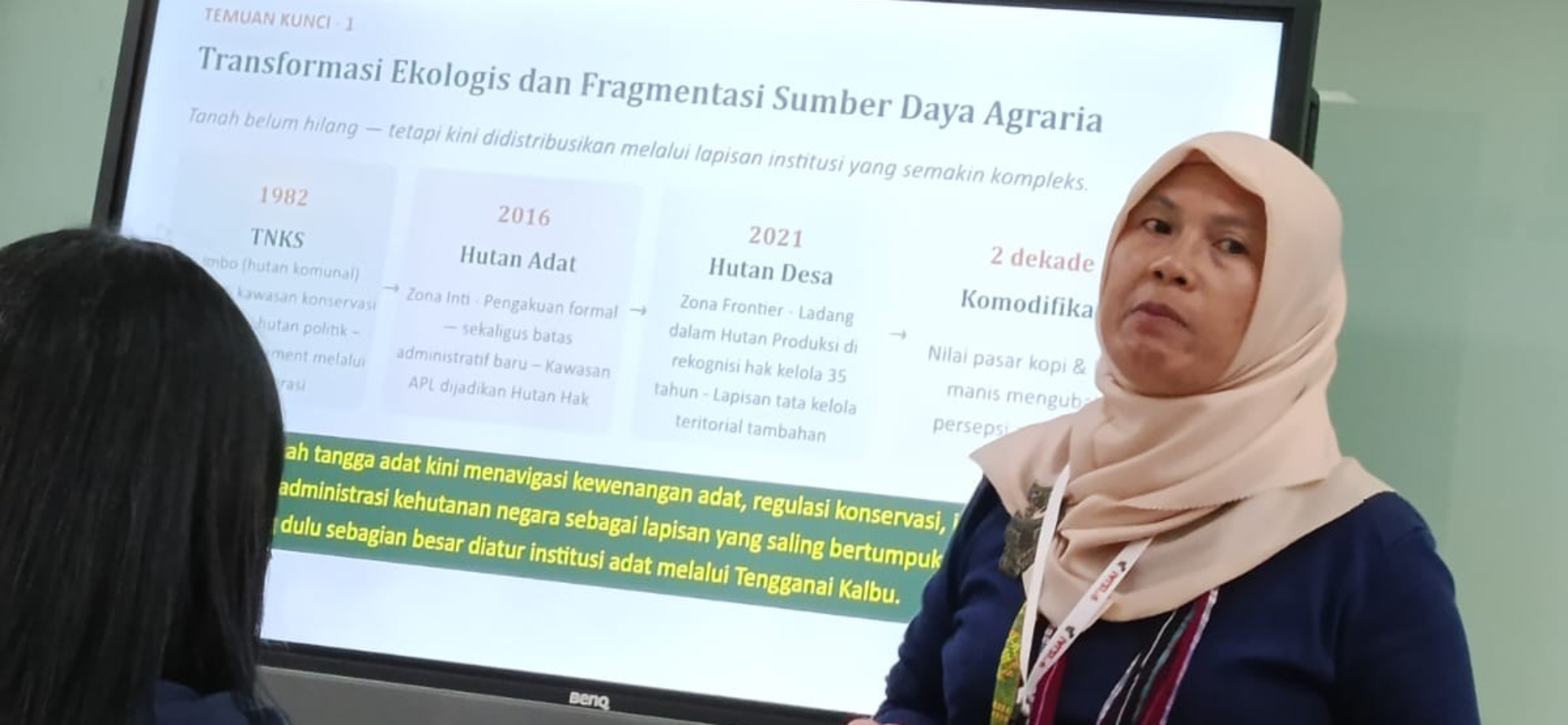
The Agrarian Resources and Pluralizing Social Reproduction panel explores land issues that intersect with family social reproduction – through various forms of resource access, contextual change, and migration modes. The main question is how changes in the agrarian environment have driven new forms of social reproduction that affect household life, labor, and transformation in the agrarian environment. This was discussed in Panel 33 – 9th International Symposium of the Indonesian Journal of Anthropology (9th ISJAI 2026), held at the Departement Anthropology, University of Indonesia, Depok, from 4–7 August 2026.
Plantation Literature - Migration Nexus (PMN) previously where migration, remittances, and livelihood diversification are strategies to maintain livelihoods. Unlike the matrilineal indigenous people in Kerinci, social reproduction is not just for livelihood, it is only a means. What we want to maintain is the sustainability of the matrilineal world as its own world, not just as a local variant of the agrarian world. Land is not just a factor of production, but a foundation that allows the matrilineal social order itself to continue — connecting the land, the female heirs, the mamak and the tengganai, and the generation of nieces. Therefore, the matrilial community of Kerinci developed various land management models in frontier areas, remittances, and a combination of agricultural work with formal work. This was discussed by Dr. Wina Khairina, M.Si, Practitioner Lecturer at the Department of Social Anthropology, Faculty of Social and Political Sciences, Universitas Sumatera Utara (USU), in her paper on panel 33 on Thursday, August 06, 2026 at the 9th ISJAI.
This panel was managed by Convenor Prof. Nancy Peluso and Suraiya Afiff, Ph.D and featured panelists including Evi Indraswati, Kalang Buwana Zakaria, Sandres Siahaan, Vienna Khairina, Charina Chazali, Jhon McCarthy, Suraiya Afiff, and Pudensius Maring, as well as Nancy Peluso and Debbie Prabawati.
The 9th ISJAI 2026 is themed "Pluriversal Future in a Multipolarized World: A Global Southern Perspective. At least 300 academics, students and practitioners from various countries gathered in 35 parallel panels, book launches, and ethnographic film screenings that addressed epistemic plurality in an increasingly multipolar academic landscape.
Related Tags: Social Reproduction, Indonesia, Universitas Sumatera Utara, University of Indonesia

