National Taiwan University
Published on 14 August 2026




As extreme rainfall, heat waves, and droughts grow more frequent, the question of what keeps ecosystems from collapsing has moved from academic interest to policy urgency. Scientists have long known that biodiversity supports ecosystem function, but how it confers stability under severe environmental fluctuation has remained unresolved. Researchers at the Institute of Fisheries Science at National Taiwan University (NTU), working with Academia Sinica and international partners including Ryukoku University and Yokohama National University in Japan, have addressed the question through a pairing of long-term field observation and new theoretical modeling.
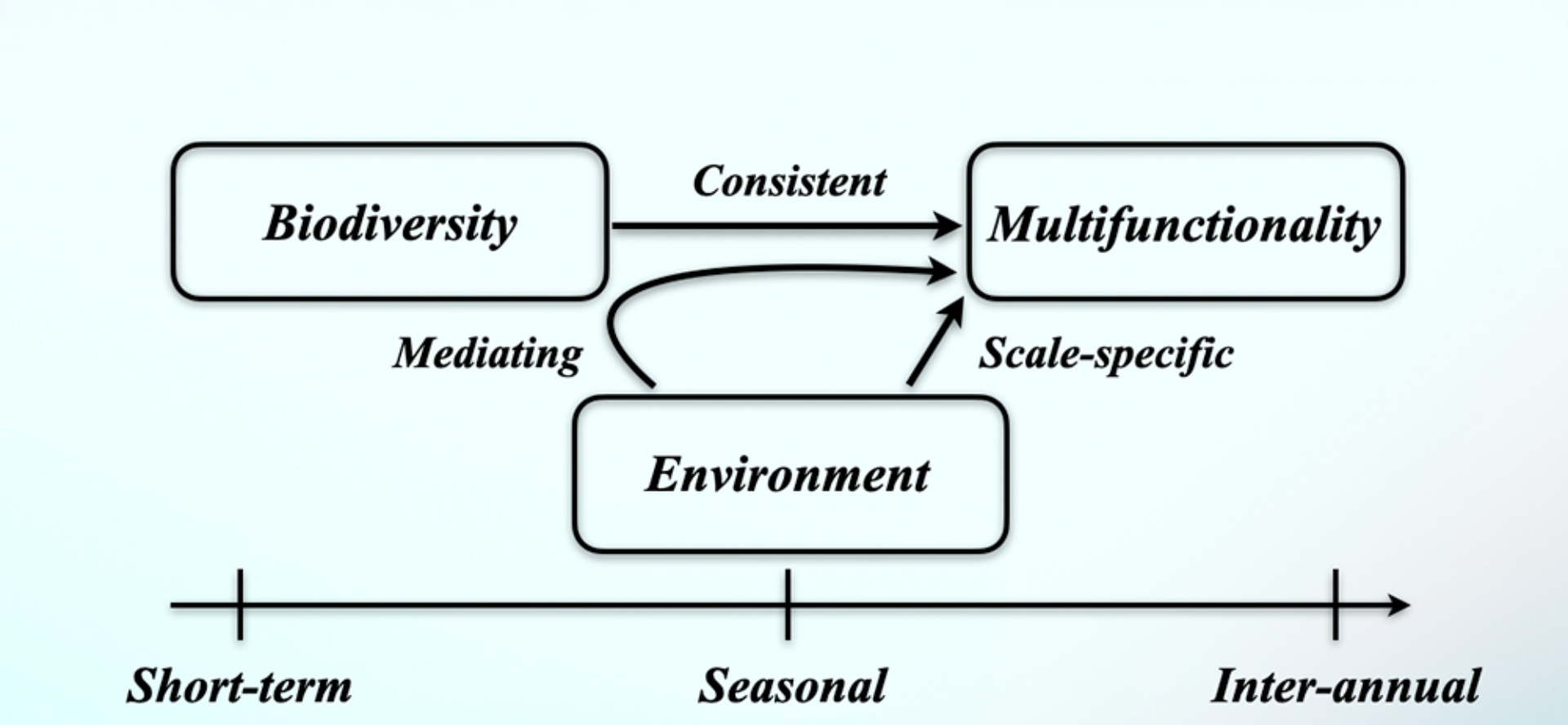
The first study drew on nine years of monitoring data from Taiwan's Feitsui Reservoir, integrating 31 ecosystem functions related to the carbon cycle to assess how biodiversity shapes ecosystem multifunctionality. Microbial diversity was found to enhance ecosystem function consistently across multiple timescales—through typhoons, seasonal shifts, and interannual environmental change—whereas environmental variables such as rainfall, temperature, and nutrients influenced function only at particular timescales, identifying biodiversity as the more persistent driver. The second study built a theoretical model that departs from the conventional treatment of biodiversity as a fixed background condition, instead framing it as an ecological variable that changes dynamically over time. The model revealed a resource-diversity feedback linking species diversity with nutrients and food web structure, through which dynamic regulation of diversity alters nutrient use efficiency and predation, lowering the risk of ecosystem collapse. The team then validated the framework against 30 years of phytoplankton monitoring data from Lake Inba in Japan, confirming that both the average level of species diversity and its variation over time causally affect ecosystem stability.
The two studies are complementary: one demonstrates empirically that biodiversity sustains aquatic ecosystem function over the long term, while the other explains the mechanism by which it does so. The central insight—that stability depends not simply on how much biodiversity an ecosystem holds but on its capacity for dynamic self-regulation—provides a new theoretical foundation for conservation policy and reinforces biodiversity protection as a key lever for ecological resilience amid global environmental change. The first study appeared in Ecology Letters in 2025 with postdoctoral researcher Wan-Hsuan Cheng as lead author; the second was published in Ecology in 2026 with Assistant Professor Chun-Wei Chang as lead author.