National Taiwan University
Published on 22 September 2026




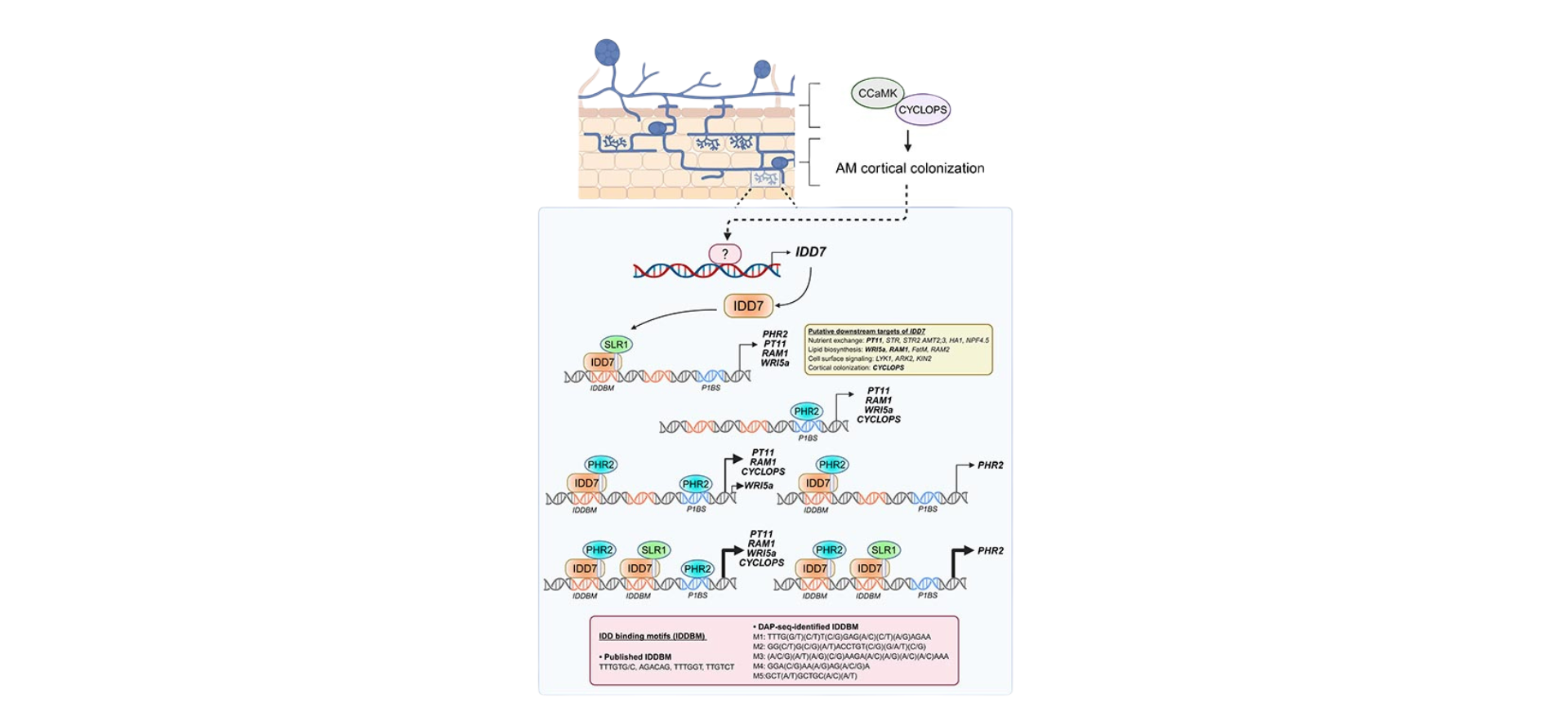
As global agriculture confronts severe environmental stress and the imperative to reduce synthetic fertilizer dependency, unlocking the natural mutualisms of crop ecosystems has emerged as a paramount scientific pursuit. Arbuscular mycorrhizal (AM) symbiosis—a pervasive mutualistic relationship between plants and soil fungi—enables crops to trade carbon for vital subterranean nutrients, particularly phosphate. Following an eight-year investigation, a research team led by Associate Professor Shu-Yi Yang from the Institute of Plant Biology at National Taiwan University (NTU) has published a breakthrough study in Nature Communications. Titled “OsIDD7 integrates signaling networks for arbuscular mycorrhizal symbiosis,” the research uncovers how the transcription factor IDD7 serves as a master molecular nexus governing this ancient partnership in rice.
While AM fungi develop branched arbuscules within root cells to facilitate reciprocal nutrient delivery, how host plants coordinate internal hormone cascades with phosphate signals to sustain these structures has long remained elusive. The NTU team demonstrated that IDD7 expression surges in arbuscule-containing root cells; without it, fungal colonization collapses, disrupting lipid synthesis and nutrient exchange. Mechanistically, IDD7 collaborates with SLR1—a DELLA protein that relays gibberellin hormone signals—and PHR2, a primary transcription factor governing phosphate starvation responses. Together, this tri-protein complex efficiently activates key symbiotic genes, with IDD7 simultaneously modulating PHR2 expression, confirming its indispensable role at the epicenter of the symbiotic transcriptional network.
By delineating how crops integrate hormonal and nutrient cues to foster microbial symbiosis, NTU’s discovery offers profound implications for food security and climate-resilient farming. Deepening the understanding of these symbiotic pathways provides an actionable genetic roadmap to enhance nutrient-use efficiency and stress tolerance in essential cereal crops. As the research team explores IDD7’s broader epigenetic mechanisms, NTU continues to translate fundamental plant science into scalable agricultural solutions, reinforcing the institution's commitment to advancing the United Nations Sustainable Development Goals through pioneering ecological innovation.