Igor Sikorsky Kyiv Polytechnic Institute
Published on 25 November 2026




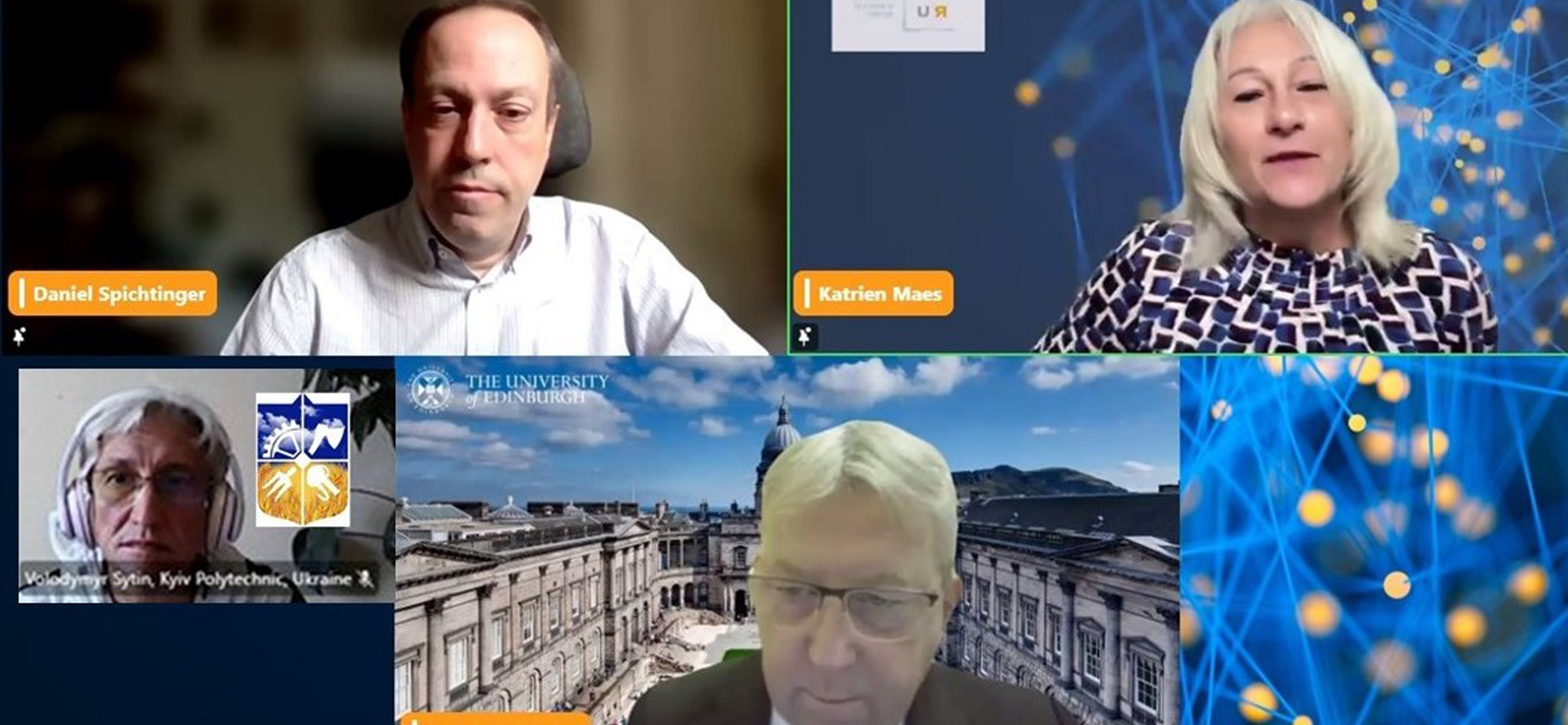
On 23 November 2026, a representative of the International Collaboration Department at the Igor Sikorsky Kyiv Polytechnic Institute (KPI) joined the webinar organised by the League of European Research Universities (LERU), an association of leading European research-intensive universities that share the values of high-quality teaching within an environment of internationally competitive research.
Held under the theme “As open as possible, as secure as needed: How can universities navigate tensions between the open science and knowledge security agendas?”, this event is part of the LERU Talks series, an online interview and discussion forum connecting the worlds of universities and science policymakers, and bringing this interaction to a wide audience.
Two experts, namely Sir Peter Mathieson, Principal and Vice-Chancellor of the University of Edinburgh, and Daniel Spichtinger, European Research Policy Analyst & Open Science Expert, engaged on questions such as:
· Is the open science motto “as open as possible as closed as necessary” still workable when research security enters the picture?
· What safeguards on knowledge security should or can be put in place? What is absolutely necessary, and what is bureaucratic overkill, for researchers and for universities?
· Who decides what can be open and what needs to be closed?
· Can incentives and recognition convince researchers to apply knowledge security guidelines in the same way as open science principles have been implemented?
· How can universities remain internationally connected while managing legitimate research-security risks?
The webinar commenced with a short yet warm welcome by Dr Katrien Maes, LERU Engagement Ambassador, who addressed a live online audience of about 200 participants and thanked them for their presence. She highlighted the basic issue under discussion: are open science and knowledge security fundamentally in opposition, or not?
According to Peter Mathieson, the task for governments and funders is to understand a balance between openness and closed data and to try and get the balance right. He also raised concerns about cybersecurity, how to minimise cyber risks. “What we tend to do is focus more on how we would recover from a cyber incident,” he observed. “In principle, I think of researchers as risk takers.”
Another issue highlighted in Peter Mathieson’s address was the real danger of self-censorship, which has become a significant barrier to academic freedom in universities across most countries.
Daniel Spichtinger emphasised that open science should remain the default scientific mode. “Focusing on what could be done in terms of open science, I would wish for the ERA [European Research Area] Act to be bold,” he said at the webinar. From his viewpoint, the most important aspect on realising open science is to link it to research assessment. Peter Mathieson added that the work on assessment of success needs to be more sophisticated.
Reflecting on heavy-handed regulation risks, Daniel Spichtinger noted: “A government can give general guidelines. However, it’s really up to institutions and researchers to come up with something that makes sense.”
In conclusion, Peter Mathieson emphasised a need for a cultural understanding, and a balancing of risks and opportunities. Daniel Spichtinger suggested that a next discussion might explore open science and artificial intelligence, whether AI is a threat or an opportunity.
“One message from both speakers stood out: universities must actively shape this debate, both at the level of institutional leadership and within the research community itself. This is not a responsibility we can simply delegate to others. No kicking the can down the road, hoping someone else will sort things out!” Kurt Deketelaere, LERU Secretary-General, wrote on LinkedIn. “Openness and security must not become opposing principles. Finding the right balance is a responsibility for universities themselves.”
Special thanks are due to Katrien Maes for expertly moderating the insightful discussion online.
Useful links:
https://www.leru.org/publications/defence-research-in-european-universities-a-conceptual-framework
https://www.leru.org/news/research-with-dual-use-potential-from-theory-to-practice-in-fp10
https://www.linkedin.com/feed/update/urn:li:activity:7530613786135691264/