INHA University
Published on 16 January 2026





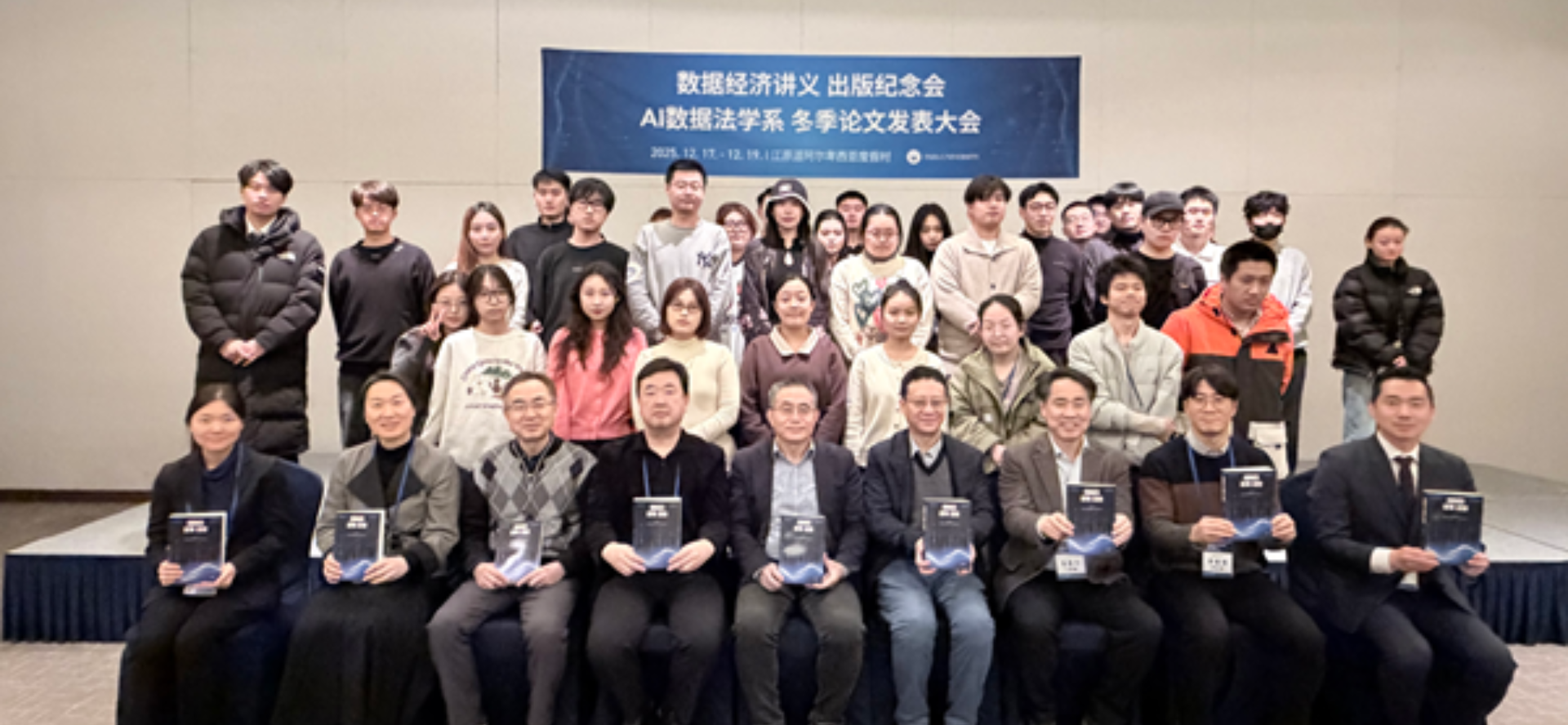
The AI & Data Law Center at Inha University recently hosted a publication ceremony for the Korean edition of Lectures on the Data Economy, authored by Professor Gao Fuping (高富平) of East China University of Political Science and Law.
The event was held in conjunction with the Winter Academic Conference of the Department of AI & Data Law at Inha University and served as a platform for sharing research achievements on data and artificial intelligence law between Korea and China, while further deepening academic exchange between the two countries.
Lectures on the Data Economy is regarded as a seminal work representing China’s research on data law and policy. The book systematically analyzes the data factor market, public data systems, digital governance, and legal and policy structures in the era of artificial intelligence. The publication of the Korean edition goes beyond a simple translation, providing an important opportunity to comparatively examine China’s institutional experience within Korea’s legal and policy environment through research led by Inha University scholars.
Professor Gao Fuping stated, “The data economy is not merely an issue of markets or transactions; it concerns how data is socially reused and transformed into knowledge and intelligence.” He added, “This Korean edition goes beyond linguistic translation and serves as an academic bridge through which China and Korea can jointly reflect on shared challenges in the data and AI era,” expressing his expectations for expanded academic cooperation across East Asia.
Professors Kim Won-oh, Jung Young-jin, Jung Chan-mo, and Kim Young-soon of Inha University Law School, along with Professor Lee Sang-woo, an adjunct professor in the Department of AI & Data Law, participated in translator presentations. They shared key issues from each chapter, perspectives encountered during the translation process, and implications for the Korean legal system. In the subsequent panel discussion, chaired by Professor Kim Won-oh of Inha University, in-depth discussions were held on future research agendas for the data economy and AI law, as well as directions for Korea–China joint research.
The university assessed the event as more than a simple celebration of a translated publication, viewing it as an opportunity to expand legal and policy discourse surrounding data and artificial intelligence from an East Asian perspective. Inha University’s AI & Data Law Center plans to continue expanding academic exchange and joint research between Korea and China.
Professor Jung Young-jin remarked, “This translation does more than introduce an outstanding Chinese academic work; it provides a shared analytical framework for comparing how Korea and China have designed their data and AI legal systems.” He added, “The translation process itself became an opportunity to reassess Korea’s AI Framework Act and digital strategy, and it will serve as a starting point for expanding future joint research between the two countries.”
Professor Kim Won-oh, Director of the AI & Data Law Center and lead translator, emphasized, “As Korea prepares for the implementation of its AI Framework Act, understanding how to conceptualize and institutionally support the data economy is a crucial task.” He continued, “Lectures on the Data Economy is an important guide that encourages an integrated view of data and AI—not merely as technological issues, but as matters of law, policy, and governance.” He concluded by noting, “This publication is the result of sustained joint research and mutual trust between Inha University and East China University of Political Science and Law.”