INHA University
Published on 28 July 2026




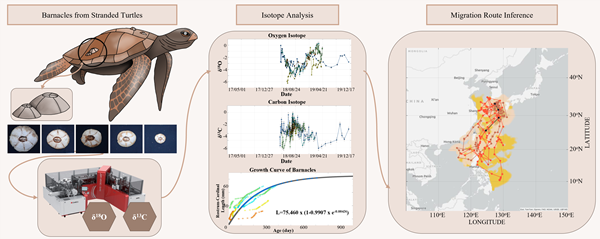
▲ Conceptual illustration of the study (process of reconstructing migration routes using environmental information recorded in barnacle shells).
Professor Taewon Kim’s research team from the Department of Marine Science at Inha University has developed a new research method for reconstructing the migration routes of sea turtles by analyzing the shells of barnacles that live attached to their carapaces.
Sea turtles are among the representative endangered marine species designated by the International Union for Conservation of Nature (IUCN). Understanding their migration routes is essential for effective conservation. However, because they travel across vast ocean regions, attaching satellite tracking devices or conducting direct observations has been limited by both cost and technical challenges.
The research team analyzed the shells of the turtle barnacle (Chelonibia testudinaria) attached to a stranded Loggerhead sea turtle found on Jeju Island using Secondary Ion Mass Spectrometry (SIMS), an ultra-high-resolution stable isotope analysis technique. As barnacle shells grow, they continuously record environmental information such as seawater temperature and salinity in successive layers, preserving past migration records much like tree rings.
The researchers analyzed changes in stable oxygen and carbon isotopes in chronological order and newly calibrated the barnacle growth curve to match the environmental conditions of East Asian waters. Based on the results, they estimated that the sea turtle traveled through the Taiwan Strait, the waters surrounding the Philippines, and the Ryukyu Islands over approximately one year and six months before arriving in waters near Jeju, where it eventually stranded.
The same analytical method was also applied to other loggerhead sea turtles and Hawksbill sea turtle. The results indicated that loggerhead sea turtles repeatedly made long-distance migrations between the Philippines and waters around Jeju, while hawksbill sea turtles migrated northward along the Ryukyu Islands.
This study is particularly significant because it demonstrates that migration routes can be reconstructed even for stranded or bycaught individuals that are difficult to monitor using satellite tracking. Since South Korea has no sea turtle nesting grounds and most available specimens are stranded or accidentally caught, this research method is expected to provide new opportunities for studies on protected marine species and the development of conservation policies.
The research findings were recently published in Marine Environmental Research, a leading international journal in the field of marine environmental science.
Kyungsik Cho, the first author of the paper, said, “Barnacle shells preserve marine environmental information experienced by their host throughout its migration. This study demonstrates that such information can be used to reconstruct the migration routes of previously untracked sea turtles without satellite tracking.”
Professor Taewon Kim, the corresponding author of the study and professor at Inha University, stated, “This research is particularly meaningful because it shows that migration routes can be reconstructed using only stranded individuals in regions like South Korea, where directly tracking sea turtles is difficult. In the future, combining analyses of various stable isotopes and trace elements is expected to provide valuable data for studying the migration ecology of large marine animals and for establishing conservation policies.”