INHA University
Published on 12 August 2026




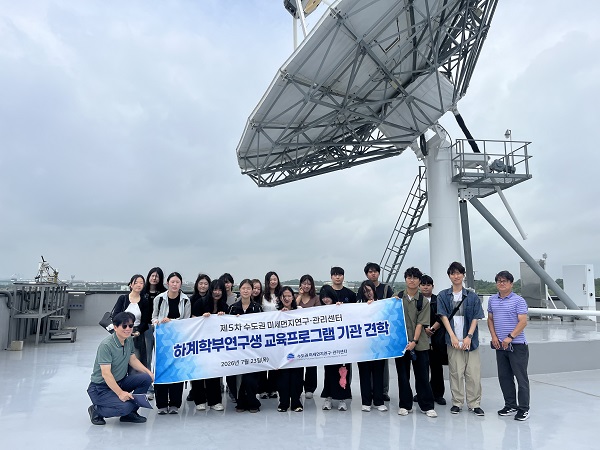
▲ Students participating in the 5th Summer Undergraduate Research Program visit the Environmental Satellite Center at the National Institute of Environmental Research.
The Metropolitan Air Quality Research and Management Center under Inha University’s Industry–Academic Cooperation Foundation recently successfully concluded its 5th Summer Undergraduate Research Program.
The program was designed for undergraduate students majoring in environmental sciences and other science and engineering disciplines at universities in the Seoul metropolitan area. It aimed to introduce the latest trends and practical applications in research and development (R&D) related to fine particulate matter and air quality while fostering future environmental professionals.
The curriculum covered a broad range of topics in air quality, including the health impacts of fine dust, the relationship between weather and particulate matter, air quality management policies in the Seoul metropolitan area, the current status of air pollutant management, aerosol fundamentals, the principles and applications of fine dust measurement equipment, an introduction to air pollution control facilities, ESG and career exploration in the environmental sector, air pollutant control technologies, and the measurement and emission assessment of road re-suspended dust.
The program also included field visits to the Environmental Satellite Center at the National Institute of Environmental Research and the Cheongna Facility of the Incheon Environmental Corporation. During the visits, students observed air quality research sites and environmental facility operations firsthand, allowing them to connect classroom learning with real-world practices.
The program featured lectures by university professors as well as experts from government agencies, research institutes, and industry. The speakers covered a wide range of topics, including air quality policies, fine dust measurement and analysis technologies, air pollution control technologies, and practical applications in industrial settings.
Through the lectures and field visits, participants gained a deeper understanding of research and career opportunities in the air quality field. Certificates of completion were awarded to 19 students who successfully completed the program.
In the post-program satisfaction survey, one participant commented, “Although I had always been interested in air quality, I was unsure about the career opportunities available. Listening to lectures from professionals in the field helped me better understand both the academic concepts and potential career paths. This program gave me the opportunity to seriously consider pursuing a career in air quality.”
Jeon Gi-jun, Director of the Metropolitan Air Quality Research and Management Center, said, “I hope this program has helped students gain a broader understanding of research and policy in the field of air quality. We will continue to expand and improve our educational programs to cultivate the next generation of environmental professionals.”