Tabitha Riyani Simbolon
Published on 13 January 2026





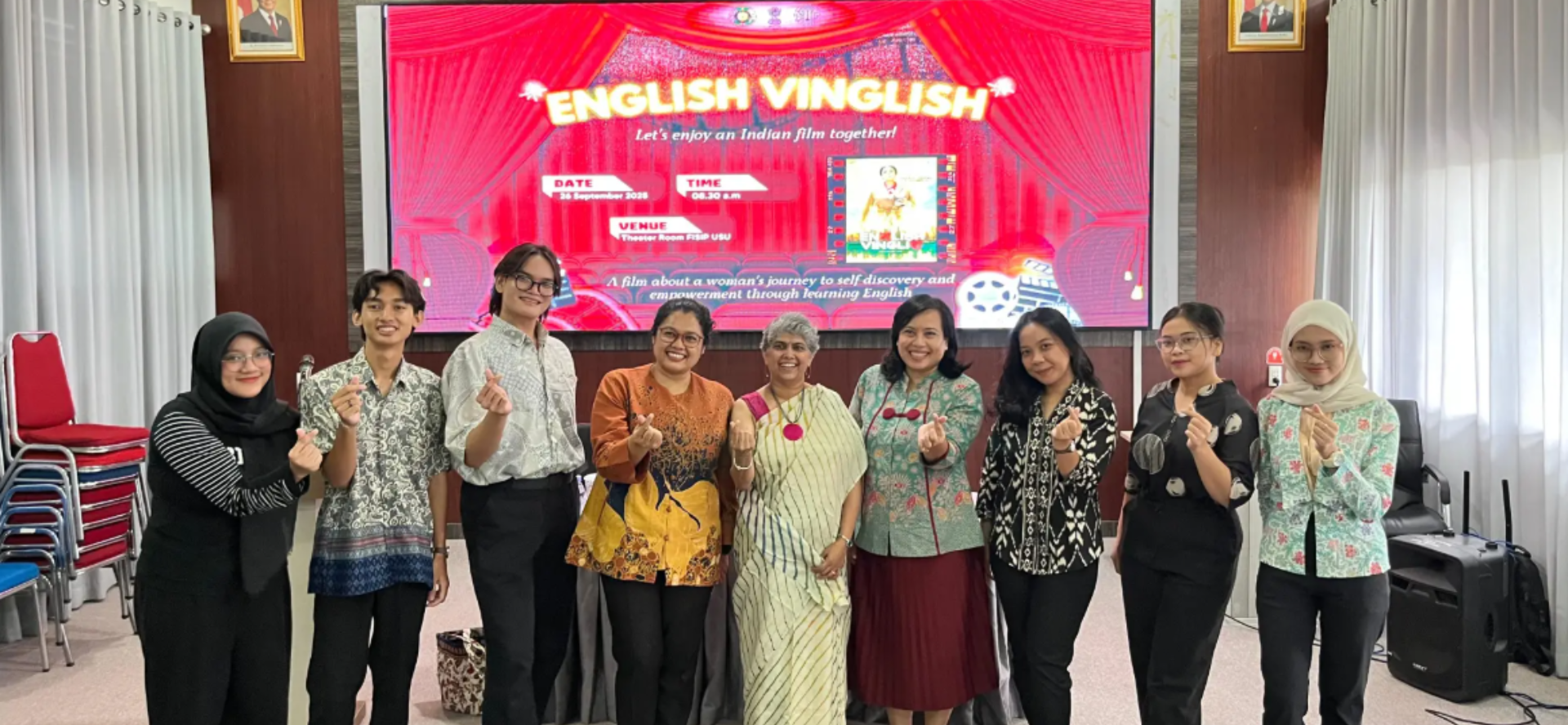
The presence of Assoc. Prof. Dr. Gauri Kopardekar, ICCR Chair Professor from Savitribai Phule Pune University, at the Faculty of Social and Political Sciences, Universitas Sumatera Utara (FISIP USU), demonstrates how academic activities can function as effective forms of cultural diplomacy. Her involvement in academic and cultural initiatives has positions the faculty not only as a learning environment, but also as a space for the exchange of meanings, values and perspectives across cultures, strengthening the university’s role in non-state diplomacy grounded in education and culture.
Within Communication Studies, particularly film studies, the activities facilitated by Dr. Kopardekar highlight audiovisual media as a tool for intercultural communication. Film is understood as a social text that represents culture, social relations and universal values; therefore, it can be analyzed critically in line with communication scholarship that views film not merely as entertainment, but as a medium that shapes perception, identity, and social understanding.
Through programs such as the Indian Movie Club, students interpret films through a cultural-communication lens, explore their social contexts, and reflect on parallels with Indonesian society. Post-screening discussions create space for equal intercultural dialogue while supporting the development of media literacy and cross-cultural sensitivity. In this process, cultural diplomacy emerges organically through narrative and visual storytelling, rather than through prescriptive, one-way initiatives. The programme also contributes to broader cultural understanding by preparing students to engage responsibly with global media and cross-cultural dialogue beyond the campus environment.
Reflecting on this approach, Farida Hanim, S.Sos., M.I.Kom., a lecturer in Communication Studies, explains:
“In communication studies, film holds a strategic position as a medium of cultural communication that not only conveys messages, but also shapes how audiences view social reality. Analytical engagement with film is therefore essential for opening dialogue across perspectives and cultivating critical sensitivity to representation, identity and power relations, especially in the context of Indian cinema, which once dominated Indonesian television.”
As ICCR Chair Professor, Dr. Kopardekar brings a cultural mandate that is closely integrated with academic practice. Her dialogic approach positions students as active participants in cultural communication, making the campus a dynamic meeting point of ideas and meanings rather than merely a venue for displaying foreign culture.
These engagements support the internationalisation of FISIP USU by providing contextual and globally oriented learning experiences. Students gain insight into other cultures while also reflecting on their own through the lens of communication and media. Collectively, these initiatives illustrate how cultural diplomacy on campus can be substantive, relevant, and sustainable.