Igor Sikorsky Kyiv Polytechnic Institute
Published on 23 April 2026




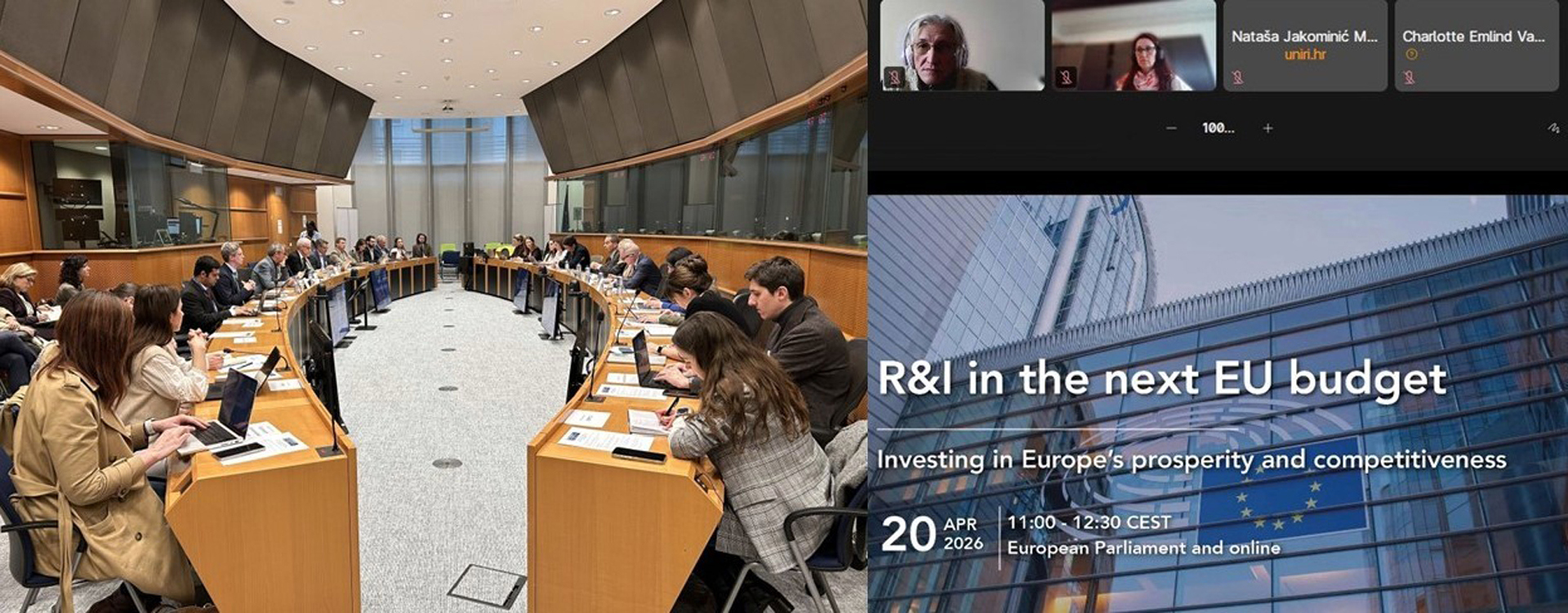
On 20 April 2026, a representative of the International Collaboration Department at Igor Sikorsky Kyiv Polytechnic Institute joined online CESAER’s high-level policy event, “R&I in the next EU budget: investing in Europe's prosperity and competitiveness,” hosted at the European Parliament.
This event placed research and innovation at the centre of the discussion on Europe’s future priorities and investments. It moved beyond a narrow budgetary debate and instead addressed a strategic question: what must Europe invest if it is serious about delivering on its ambitions?
In this context, the event examined the case for approximately €220 billion for FP10 as a credible and politically coherent baseline for a European Union seeking to strengthen its competitiveness, prosperity and resilience, as reflected in the draft reports on FP10 by the European Parliament.
The discussion explored how research and innovation should be understood not as policy silos, but as a foundational capability underpinning progress across Europe’s key priorities.
Participants were also discussing cross-border excellence as a means to pull talent at the European level. They underlined the importance of FP10 capable of functioning as a magnet for talent, including through association with third countries, from a geopolitical perspective.
A strong FP10 would therefore be about far more than research policy alone. It would speak to Europe’s capacity to drive economic strength, industrial renewal, security, preparedness, sustainability, public health, digital leadership and societal well-being.
According to Manuel Heitor, Professor at Portugal’s Instituto Superior Técnico and Chair of European Commission expert group on the future of the Horizon Europe key funding programme for research and innovation, experts have clearly calculated €220 billion for FP10 to accelerate research and innovation. By comparison, the United States spends some €300 billion more annually for R&D than Europe.
“While we debate €175 versus €200 billion at EU level, the real comparison towards global leaders is measured in trillions,” Mattias Björnmalm, Secretary General of the CESAER association (Conference of European Schools for Advanced Engineering Education and Research), wrote on LinkedIn. “At times, it feels like we are arguing about how big or small our puddle should be, while a waterfall is roaring just around the corner.”
Bertrand Bouchet, CEA (Commissariat à l'énergie atomique) Representative in Brussels, acknowledged Europe’s relatively low capacity to transform research results into commercial innovation as the weakness.
Panellists highlighted a transfer to innovation through support for startups under Pillar Three – Innovative Europe. In essence, Europe needs competitiveness based on innovation, increasing productivity, and the high-quality products that could be sold worldwide. In addition, it was pointed out that really guaranteeing the green transition in the digital era can only be feasible with more research and innovation. A more ambitious, integrated approach would boost an increase of 2.6% of GDP by 2035.
René Repasi, Member of European Parliament, compared Horizon Europe to one of the shining stars in the world in terms of innovation, thanks to the European Research Council in particular.
In conclusion, MEP Hélder Sousa Silva emphasised the need to ensure predictable and sufficient resources for Horizon Europe in consideration of a long-term nature of financing projects.
https://research-matters.eu/wp-content/uploads/2026/04/mheitor-FINAL-text-EP-20april2026.pdf