Sogang University
Published on 23 April 2026




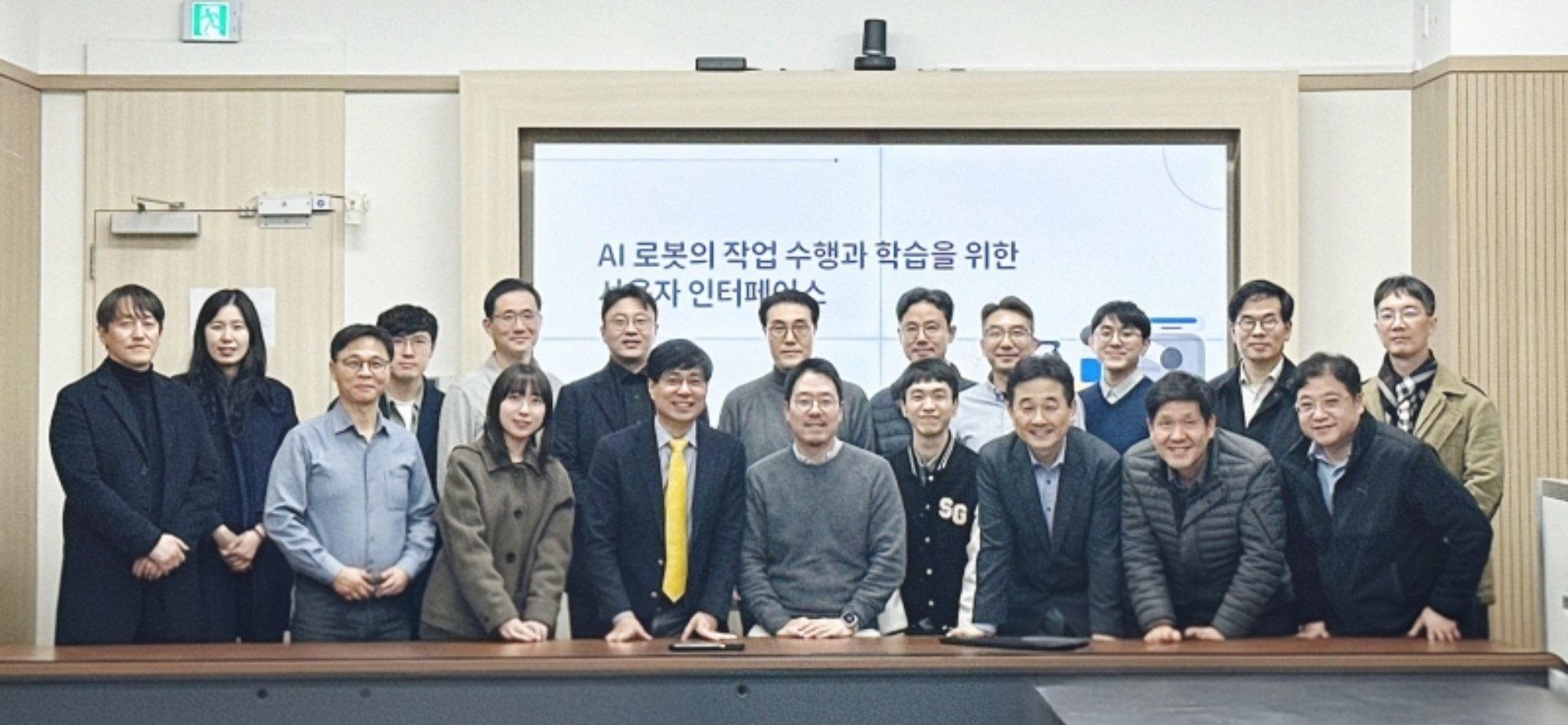
Sogang University held its March brown-bag seminar under SAIX Peers, focusing on the current state and industrial trajectory of robot AI. The session featured Professor Changjoo Nam from the Department of Electronic Engineering and founder of Vertical Labs, a university-affiliated startup developing data collection platforms for robot learning, who presented on manipulation, humanoid robotics, and the shift toward action-generating AI systems.
Professor Nam opened with a framing observation: as AI moves beyond large language models into systems capable of physical action, the central question in robotics is no longer perception or language understanding alone, but how a model translates situational awareness into movement. He described the growing adoption of end-to-end learning architectures, in which a single model learns directly from sensor input to motor output, replacing earlier modular pipelines. At the core of this shift are Vision-Language-Action (VLA) models, which integrate visual encoders and language models to interpret context and map generated tokens onto joint values for physical execution.
The seminar also addressed world models — systems that predict how an environment will change in response to a given action, enabling simulation-based verification before physical execution. Professor Nam noted that the physical cost of trial-and-error in real environments makes such predictive modelling increasingly important: "The model that generates actions and the world model that verifies them in advance are developing together."
Discussion turned to the question of what learning paradigms are most effective for robot AI. Professor Nam acknowledged that while foundation models are expanding in scope, direct application to real-world settings remains difficult, and that additional data-driven fine-tuning is typically required on the ground. On reinforcement learning, he highlighted the exploration-exploitation tradeoff: broad exploration is theoretically valuable but practically constrained in physical environments, where repeated attempts risk damaging objects or requiring continuous environmental reset. Simulation-based training therefore remains the dominant approach for exploration-heavy tasks. For specific industrial processes, imitation learning — training robots on recorded human demonstrations — offers a more data-efficient path to reliable performance.
On application domains, Professor Nam drew a contrast between entertainment and manufacturing. Humanoid robots in entertainment operate in contexts where failure is tolerable; manufacturing and logistics demand precision, but involve a more bounded set of tasks, making them more immediately suited to deployment. Drawing on his experience at Vertical Labs, he argued that the real answers lie in the field: "You have to go to the site, collect the data directly, and build from there." He added that small and mid-sized manufacturers are not looking for general-purpose systems but for process-level automation — and that AI enables faster deployment than traditional systems integration approaches.
The session illustrated how robot AI is moving from a research-stage technology into active industrial application, with Professor Nam's dual role as researcher and founder offering a grounded perspective on both the technical possibilities and the practical constraints of current systems.