INHA University
Published on 27 November 2026




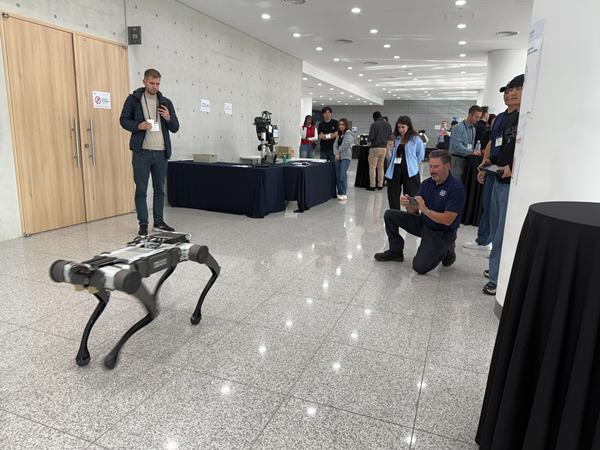
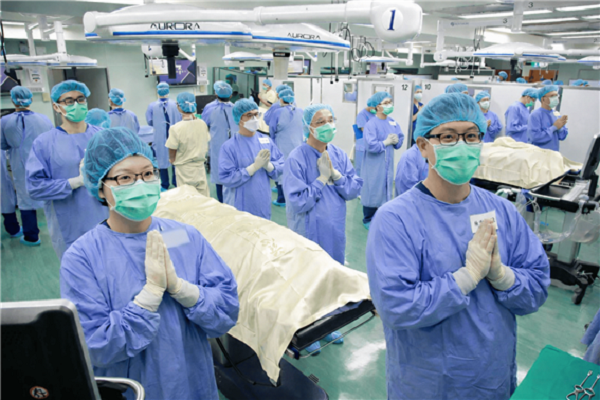
▲ Participants of ‘IEEE SSRR 2026 Incheon’ observe robot demonstrations at the Songdo Aerospace Convergence Campus.
Inha University recently hosted the international academic conference ‘IEEE SSRR 2026 Incheon’ at its Songdo Aerospace Convergence Campus, bringing together experts to discuss robotic technologies for safety and disaster response.
The International Symposium on Safety, Security, and Rescue Robotics (SSRR) focuses on robotic technologies designed for use in extreme environments, including disaster and accident sites.
Researchers from around the world participated in the event, sharing advances in rescue robotics and discussing practical applications in real-world situations. Professor Cho Younggeun of the Department of Electrical and Computer Engineering and Professor Shim Inwook of the Department of Smart Mobility Engineering served as co-chairs of the local organizing committee and led the event.
The keynote presentations introduced various research directions in safety and disaster response robotics. Professor T. Thang Vo-Doan of the University of Queensland in Australia discussed the potential use of biohybrid robots, which combine living insects with miniature electronic devices, in search and rescue operations.
Professor Hugo Rodrigue of Sungkyunkwan University presented research on soft robotics, which combines strength and flexibility through pneumatic actuation technology. Professor Paul Oh of the University of Nevada, Las Vegas, discussed how research on drones and humanoid robots can contribute to disaster response technologies, along with future challenges in the field.
Industry presentations featured Dr. Kim Sungkyun of FieldAI, who shared research on robot autonomy and practical application experiences. A rescue robotics workshop led by Adam Jacoff of the U.S. National Institute of Standards and Technology (NIST) introduced standardized testing methods for evaluating the performance of ground and aerial robots.
A dedicated rescue robot testing course was set up at the venue, allowing participants to observe testing procedures firsthand. Demonstrations by Rainbow Robotics also gave attendees an opportunity to see robots in operation alongside the academic presentations.
The paper sessions covered a wide range of topics, including multi-robot collaboration and task allocation, localization and mapping, remote exploration of disaster areas, and responses to medical and nuclear accidents. On the final day, Professor Robin Murphy and Professor Satoshi Tadokoro, leading experts in rescue robotics, held a discussion on their experiences in actual disaster response operations and future research directions.
The conference was supported by Incheon Metropolitan City, Incheon Technopark, FieldAI, and Rainbow Robotics, with additional support from the Robotics Specialization College. Inha University provided the facilities and venues, while student volunteers contributed to event preparations and on-site operations.
Professors Cho Younggeun and Shim Inwook commented, “It was meaningful to bring together academic presentations, robot demonstrations, and discussions on practical applications in one place. We hope that this exchange, made possible through the support of the university, its students, domestic and international organizing committees, and sponsoring organizations, will lead to future joint research and industry-academia collaboration.”

▲ Researchers from Korea and abroad pose for a commemorative photo at ‘IEEE SSRR 2026 Incheon’.