Asfendiyarov National Medical University
Published on 27 November 2026




The development of the pharmaceutical industry requires not only an expanding range of medicinal products but also scientifically grounded approaches to their development, quality assessment, efficacy evaluation, and safety assurance. Phytopharmacology plays an important role in this process by integrating knowledge of plant-derived biologically active substances, their mechanisms of action, pharmaceutical development, and evidence-based assessment of herbal medicines.
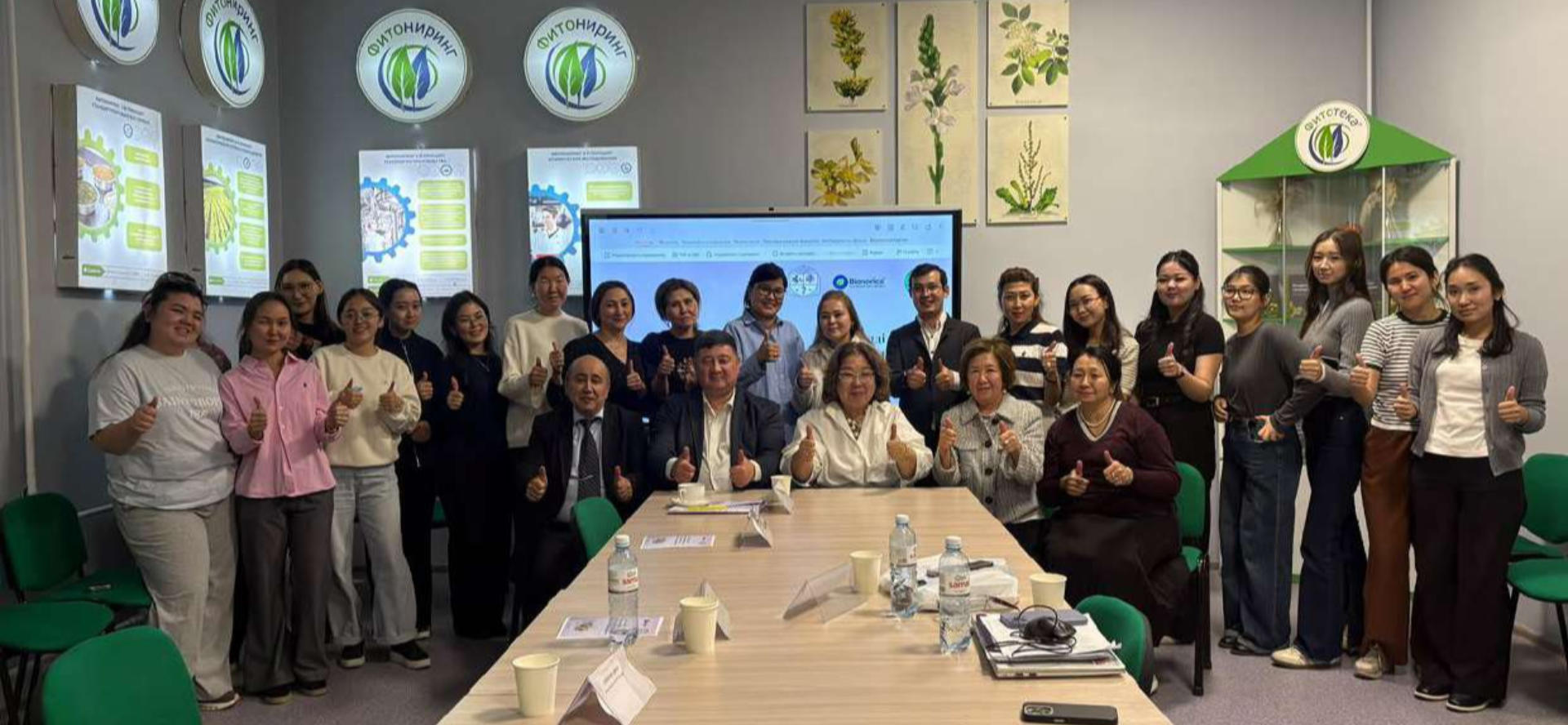
These issues were addressed at the seminar “Evidence-Based Phytopharmacology as the Foundation of Drug Quality and Safety,” held on October 23, 2026, in the Phytotheca Hall of Asfendiyarov Kazakh National Medical University (KazNMU).
The event was organized by the School of Pharmacy of KazNMU, represented by the Dean’s Office and the Department of Organization, Management and Economics of Pharmacy and Clinical Pharmacy, in cooperation with Bionorica LLC. Participants included young scientists, doctoral and master’s students, faculty members, and pharmaceutical industry professionals.
The seminar aimed to strengthen a professional environment in which university research, pharmaceutical education, and industry practice interact. This approach reflects the interconnectedness of three essential components: science, education, and practice.
The scientific component focuses on developing research competencies, critically evaluating evidence, applying modern pharmacological and pharmaceutical analytical methods, and investigating the mechanisms of action of biologically active substances. These activities support the generation of reliable data on the properties, quality, and potential applications of herbal medicinal products.
The educational component involves integrating current scientific advances into undergraduate, master’s, and doctoral programmes. Engagement in professional discussions helps students and early-career researchers develop analytical thinking, research independence, and an understanding of how theoretical knowledge relates to the requirements of contemporary pharmaceutical practice.
The practical component addresses the needs of the pharmaceutical industry and healthcare system. These include ensuring medicine quality, meeting standardization requirements, promoting the rational use of medicines, implementing pharmacovigilance, and strengthening professional responsibility for the safety of pharmacotherapy.
The interaction of these components supports the preparation of specialists who can apply established knowledge and contribute to the development, scientific validation, and implementation of innovative pharmaceutical solutions. For the School of Pharmacy of KazNMU, this approach is strategically important: professional training must respond to advances in research, international requirements, and the evolving needs of healthcare.
The participation of academic and industry representatives created opportunities to exchange scientific and professional knowledge, discuss current challenges, and consider joint educational and research initiatives. University–industry cooperation is particularly valuable as a means of strengthening academic partnerships, facilitating knowledge transfer, and aligning educational programmes with real professional challenges.
For master’s students, doctoral students, and young researchers, this format helps demonstrate the practical relevance of scientific work, identify promising dissertation topics, and develop interdisciplinary projects. Discussions on the standardization, quality, and safety of herbal medicinal products also contribute to a shared understanding of the competencies required of modern pharmaceutical specialists.
The seminar’s focus is consistent with the United Nations Sustainable Development Goals (SDGs). It is directly related to SDG 3, “Good Health and Well-Being,” because evidence-based assessment of medicine quality, safety, and efficacy is essential to protecting public health. Its contribution to SDG 4, “Quality Education,” lies in incorporating current scientific knowledge into teaching, strengthening research competencies, and supporting continuous professional development. Cooperation between the university and the pharmaceutical industry also reflects SDG 17, “Partnerships for the Goals,” which emphasizes collaboration among educational, scientific, and industrial organizations.
The seminar therefore provided a platform for connecting scientific evidence with educational priorities and the practical needs of the pharmaceutical sector. Its significance lies in promoting an approach in which research informs educational content, while professional practice helps define relevant research questions and competencies.
Modern pharmacy requires specialists who can integrate scientific thinking, professional knowledge, and practical skills, critically evaluate evidence, and make responsible decisions in the interests of patient safety. Accordingly, the integration of science, education, and practice is not simply a form of cooperation; it is an essential condition for the sustainable development of pharmaceutical education and for improving pharmaceutical care and medicine provision.
The School of Pharmacy of KazNMU continues to develop cooperation with the professional community, supporting research culture, knowledge exchange, and the preparation of competitive specialists whose competencies meet contemporary international standards of pharmaceutical practice.