Sogang University
Published on 3 September 2026




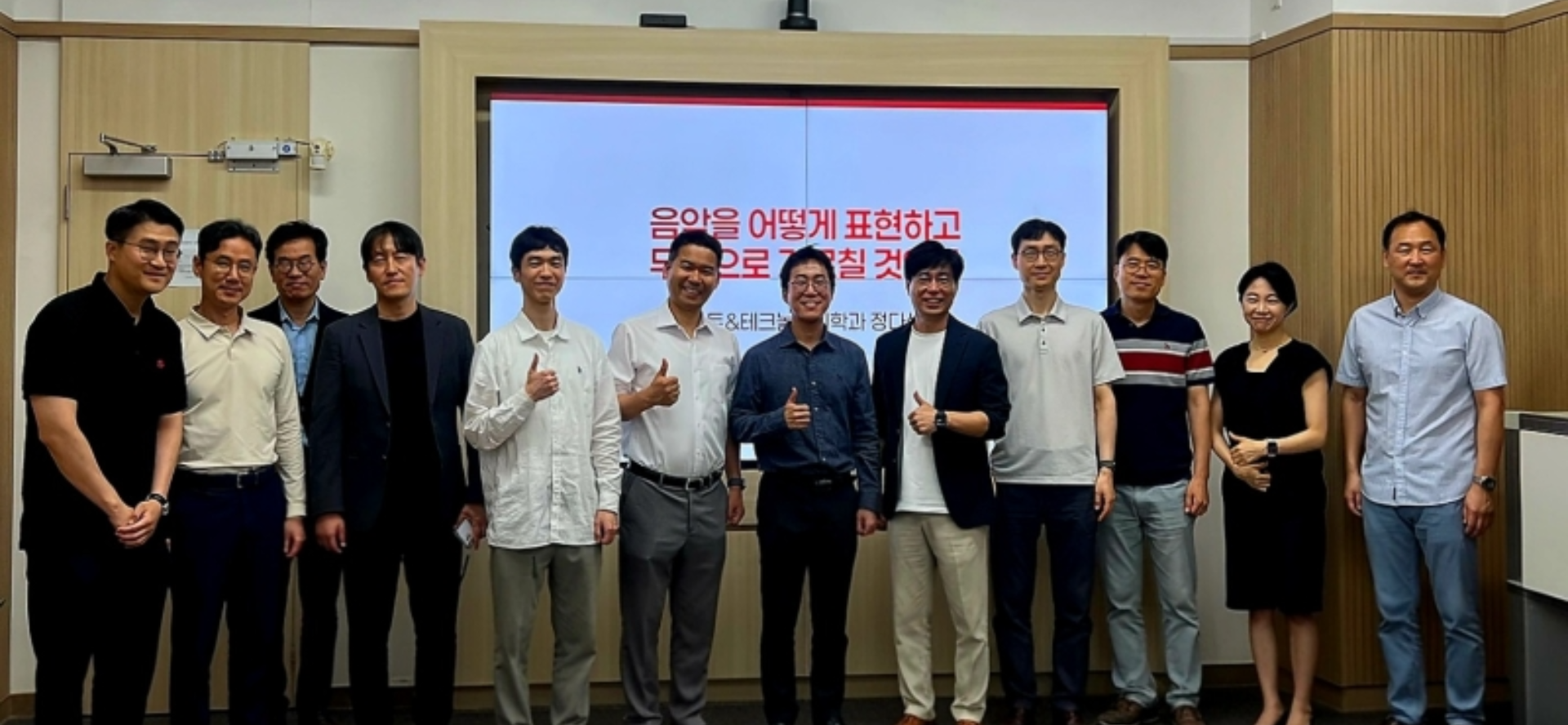
Sogang University held its June brown-bag seminar under SAIX Peers, featuring Professor Dasaem Jeong from the Department of Art & Technology. The session focused on the academic foundations and cultural implications of music AI — a field that has expanded rapidly as generative AI moves beyond language and image into the domain of sound and musical expression.
Professor Jeong introduced her research as spanning music informatics and music AI, with work covering score analysis, music generation, and expressive performance modeling. She shared that her doctoral project, an Expressive Piano Performance Model, was ranked second after a human performer at the 2025 ISMIR international competition. She has also served as General Chair of ISMIR 2025 and as a presenter and organizer at the Dagstuhl Seminar, reflecting sustained engagement with the international music AI research community.
The seminar was organized around three core questions in music AI research: how to encode music into neural networks, how to build scalable music datasets, and whether deep learning can function as a musicological research tool. Professor Jeong noted that music presents a distinct challenge compared to other AI domains — its representational structure requires handling multiple symbolic systems simultaneously, including scores, audio, performance data, and images.
A central case study was a project on AI generation of Korean court music based on jeongganbo — a traditional Korean musical notation system developed during the reign of King Sejong. Rather than converting the notation into Western staff notation, Professor Jeong's team tokenized the jeongganbo symbols directly, allowing the model to learn the structural logic of the notation on its own terms. "Forcing Western notation standards onto the material," she explained, "would compromise the structural characteristics of traditional music." The resulting model was developed in collaboration with the National Gugak Center and realized in performance; the underlying research received the Best Paper Award at ISMIR 2024.
Professor Jeong also presented research on cross-modal conversion between audio and score images, using score videos — widely available on YouTube — as training data. The approach allows image-audio pairs to serve as mutual supervision signals without requiring separately labeled symbolic data, opening a pathway to large-scale music AI training from existing online resources.
The seminar also addressed broader tensions surrounding music AI. Professor Jeong observed that a perception of conflict between AI technology and human creative practice is generating new friction between music technologists and artists. She argued that the more productive question is not what AI will replace, but what kinds of tools can be designed to deepen human engagement with art: "We should be asking how to design technology that allows people to participate more fully in music — not what AI will take over."
Participants agreed that music AI has the potential to reshape the experience of art itself, and that the field calls for ongoing dialogue between technical development and artistic practice.