INHA University
Published on 16 July 2026




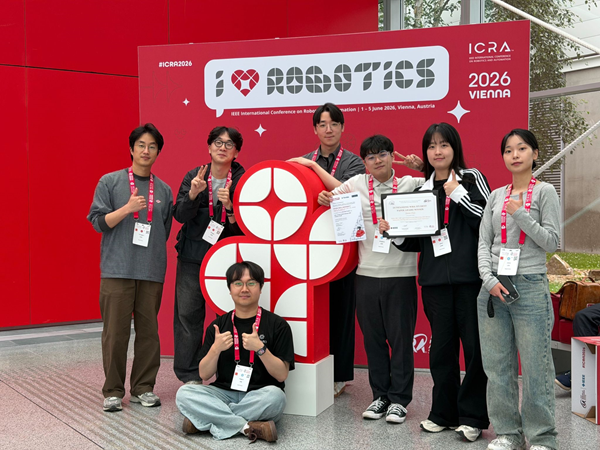
▲ SPARO Lab (Spatial AI and Robotics Lab), led by Professor Youngkeun Cho of the Department of Electrical and Electronic Engineering at Inha University, achieved outstanding research results at IEEE ICRA.
At Inha University, the Spatial AI and Robotics Lab (SPARO Lab), led by Professor Youngkeun Cho of the Department of Electrical and Electronic Engineering, recently achieved outstanding research results at the world’s most prestigious robotics conference, IEEE ICRA (International Conference on Robotics and Automation) 2026.
At this year’s conference, SPARO Lab presented four full papers covering Spatial AI, robot perception, inertial odometry, semantic localization, traversable area estimation, and neural network-based map generation. In particular, the lab demonstrated its international competitiveness in robotics and Spatial AI by achieving several notable accomplishments, including selection as a finalist for the Best Paper Award, receiving a Student Paper Award, and placing second in the International SLAM Challenge.
First, the paper “KISS-IMU: Self-supervised Inertial Odometry with Motion-balanced Learning and Uncertainty-aware Inference” was selected as a finalist for the Best Paper Award in Robot Perception at ICRA 2026. This official ICRA paper award recognizes outstanding research in robot perception, a field focused on enabling robots to understand both their surroundings and their own movement.
Jiwon Choi, the paper’s first author, developed KISS-IMU, a self-supervised inertial odometry technique that estimates a robot’s trajectory by learning from Inertial Measurement Unit (IMU) data without requiring ground-truth trajectory data.
The research team used LiDAR-based Iterative Closest Point (ICP) registration and pose graph optimization results as training signals. They also combined a motion-balanced learning strategy with an uncertainty-aware inference method that adjusts sensor reliability according to the uncertainty of the estimation results. This approach enables stable localization even when the robot encounters motion patterns or sensor noise that differ from those observed during training.
For the same research, Jiwon Choi was also selected as the recipient of the Outstanding Women in Robotics Student Paper Award, presented by the Women in Robotics and Automation (WiRA) Committee under the IEEE Robotics and Automation Society (RAS). The award recognizes female student researchers presenting papers at ICRA whose work demonstrates outstanding originality, technical contribution, and research impact.
SPARO Lab also achieved outstanding results in the Hilti–Trimble SLAM Challenge 2026, an international competition evaluating robot localization performance in real industrial environments.
Working in collaboration with robotics company Riibotics, the research team developed a 360-degree Visual-Inertial SLAM System and placed second in the SLAM category among 62 officially ranked teams. More than 1,800 submissions were entered into the competition, and the SPARO Inha University Team scored 2,393.9 out of 2,500 points.
The Hilti–Trimble SLAM Challenge is jointly organized by Hilti, Trimble, and the Dynamic Robot Systems Group at the University of Oxford. The competition evaluates the accuracy and robustness of SLAM systems under challenging conditions—including dark indoor environments, repetitive corridor structures, and moving objects—using 360-degree camera images and IMU data collected from real construction sites.
SLAM (Simultaneous Localization and Mapping) is a core robotics technology that enables robots to estimate their own position while simultaneously constructing a map of their surroundings.
Using the provided dual fisheye camera images and IMU data, the research team built a visual-inertial SLAM system. By integrating low-light image enhancement, static and dynamic object masking, line-feature-based image matching, factor graph optimization, and global trajectory correction techniques, they achieved reliable localization performance even in complex indoor environments.
Professor Youngkeun Cho said, “These achievements are particularly meaningful because our students were recognized not only through the presentation of full papers but also through international paper awards and the SLAM Challenge, which reflects real industrial environments. I would like to thank our students, co-authors, and our collaborating partner Riibotics. We will continue conducting research on Spatial AI and robot perception technologies that can be applied to real-world robotic systems.”

▲ SPARO Lab (Spatial AI and Robotics Lab), led by Professor Youngkeun Cho of the Department of Electrical and Electronic Engineering at Inha University, achieved outstanding research results at IEEE ICRA.