GlobalConnectivity_IPB
Published on 1 July 2026




IPB University has contributed to the SustainPalm project, a collaborative initiative between Indonesia and the Netherlands that aims to promote innovative solutions for the sustainable palm oil sector. The project brings together Wageningen University & Research (WUR), Van Hall Larenstein University of Applied Sciences (VHL), Universitas Lambung Mangkurat (ULM), Indonesia’s National Research and Innovation Agency (BRIN), and IPB University.
Supported by the Ministry of Foreign Affairs of the Netherlands and Indonesia’s Coordinating Ministry for Economic Affairs, and funded by the Government of the Netherlands, SustainPalm was implemented from 2023 to 2025 to address sustainability challenges in Indonesia’s palm oil industry.
The SustainPalm project aims to improve land-use efficiency while advancing sustainable oil palm production, with a particular emphasis on peatland ecosystems. The program is implemented through three complementary work packages (WPs). WP1 aims to enhance oil palm productivity and land-use efficiency through better management practices, intercropping, and livestock integration. WP2 focuses on the circular and sustainable utilization of oil palm biomass residues to create added value while reducing greenhouse gas emissions. WP3 is dedicated to developing plantation landscapes rich in carbon and biodiversity, particularly on peatlands, through integrated land-use systems and enabling business models.
Throughout its implementation, SustainPalm adopted Communities of Practice (CoPs) and Living Labs (LLs) approaches across several locations in Sumatra and Kalimantan. The project worked closely with local governments, smallholder farmers, private companies, and local communities while also providing research and internship opportunities for students.
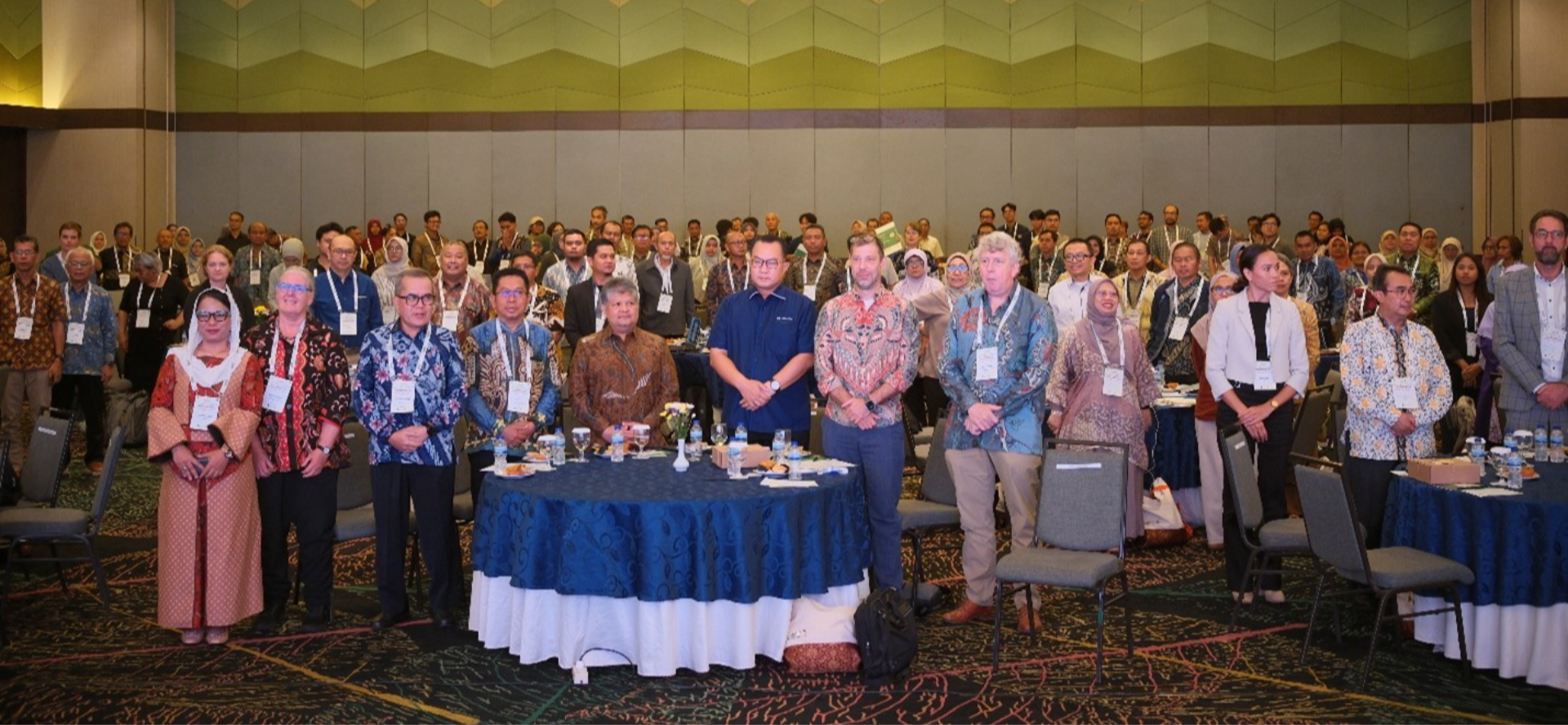
The outcomes of the three-year collaboration were presented during the final SustainPalm meeting, held on September 1–2, 2025, at the IPB International Convention Center in Bogor. During the event, project partners highlighted a number of achievements, including the integration of oil palm cultivation with food crops and livestock systems in Bengkulu Utara, South Kalimantan, and Central Kalimantan. Other notable outcomes included the circular utilization of oil palm waste for biogas production, the development of palm-sap-based sugar products, biofoam and wood-like materials derived from oil palm trunks, as well as peatland restoration initiatives through rewetting and paludiculture practices.
Through SustainPalm, research findings are expected to extend beyond academia by bridging the gap between scientific knowledge, policy development, and practical implementation. The project demonstrates how international collaboration can generate tangible solutions that support the long-term sustainability and resilience of Indonesia’s palm oil sector.