Sogang University
Published on 27 April 2026




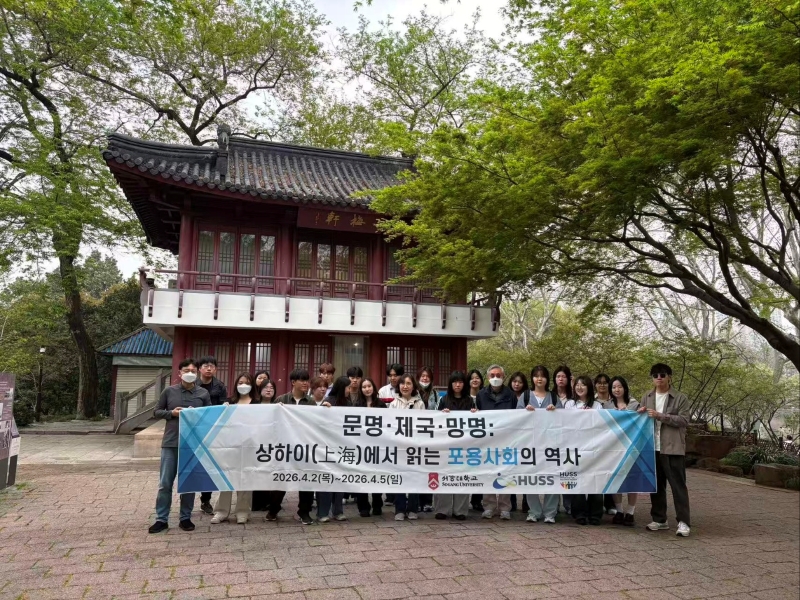
What does inclusion look like in practice, across history and across cultures? That was the question at the center of a four-day field program organized by Sogang University's HUSS Initiative for Inclusive Society, which brought twenty undergraduate students to Shanghai from April 2 to 5.
The program, titled "Civilization, Empire, and Exile: Reading the History of Inclusive Society in Shanghai," was designed around a central premise: that Shanghai's layered urban history offers an unusually rich site for examining how societies have — and have not — made room for those pushed to their margins. Students approached the city through three thematic lenses. The first traced the formation of Yangtze River civilization and Shanghai's early cultural foundations. The second examined the city's development as an imperial international port, where competing colonial powers left visible marks on the built environment. The third turned to histories of refuge and displacement — the Korean independence movement, Jewish refugees who fled to Shanghai during the Second World War, and the experiences of comfort women documented in the city's historical record.
The itinerary moved through these layers directly. Participants visited the Shanghai Museum and Guangfulin Relics Park before walking the Bund and Nanjing Road, where the architecture of the imperial era remains largely intact. They then visited the former site of the Korean Provisional Government and the Yun Bong-gil Memorial, followed by the Jewish Refugees Museum and a museum dedicated to the history of comfort women.
Preparation began well before departure. From March onward, students worked in small groups through a series of seminars, researching and presenting on their assigned sub-themes before applying that groundwork to what they encountered on site. Five faculty members from the Department of History accompanied and guided the program throughout.
For one participant, the experience reframed a city she thought she knew. Kim Jin-seo (History, '22) reflected that beneath Shanghai's reputation as a cosmopolitan metropolis, she found "a historical layer of inclusion through exile and memory" — and that witnessing how the city had offered refuge to Korean independence activists and Jewish refugees alike led her to conclude that a truly inclusive society begins with making space for the marginalized and committing to remember their experiences.
A closing outcomes session is scheduled for April 9 on campus. The HUSS Initiative for Inclusive Society has indicated it will continue developing field-based global programs aimed at equipping students with the interdisciplinary perspective and civic sensibility needed to engage with questions of inclusion, equity, and justice — in history and in the present.