The Rumah Ceria Medan Foundation (YRCM), an inclusive school in Medan, serves as a place to meet the educational needs of children with disabilities. It was founded by Yuli Yanika, fondly known as Uye, and Risa Riskayanti, co-founder and secretary of YRCM, who is an alumnus of the University of North Sumatra (USU) Communication Science program. At this school, sign language is one of the languages required for communication. The Rumah Ceria Medan Foundation is located at Jl. Bunga Cempaka VII No. 41 Y, Padang Bulan Selayang II, Medan Selayang District, Medan City, North Sumatra.
Uye’s interest in the world of disability originated from his childhood experiences growing up close to children with disabilities. This closeness eventually fostered empathy and a strong desire in her to create a learning space that is friendly to all children.
Uye’s journey in disability activities began in 2013 when she worked as a teacher at a nature school. It was there that she realised the wide communication gap between children with disabilities and those without. She saw how children with disabilities often struggled to express themselves and be accepted in social interactions. Driven by this concern, Uye eventually established a creativity workshop as a platform for children with disabilities to channel their talents and expressions.
Together with her friends who are members of a community that cares for people with disabilities, she opened various classes through the creativity studio, ranging from dance and photography classes to learning activities designed to build children’s self-confidence. The creativity studio activities are held regularly every week and have become a warm place for many children with disabilities in the neighborhood where she lives.
Starting from the creativity studio, an inclusive school called Yayasan Rumah Ceria Medan was established in 2019. Rumah Ceria Medan is expected to become a nature school where children can learn freely, close to the environment, and grow without limits.
YRCM has grown into an inclusive school that provides learning opportunities for children with and without disabilities. This school not only focuses on academic aspects, but also on character education, empathy, and independence. Uye believes that true education is when every child does not look at their physical condition, so they can learn with a sense of security and be accepted for who they are.
As one of the inclusive schools in the city of Medan, YRCM offers various educational programs that can help children with disabilities without discrimination, one of which is the Tuli Mengaji program. This program is the first of its kind in Medan City, making it a pioneer and inspiration for other schools.
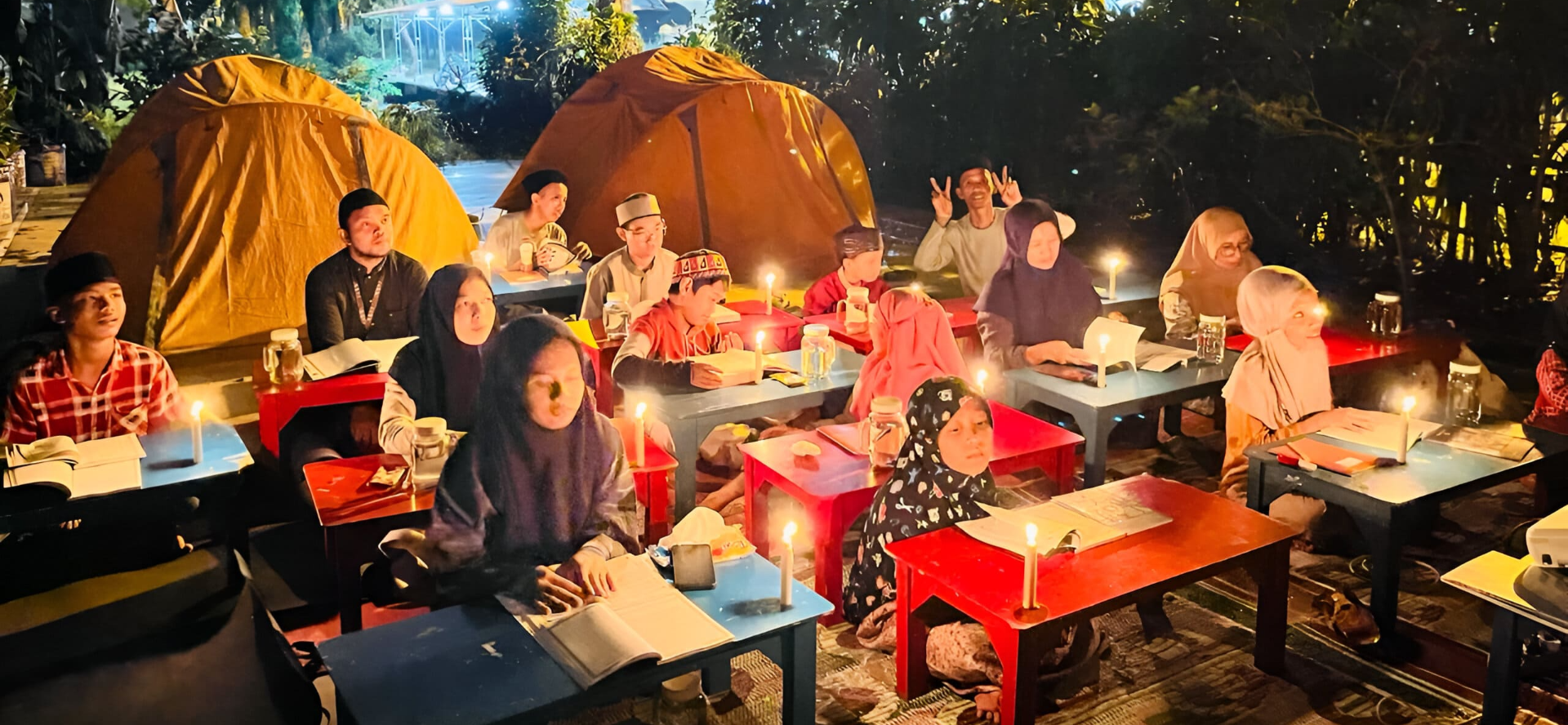
Not only deaf children, but this activity is also open to children without disabilities. This program is routinely held every Ramadan and lasts for 11 days. During the first 8 days, the children will learn to recite the Quran, and the remaining 3 days will be spent camping at the school for in-depth learning.
During the program, the children will start learning to recite the Quran at 3 p.m. until breaking the fast. Each child will also have their own learning targets so that a high level of enthusiasm will arise in their hearts. This activity is usually held in the second week of Ramadan and takes place at the Rumah Ceria Foundation in Medan.
Tuli Mengaji was created because of YRCM’s concern for children with disabilities who cannot even recite the Quran and understand what it is. They do not understand who God is and question whether God is male or female. The lack of literacy among children with disabilities is the fundamental reason why this educational program was started.
Teaching the deaf to recite the Quran is not only carried out during Ramadan. Every morning, the children are taught by teachers to recite the Quran or when learning activities have been completed. Every Friday, the school also holds Quran recitation activities as a form of in-depth learning.
Every teacher who will teach in this program will receive training from the Ministry of Religious Affairs. After obtaining permission from the training, each teacher can teach in the Deaf Recitation program.
Through the Tuli Mengaji program, YRCM serves as a school that promotes equality between people with and without disabilities. It is hoped that this positive initiative will continue and inspire others.
Through the Deaf Recitation program, YRCM is present as a school that provides equality between people with and without disabilities. Hopefully, this positive activity can continue and become a positive inspiration for others.