INHA University
Published on 3 February 2026





A joint research team led by Dr. Gu Ye-jin of the Natural Circulation Electronic Materials Research Institute at Inha University and the Polymer Engineering and Materials Synthesis Laboratory has recently attracted significant academic attention by consecutively proposing strategies to overcome the reliability issues and performance limitations of photoresist materials used in EUV lithography-based ultra-high-density semiconductor manufacturing processes.
EUV lithography is a technology that uses extremely short-wavelength light to draw ultra-fine semiconductor circuits at the nanometer scale. The material that actually forms the shapes of transistors and metal interconnects within integrated circuits is the photoresist, which undergoes chemical changes upon exposure to light to create the circuit pattern. As such, photoresists are considered a core patterning material essential for accurately fabricating semiconductor circuits.
Recently, tin nanocluster-based photoresists, which enable more precise circuit patterning than conventional organic photoresists, have emerged as promising next-generation materials. However, these materials suffer from limitations in that their properties change upon exposure to air during processing, leading to degraded pattern quality and reduced process stability.
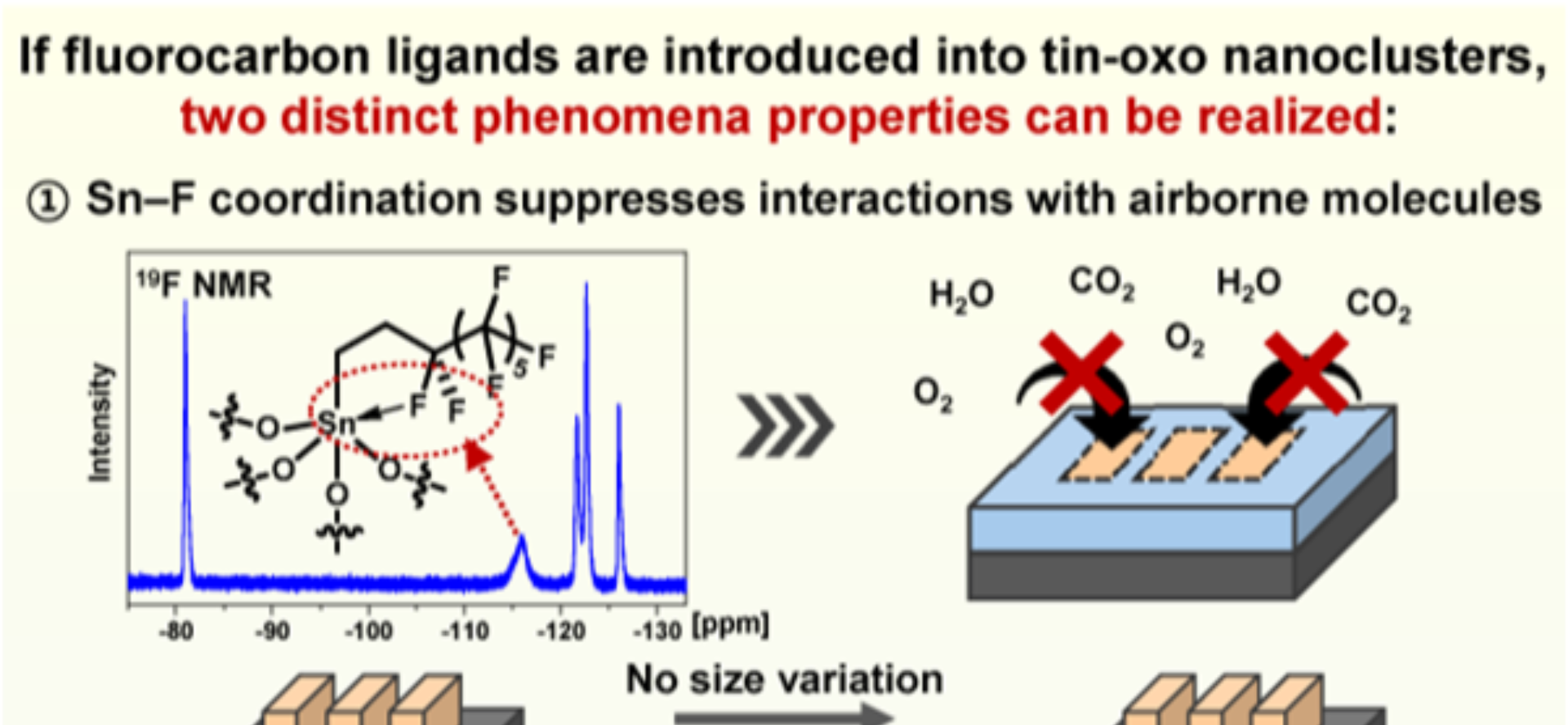
Dr. Gu Ye-jin focused on the fact that this instability originates from a specific chemical property of tin—Lewis acidity. Because tin readily reacts with moisture in the air, she proposed a strategy to mitigate this issue by incorporating fluorine atoms. Through material synthesis and lithography experiments, she demonstrated that this approach significantly enhances the stability and process reliability of photoresists.
The fluorine-incorporated tin oxide photoresist synthesized by the joint research team exhibited excellent process stability, showing outstanding patterning resolution at the 10-nanometer (nm) scale without reliability degradation caused by atmospheric exposure. Furthermore, by leveraging the material properties enabled by fluorine incorporation, the team implemented a bilayer photoresist structure. As a result, circuits could be formed using lower EUV exposure doses, significantly improving overall process efficiency.
This research was conducted in collaboration with the Samsung Electronics Semiconductor Research Center under the support of the Samsung Future Technology Incubation Center. The results were recently published in Advanced Functional Materials, a highly influential international journal in materials science, under the title:
“Tin-Oxo Nanocluster Extreme UV Photoresists Equipped with Chemical Features for Atmospheric Stability and High EUV Sensitivity.”
In addition to this work, Dr. Gu also conducted research on chemically amplified resists (CARs), proposing a new approach to improve the productivity of EUV lithography processes. EUV lithography operates using light with a wavelength of 13.5 nm, and insufficient photon delivery during exposure can lead to degraded pattern quality.
Rather than increasing the exposure dose, Dr. Gu proposed incorporating high light-absorption elements into the photoresist. This strategy reduces photon loss during exposure, thereby enhancing pattern quality while maintaining process efficiency.
Experimental results confirmed that iodine is an effective element for improving the operational efficiency of chemically amplified photoresists. Based on these findings, the team synthesized a CT contrast agent–based radiation sensitizer containing a high concentration of iodine and applied it to commercial EUV photoresists. This approach successfully demonstrated simultaneous improvements in EUV sensitivity and pattern quality.
This research was carried out in collaboration with the Electronic Materials Division of Dongjin Semichem and was recently published in ACS Applied Materials & Interfaces under the title: “Positive Role of Iodine Atoms in Chemically Amplified Photoresists for Extreme Ultraviolet Lithography.”
Dr. Gu Ye-jin of the Natural Circulation Electronic Materials Research Institute at Inha University stated, “It was meaningful to propose solutions to advanced semiconductor technology challenges through close collaboration with industry. I will continue pursuing research that contributes to strengthening the competitiveness of Korea’s semiconductor technology.”

▲ Two key characteristics: By introducing fluorinated ligands into tin oxide, reactivity between tin and atmospheric molecules is reduced, chemical orthogonality is secured, and multilayer thin-film structures become feasible—resulting in enhanced resist sensitivity.

▲ Iodine was identified as a high-absorption element that improves the efficiency of chemically amplified photoresists. By applying a CT contrast agent–based radiation sensitizer containing a high concentration of iodine to commercial EUV photoresists, simultaneous improvements in sensitivity and pattern quality were demonstrated.

▲Dr. Gu Ye-jin of the Natural Circulation Electronic Materials Research Institute