National Taiwan University
Published on 3 February 2026





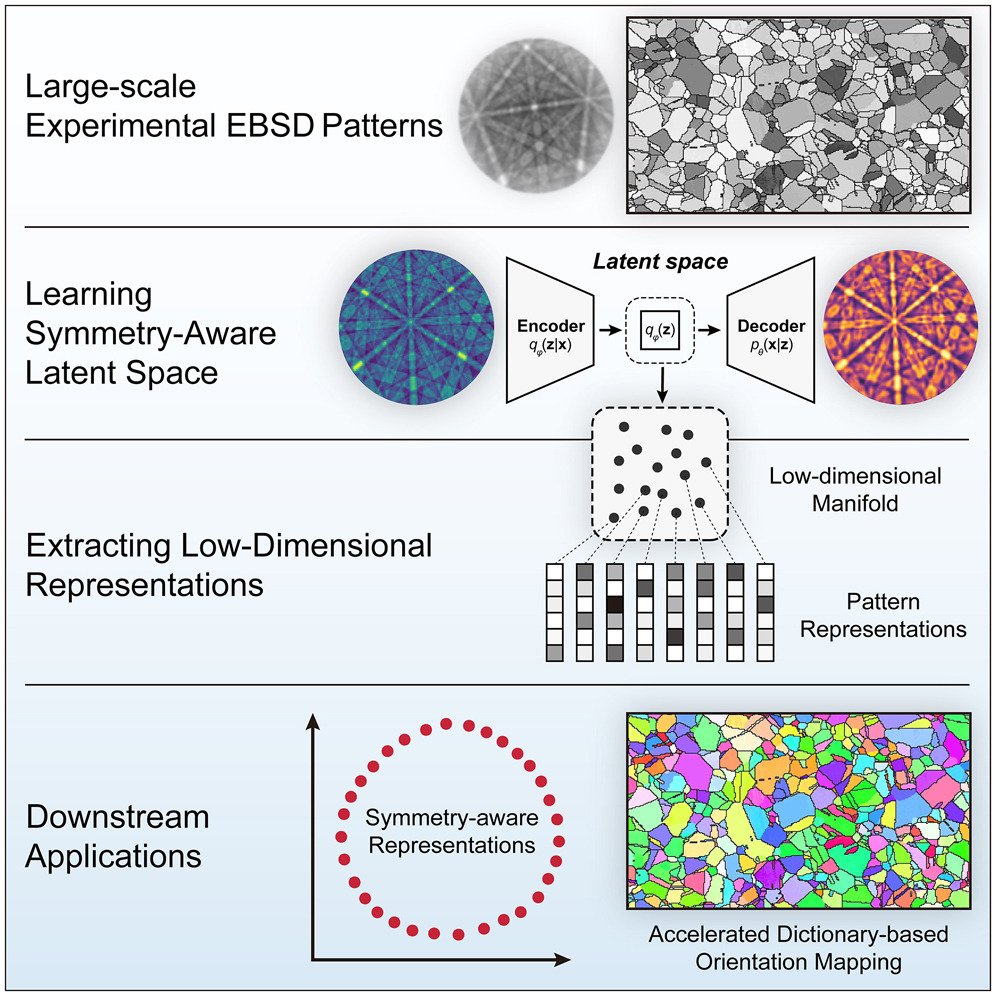
National Taiwan University (NTU) Assistant Professor Shaopu Tsai, together with Cambridge PhD Dr. Boyan Tong, led a team to develop Lattice, an AI method that “learns” crystal physics from EBSD data. Using a variational autoencoder (VAE), Lattice indexes patterns 7.5 times faster, compresses data by 99.9%, and captures rotational symmetries, effectively creating a “physics-aware” AI for crystal analysis.
In materials research, determining crystal structures is often a slow, labor-intensive process essential for linking structure to performance. Traditional electron backscatter diffraction (EBSD) methods, widely used in scanning electron microscopy, face trade-offs between speed and accuracy: fast approaches like Hough transforms lack precision, while dictionary indexing and full pattern matching are highly accurate but time-consuming and resource-intensive.
The three-year project, primarily executed by NTU student Yujun Liu, has already been applied to fully recrystallized 316 stainless steel and was published in Cell Reports Physical Science. Funded by the NSC, NTU R&D, and Walsin Lihwa, the team plans to expand this physics-informed AI approach for broader materials science applications.
https://www.cell.com/cell-reports-physical-science/fulltext/S2666-3864(25)00470-9