INHA University
Published on 7 April 2026





A research team led by Professor Lim Hongki of the Department of Electrical and Computer Engineering at INHA University has recently developed ‘FAST-DIPS,’ a new artificial intelligence technology for image restoration based on diffusion models.
Professor Lim’s research team proposed a method to more quickly and stably solve ‘inverse problems,’ which involve reconstructing original images from degraded or partially observed data.
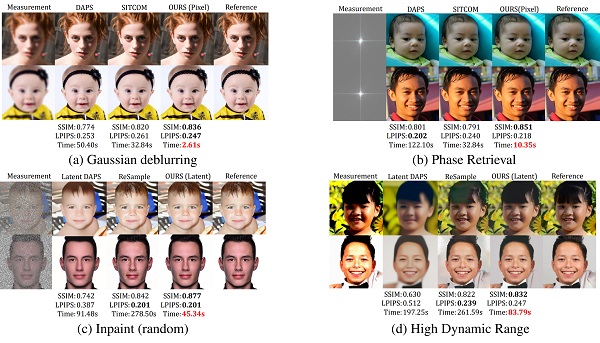
Image inverse problems are core challenges in computer vision and image processing, including super-resolution, inpainting, deblurring, phase retrieval, and HDR restoration. However, existing diffusion model-based restoration techniques have limitations: as problem types become more complex, they require repetitive gradient calculations or internal optimization processes, leading to high computational costs. In some cases, adjoint operators or pseudo-inverse matrices for each operator must be designed separately.
The core of the FAST-DIPS method proposed by the research team is to achieve fast and stable restoration with minimal computation at each step by combining constraints that strictly maintain consistency with measured values with analytically calculated optimal step sizes. This adjoint-free approach allows for flexible application to various linear and non-linear restoration problems without separate retraining. Furthermore, its implementation based on automatic differentiation offers the advantage not having to manually design complex adjoint-free analytic steps or pseudo-inverse matrices.
Additionally, the research team proposed a hybrid approach that combines pixel space and latent space. In the initial stages, reconstruction is performed in pixel space for fast computation, and it then transitions to latent space to better utilize the representative power of generative models, simultaneously enhancing both restoration quality and computational efficiency.
This study is significant for simultaneously increasing computational efficiency and application flexibility in diffusion model-based image restoration. The developed technology is expected to be widely utilized in various computer vision and scientific application fields that require high-speed, high-quality image reconstruction.
These research results were published in the paper titled ‘FAST-DIPS: Adjoint-Free Analytic Steps and Hard-Constrained Likelihood Correction for Diffusion-Prior Inverse Problems,’ with doctoral student Kim Min-woo and MS-PhD integrated student Shin Seung-hyeok participating as joint first authors under the guidance of Professor Lim Hongki.
The paper was recently accepted for ICLR 2026, an international academic conference in the field of artificial intelligence. ICLR is considered the world's most prestigious international conference in the field of deep learning.
The research team is scheduled to present their findings at ICLR 2026 in Rio de Janeiro, Brazil, this coming April.

▲Image restoration results and comparisons developed by Professor Lim Hongki’s research team using FAST-DIPS