NCUSEC
Published on 3 March 2026





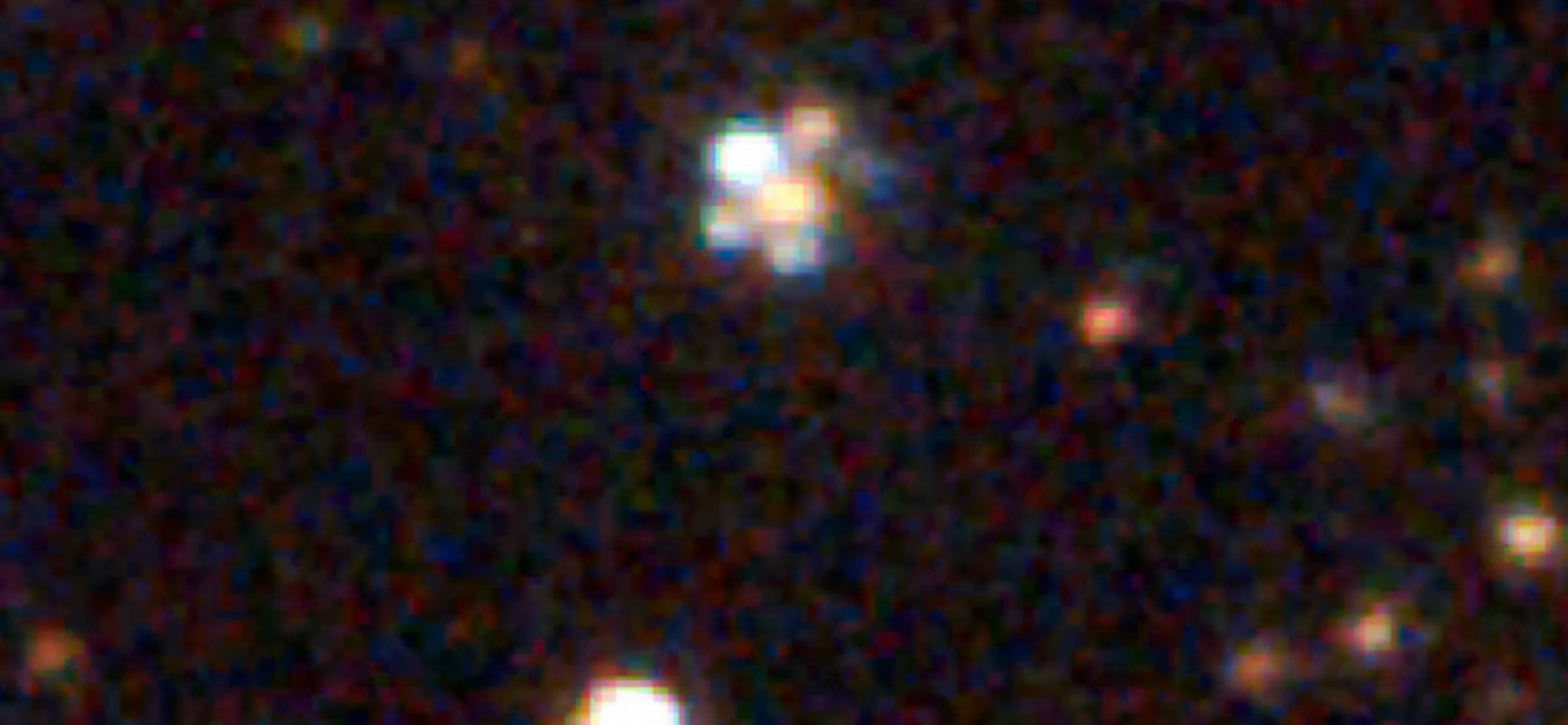
In this international collaboration, the NCU team played a central role in key observing and data-analysis efforts, providing crucial data to confirm this rare strongly gravitationally lensed supernova system. Assistant Professor Ting-Wan Chen’s team used the Lulin One-meter Telescope (LOT) for image confirmation and photometric monitoring. She noted that on nights with good weather and excellent seeing, LOT images can even resolve the individual lensed images of SN Winny, providing key observational constraints for the photometric analysis and lens modeling.
Postdoctoral researcher Dr. Amar Aryan analyzed r-band imaging from the Canada-France-Hawaii Telescope (CFHT) and identified an additional transient point source near the previously reported multiple images. He reported it via a Transient Name Server AstroNote as a possible fifth lensed image. Using the positions of all five copies, Leon Ecker and Allan Schweinfurth et al., built the first model of the lens mass distribution. On the data-processing side, the DETECT tool developed by graduate student Yu-Hsing Lee independently flagged this bright transient through routine cross-matching between newly discovered transients and Dark Energy Spectroscopic Instrument (DESI) galaxy data. This substantially improves candidate-identification efficiency and rapid follow-up capability, providing a robust basis for precise measurements of the time delays between the multiple images.
Assistant Professor Ting-Wan Chen explained that gravitational lensing is like a natural magnifying glass in the universe: it bends the light from the same background object along multiple paths, allowing us to see several “duplicate” images. Because each light path travels a different distance and experiences a different amount of gravitational bending, the light reaches Earth at different times, so the images can brighten at different moments. By precisely measuring these time delays between the multiple images and combining them with a mass-distribution model of the lensing galaxy, the team can constrain cosmological distances and key parameters of the Universe’s expansion, such as the Hubble constant. First author of the paper Dr. Stefan Taubenberger added that, unlike the cosmic distance ladder, this is a one-step method, with fewer and completely different sources of systematic uncertainty, helping to clarify the long-standing Hubble tension.
For further details, please refer to the articles published/submitted in Astronomy & Astrophysics at:
Taubenberger et al.: https://arxiv.org/abs/2510.21694
Ecker, Schweinfurth et al: http://arxiv.org/abs/2602.16620