


Ajman University
Published on 3 March 2026





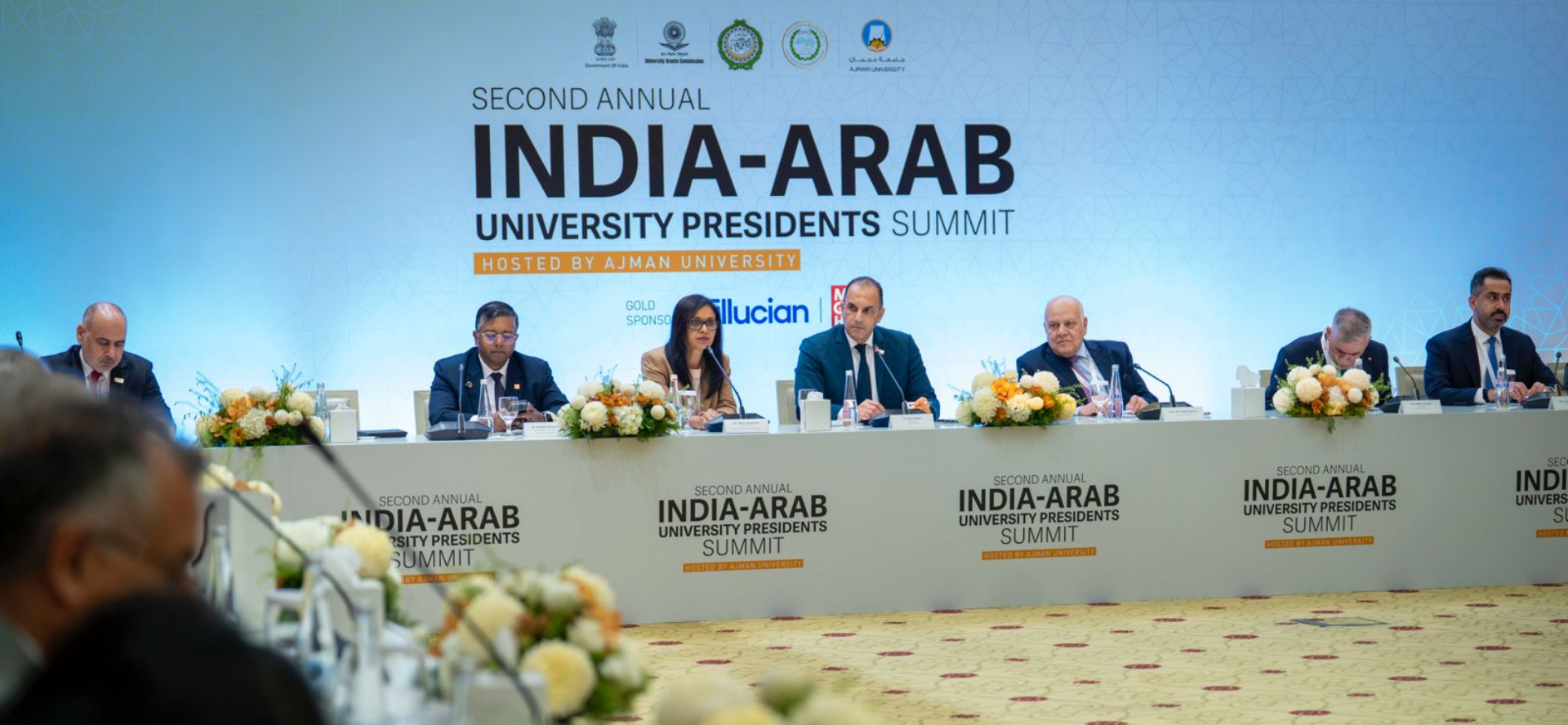
Under the patronage of H.H. Sheikh Ammar bin Humaid Al Nuaimi, Crown Prince of Ajman, Chairman of the Executive Council, and Chairman of Ajman University’s Board of Trustees, Ajman University inaugurated the second Annual India–Arab University Presidents’ Summit, marking the first time the gathering has been hosted in the Arab region.
Hend under the theme “Impact Beyond Borders: Research, Innovation, and Mobility,” the Summit opened with a powerful call to transform cross-regional collaboration, led by a renewed focus on public value, academic excellence, and societal impact. Marking its trailblazing debut in the Middle East, the Summit set an ambitious tone for advancing international cooperation in higher education, research and workforce development.
The Summit is organized in partnership with the Association of Arab Universities, the General Secretariat of the League of Arab States, the Ministry of External Affairs of India, the University Grants Commission (UGC), and the Association of Indian Universities (AIU). The initiative is further supported by industry partners Ellucian and McGraw Hill, underscoring the alignment between policy, academia, and the private sector in advancing a forward-looking higher education agenda.
A Timely Response to Global Shifts in Education and Employment
The Summit comes at a time when the demand for skills‑first education is at an all-time high, According to the insights from the ‘World Economic Forum’, Broadening digital access is expected to be the most transformative trend—both across technology‑related domains and overall—with 60% of employers anticipating reshaping their business by 2030. Technological Advancements, particularly AI and information processing (86%), robotics and automation (58%), and energy generation, storage and distribution (41%), are projected to drive both the fastest-growing and fastest-declining job roles.
These shifts are fueling a surge in demand for technology-related skills, with AI and big data, networks and cybersecurity, and technological literacy identified as the top three fastest-growing skill areas. At the same time, analytical thinking remains the most sought-after core skill, with seven in ten employers considering it essential as of 2025. This is closely followed by resilience, flexibility, agility, leadership, and social influence—highlighting the need for universities to nurture both technical and human-centric competencies.
The event commenced with a welcome address by Dr. Karim Seghir, Chancellor of Ajman University, exploring how the future of learning can be reimagined by strengthening India–Arab partnerships.
He stated: “Our regions stand at the threshold of one of the most consequential transformations of our time—technological, economic, and societal. Universities must lead this change by embracing a skills-first mindset, expanding mobility, and building research ecosystems that will empower our youth for a rapidly evolving world of work. At Ajman University, we remain committed to ensuring that this transformation is inclusive, skills-driven, and anchored in public value.”
Building on the Chancellor’s call to reimagine the future of learning through stronger India–Arab collaboration, the Summit brought forward a distinguished group of regional and diplomatic leaders to deepen the dialogue.
Prof. Amr Ezzat Salama, Secretary-General of the Association of Arab Universities, underscored the urgency of coordinated academic reform and greater institutional alignment across the Arab higher education landscape. Dr. Farraj Al-Ajami, Minister Plenipotentiary and Director of the Education and Scientific Research Department at the League of Arab States, addressed the policy architecture required to strengthen research ecosystems and formalize cross-regional cooperation. Dr. Seepak Mittal, Ambassador of India to the UAE, added an international dimension, highlighting the expanding educational partnership between India and the Arab world and the role universities play in translating diplomacy into sustained academic and economic collaboration.
The plenary session ‘Reimagining India–Arab Academic Partnerships’ featured a keynote address by Dr Dipak Jain, President (European) at the China Europe International Business School. He unveiled unique pathways for joint research, innovation and dual‑degree programs, aligning with regional ambitions to position skill‑based education, AI and digital transformation as cornerstones of national development agendas.
This was followed by a fireside chat featuring Professor (Dr.) C. Raj Kumar, Vice Chancellor of OP Jindal Global University and Dr Ashwin Fernandes, Executive Director (AMESA), QS Quacquarelli Symonds QS. The discussion focused on innovating practical mechanisms to transform strategic intent into impactful collaborations, governance frameworks, joint research clusters and industry‑integrated learning.
The Summit also set the stage for its first-ever Presidential Roundtable, co‑chaired by Dr Karim Seghir and Dr Vidya Yeravdekar, Pro Chancellor of Symbiosis International University. It facilitated critical discourses on transforming vision into action, with a focus on how institutions can jointly design programs that address the evolving needs of students, faculty and employers across both regions.
Other esteemed speakers including senior representatives from the League of Arab States, the UAE Ministry of Higher Education and Scientific Research, and the Government of India (UGC), delivered impactful addresses, emphasizing the strategic importance of bilateral academic partnerships in strengthening the global education system.
Amplifying the Summit’s impact, speakers from Khalifa University, Aligarh Muslim University, Goa Institute of Management, The University of Birmingham Dubai and Alserkal Group examined how universities can bridge the education-employability gap by embedding future-ready skills in academic curricula. This seamlessly aligns with the ongoing regional technological transformation, particularly across AI and automation, fuelling the demand for advanced technical skills.
Fostering Mobility and Research Collaboration
The final panel session of the day aimed to strengthen student and faculty mobility between Indian and Arab universities. Moderated by Prof. Anas Alsoud, Executive Director, of the Association of AFostering Mobility and Research Collaborationrab Universities, it brought together leaders from Lovely Professional University, German Jordan University, Symbiosis International University and Applied Science University Bahrain, facilitating impactful discussions on sustainable mobility frameworks, experiential learning pathways and the role of faculty exchange in strengthening research collaboration.

