INHA University
Published on 14 January 2026





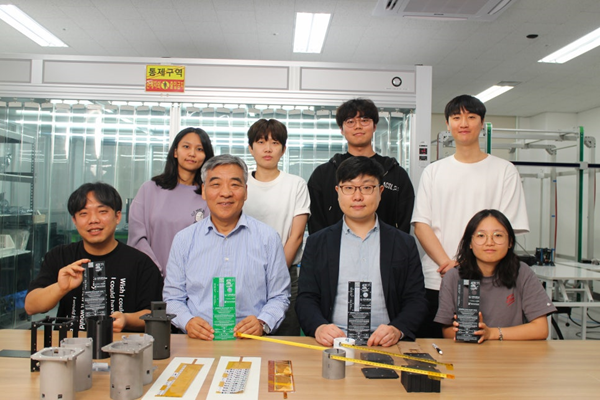

▲3U-class CubeSat ‘INHARoSAT’ (10×10×30 cm), developed by the Aerospace Control and Systems Laboratory
The CubeSat developed by the research team led by Professor Ki-Young Choi of the Department of Aerospace Engineering at Inha University has successfully entered Earth’s orbit along with the fourth launch of Korea’s Nuri rocket.
The 3U-class CubeSat ‘INHARoSAT’, designed and built by the Aerospace Control and Systems Laboratory, features a groundbreaking technology: it is the world’s first CubeSat to carry a flexible solar cell module rolled up for launch and deployed in space.
INHARoSAT was selected as a flight mission in the 2022 CubeSat Competition hosted by the Korea Aerospace Research Institute (KARI), and was launched aboard Nuri during its successful fourth flight on the 27th.
Upon entering its target orbit, INHARoSAT deployed the RoSADA (Rollable Solar Array Drum Assembly)—a roll-out solar array structure developed by the research team—and is set to conduct various missions, including evaluating the performance of the flexible solar cells developed by the domestic company Plexel Space.
In small satellites, limited surface area often results in chronic power shortages. Traditional satellites use folded panel-type solar arrays, which increase both size and mass. The Inha research team addressed this issue by proposing a method of rolling up flexible solar cells for compact stowage, enabling the deployment of wider solar arrays in space. This approach is expected to contribute to future technologies such as space solar power stations.
A key mission of INHARoSAT is to verify Inha university’s independent capability to develop and operate space-grade electronics. In addition to its main computer, the satellite carries an internally developed Integrated Onboard Computer (I-OBC). Successful validation of the I-OBC will demonstrate Inha University’s ability to produce space-qualified electronics.
To support the mission, Inha university has also established its own ground station at the Songdo Aerospace Convergence Campus, enabling direct communication with the satellite. Through operating the ground station and communicating with INHARoSAT, Inha university aims to further strengthen its operational expertise.
The project has significantly enhanced Inha university’s capacity in space development, with faculty and graduate students across aerospace specializations participating in CubeSat development. Looking ahead, Inha University plans to continue advancing education and research in space technologies and contributing to the growth of the national space industry. As part of this vision, Inha university recently established the Aerospace & Defense Specialized Graduate School, aimed at leading global innovation in aerospace and defense fields.
Professor Ki-Young Choi, principal investigator of the CubeSat project, stated, “The successful orbital insertion of INHARoSAT marks the culmination of Inha University’s continuous challenges and investments in core aerospace fields—from launching its first indigenous rocket in the 1960s to establishing the Aerospace Convergence Campus. We will continue to strengthen our role in space technology education, research, and industry collaboration, ensuring that our students develop the core competencies needed to lead the future space industry.”

▲ INHARoSAT undergoing high-temperature testing in a thermal vacuum chamber.