Sogang University
Published on 7 May 2026




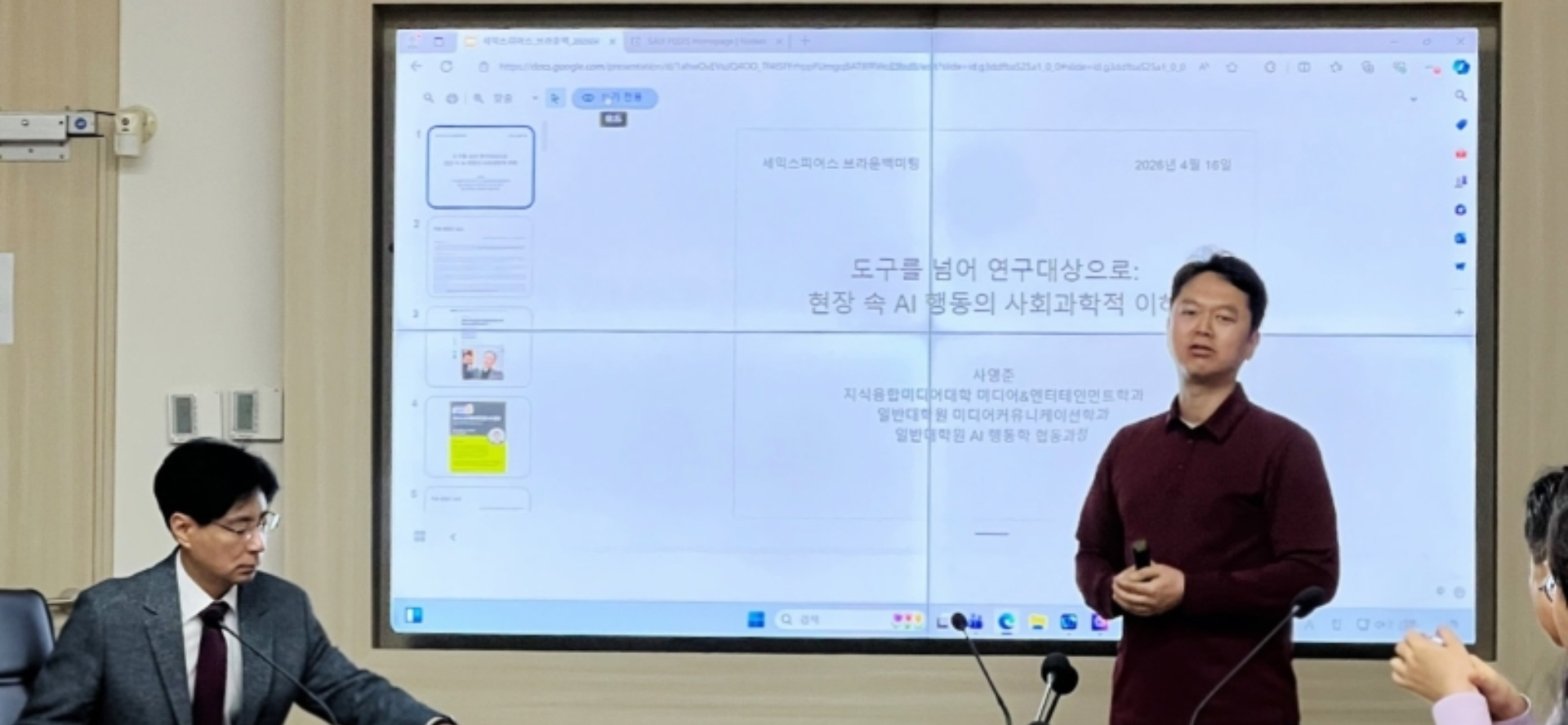
Sogang University's AI convergence forum SAIXPeers held its April brown bag seminar under the theme "Understanding AI Behavior in Context: A Social Science Perspective," drawing faculty from across disciplines for an extended discussion on how AI behavior should be studied as a field in its own right.
The session was led by Professor Young June Sah of the Department of Media and Entertainment, who is spearheading the launch of Sogang's new Interdisciplinary AI Behavioral Studies program. His presentation proposed a paradigm shift: rather than analyzing AI purely through technical architecture, researchers should examine AI behavior through non-technical, social scientific frameworks — studying how AI systems act, learn, and evolve within human social environments.
Professor Sah introduced Tinbergen's four questions — originally developed in ethology — as an analytical framework adaptable to AI: Mechanism (why does an AI behave as it does?), Development (how does training data shape its behavior?), Function (what role does AI behavior serve in society?), and Evolution (how does AI change through interaction with technology and society?). He argued this framework enables both micro-level analysis of individual AI systems and a macro-level view of the AI ecosystem as a whole.
The seminar also examined AI's "black box" problem from a behavioral perspective. Drawing on parallels with explainable AI (XAI) research — which compares how AI weights visual inputs against human perceptual processing — Professor Sah suggested that social scientific inquiry into human behavior can generate hypotheses applicable to AI decision-making. One-shot learning, which mirrors how children rapidly acquire concepts from a single exposure, was cited by attendees as an example of human learning principles already informing AI model design.
On the question of harmful outputs, Professor Sah analyzed "toxic degeneration" — AI-generated antisocial or hateful content — through the behavioral lens: as a product of the system's next-token prediction mechanism combined with biased training data drawn from environments such as Reddit. The framework, he argued, allows researchers to identify and address the social and developmental origins of such behavior, not only its technical causes.
The discussion extended to broader questions of social value. Professor Sah raised the possibility that AI's displacement of knowledge-based labor could accelerate the decline of credential-driven hierarchies, and questioned whether evolutionary rationales for social institutions such as marriage remain meaningful in an AI-mediated society. Faculty from multiple disciplines engaged with these questions, affirming the value of continued interdisciplinary exchange.
The seminar coincided with the formal announcement of Sogang's Interdisciplinary AI Behavioral Studies program, to be offered through the Graduate School beginning in the fall 2026 semester. The program integrates psychology, education, media and communication, and technology management, with the aim of training researchers and practitioners equipped to address human-centered challenges in the age of AI. Applications for fall 2026 admission are open from April 30 to May 7; further details are available at https://aibeh.sogang.ac.kr/.