INHA University
Published on 16 March 2026





▲ (From left) Min Kyung-Hoon, first author and integrated master’s/doctoral researcher in the Department of Chemistry and Chemical Engineering, and Professor Shim Sang-Eun(Advisor) of the Department of Chemical Engineering.
Professor Shim Sang-Eun’s research team in the Department of Chemical Engineering recently developed a next-generation catalyst technology capable of capturing carbon dioxide and converting it into useful compounds simultaneously.
This technology is a new method of directly growing Metal-Organic Frameworks (MOF) inside silica-based aerogels.
Professor Shim’s research team designed the aerogel—which has a lightweight and highly porous structure—to act as a confined reaction space, ensuring the catalytic material forms uniformly inside. Through this, they reduced particle aggregation, a common issue in conventional catalysts, and enabled more effective utilization of the active sites required for the reaction.
In particular, they developed a new aerogel support by combining silicon-based polymers with hydrophilic polymers and succeeded in evenly dispersing MOF, which is effective for carbon dioxide adsorption and conversion reactions, inside. This structure possesses both a high surface area and a rigid framework, offering the advantage of maintaining its shape even under demanding synthesis conditions.
Additionally, they further enhanced reaction efficiency by introducing an ionic liquid that serves to effectively capture carbon dioxide on the catalyst surface. As a result, it showed excellent carbon dioxide adsorption performance even at room temperature, and in catalytic reaction experiments, achieved near-perfect reaction efficiency with only a very small amount of catalyst.
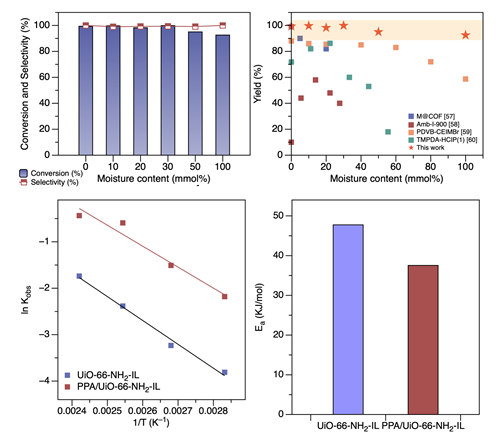
This catalyst showed almost no performance degradation even after more than 10 repeated uses and operated stably even in environments where moisture was present. It is evaluated that the hydrophobic characteristics of the siloxane-based structure increased the possibility of application to actual industrial processes. Min Kyung-Hoon, an integrated master’s/doctoral researcher in the Department of Chemistry and Chemical Engineering Fusion, participated as the first author of this study.
Professor Shim Sang-Eun said, “By employing a strategy of growing the catalyst directly inside the aerogel, we effectively overcame the limitations of existing metal-organic framework catalysts,” adding, “This technology will serve as a practical alternative that contributes to reducing carbon dioxide and utilizing it as a resource.”

▲Schematic diagram of the research on improving carbon dioxide conversion performance through catalyst growth inside aerogel.
Meanwhile, the results of this study were published in the international academic journal Advanced Composites and Hybrid Materials (Impact factor: 21.8).