L.N. Gumilyov Eurasian National University
Published on 20 February 2026




Thirty years is no longer merely a jubilee date; it is a historical distance that makes it possible to assess the university’s role in the destiny of the nation. Over such a period, many universities manage to establish academic schools, educate generations of specialists, and build reputations. However, only a few become direct participants and witnesses of state history.
For three decades, L.N. Gumilyov Eurasian National University has developed alongside independent Kazakhstan and its new capital, absorbing the spirit of the era—its aspirations, ambitions, and global outlook. The university has become not only an educational and research center, but also a space for international dialogue where key contemporary issues—from regional security to intercivilizational interaction—have been discussed.
The uniqueness of ENU lies in a fact unparalleled in the national higher education system: over thirty years, the university has been visited by 43 world leaders, including 26 presidents, 4 prime ministers, and 13 heads of international organizations and spiritual leaders. These visits reflected not accidental interest, but sustained trust in the university as an intellectual platform where the future is shaped.
The history of these meetings is not a list of protocol visits. It is a chronicle of Kazakhstan’s emergence as a responsible member of the global community, recorded in university lecture halls, scholarly debates, and public lectures.
The late 1990s marked Kazakhstan’s active engagement with Europe. During this period, the university hosted Presidents Aleksander Kwaśniewski of Poland, Alexander Lukashenko of Belarus, Emil Constantinescu of Romania, and Valdas Adamkus of Lithuania. These visits coincided with Kazakhstan’s consolidation as an international actor and Astana’s formation as a new diplomatic capital of Eurasia.
The early 2000s became a period of global recognition for both Kazakhstan and ENU. University audiences heard speeches by leaders who shaped the post-Soviet and global order—Vladimir Putin, Boris Yeltsin, and Mikhail Gorbachev. The university also welcomed Presidents Saparmurat Niyazov of Turkmenistan, Leonid Kuchma of Ukraine, Milan Kučan of Slovenia, Georgi Parvanov of Bulgaria, and Ilham Aliyev of Azerbaijan.
A significant milestone was the visit of NATO Secretary General George Robertson, who emphasized Kazakhstan’s responsible role in international security, as well as the visit of Turkish President Ahmet Necdet Sezer, which strengthened humanitarian and educational cooperation.
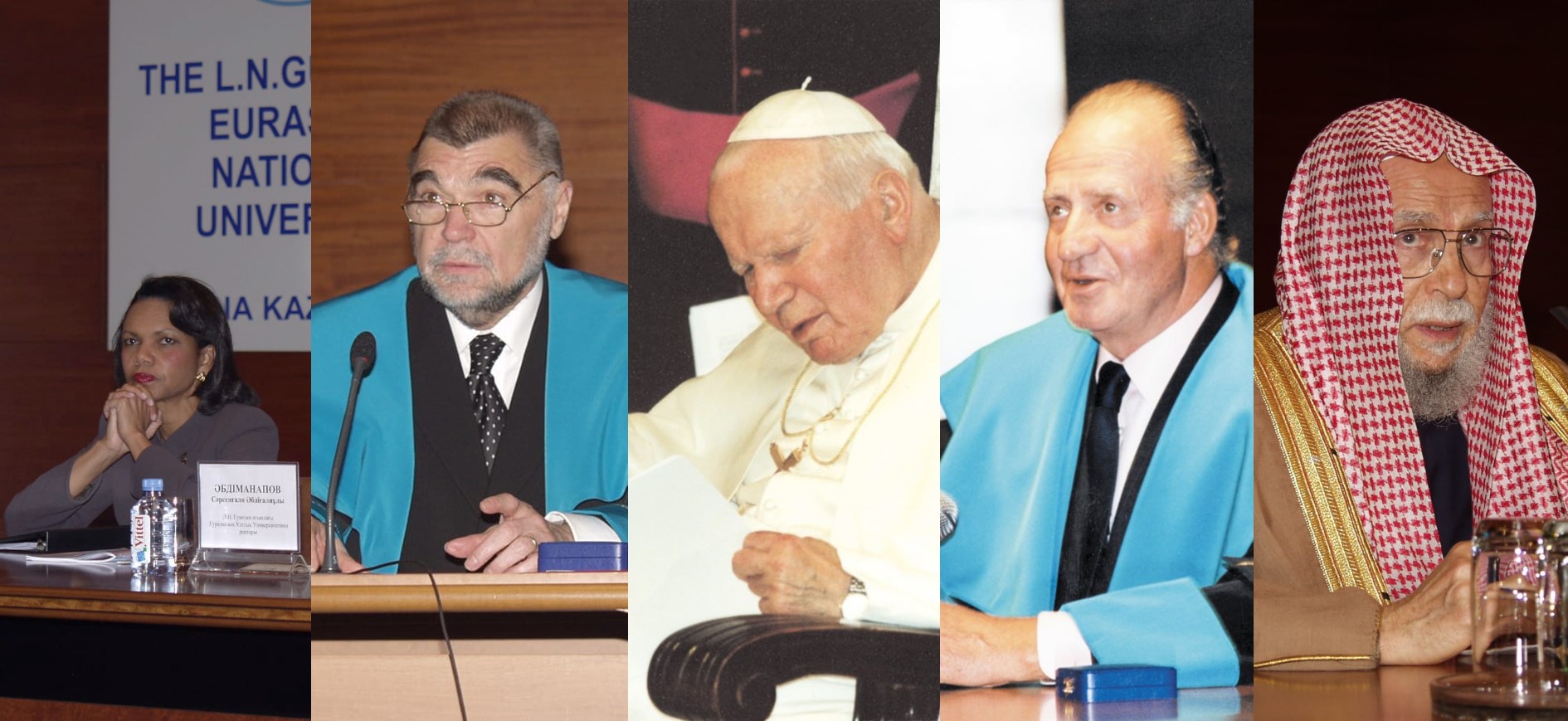
A special place in the university’s history belongs to the visit of Pope John Paul II on September 23, 2001. Addressing the academic community, he spoke about peace, dialogue between cultures, the responsibility of intellectuals, and the role of education in bringing nations together. This visit became an event of national significance and inscribed ENU into the global history of interreligious and intercivilizational dialogue.
June 2004 marked an unprecedented concentration of Eurasian dialogue at ENU, with visits by Presidents Robert Kocharyan of Armenia, Emomali Rahmon of Tajikistan, Arnold Rüütel of Estonia, and Norwegian Prime Minister Kjell Magne Bondevik.
That same year, the visit of King Juan Carlos I of Spain underscored the high level of trust extended to Kazakhstan and highlighted the symbolic importance of humanitarian and educational ties between the two countries.
Over the years, ENU has hosted President Vaira Vīķe-Freiberga of Latvia, World Bank President James Wolfensohn, President Mikheil Saakashvili of Georgia, and Princess Maha Chakri Sirindhorn of Thailand.
The university’s podium has welcomed speeches by U.S. Secretaries of State Condoleezza Rice and Hillary Rodham Clinton, UNESCO Director-General Koïchiro Matsuura, Malaysian Prime Minister Mahathir Mohamad, President Lee Myung-bak of the Republic of Korea, and President Mahmoud Ahmadinejad of Iran.
In the 2010s, the geography of visits expanded further. ENU hosted Crown Prince Haakon Magnus of Norway, Jordanian Prime Ministers Abdel Salam Majali and Adnan Badran, and Speaker of the Finnish Parliament Eero Heinäluoma.
A special place in recent history belongs to the visit of the Grand Imam of Al-Azhar, Ahmed el-Tayeb, highlighting Kazakhstan’s contribution to interfaith harmony, as well as the visit of Serbian President Aleksandar Vučić.
Between 2012 and 2019, the university welcomed a constellation of outstanding scholars—Nobel Prize laureates whose names are permanently inscribed in global science.
James Mirrlees — Nobel Prize laureate in Economics;
Robert Aumann — Nobel Prize laureate in Economics;
Roger Kornberg — Nobel Prize laureate in Chemistry;
John Forbes Nash — Nobel Prize laureate in Economics;
Eric Maskin — Nobel Prize laureate in Economics;
Edward Prescott — Nobel Prize laureate in Economics;
Robert Mundell — Nobel Prize laureate in Economics;
Zhores Alferov — Nobel Prize laureate in Physics;
José Manuel Barroso — Nobel Peace Prize laureate;
Finn Kydland — Nobel Prize laureate in Economics;
Klaus von Klitzing — Nobel Prize laureate in Physics;
Muhammad Yunus — Nobel Prize laureate in Economics;
George Smoot — Nobel Prize laureate in Physics;
Rae Kwon Chung — Nobel Peace Prize laureate;
Christopher Pissarides — Nobel Prize laureate in Economics;
Paul Romer — Nobel Prize laureate in Economics;
Gerard 't Hooft — Nobel Prize laureate in Physics;
James Watson — Nobel Prize laureate in Physiology or Medicine;
Stanley Fischer — Nobel Prize laureate in Economics;
James Rothman — Nobel Prize laureate in Physiology or Medicine;
Arieh Warshel — Nobel Prize laureate in Chemistry.
These lectures provided students and faculty with unique opportunities for professional and personal growth. The personal stories of Nobel laureates inspired young people to pursue research and overcome challenges.
All these visits shared one common feature: they took place in a format of live dialogue. Through lectures and discussions, global politics acquired a human dimension, becoming tangible through ideas, arguments, and responsibility.
For me personally, the history of Eurasian National University is not only an institutional chronicle but part of my own biography. As a student, I had the opportunity to attend meetings with Pope John Paul II, King Juan Carlos I of Spain, and U.S. Secretary of State Condoleezza Rice. These encounters shaped my worldview and reinforced the understanding that a university is not merely a place of knowledge, but a space where responsibility and civic awareness are formed.
The history of L.N. Gumilyov Eurasian National University is the history of the country told through the language of education, science, culture, and international dialogue.
The fact that ENU has remained a platform of such high international standing for three decades confirms its special status as a university of the era of independence—a university of trust and intellectual openness to the world.
Celebrating its 30th anniversary, Eurasian National University continues its mission to educate the nation’s intellectual elite, advance science and education, and strengthen a culture of dialogue, thereby contributing to Kazakhstan’s strategic future.
Vice-Rector for Strategic Development and Internationalization
L.N. Gumilyov Eurasian National University
PhD in History, Associate Professor
Duman Aitmagambetov